
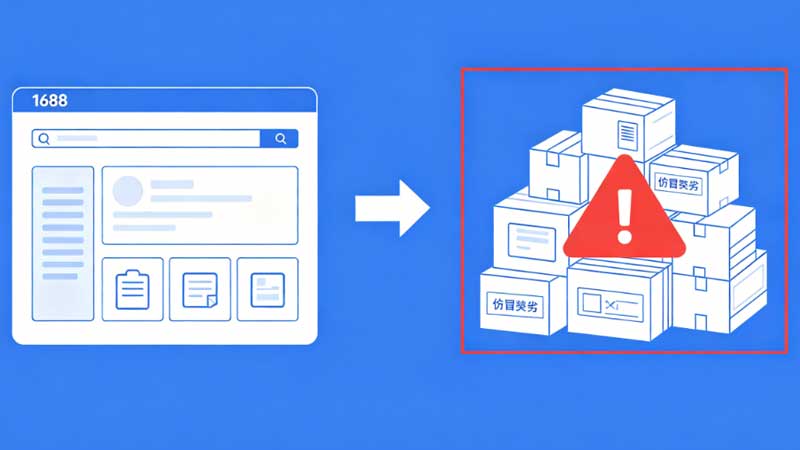
The regulatory net around online counterfeiting in China has tightened dramatically, and the latest target is one that brand owners have long identified as a critical enforcement gap: the wholesale supply chain operating on 1688.com. In a significant expansion of China's E-Commerce Law framework, newly enacted amendments now impose direct liability on B2B platforms that fail to act against repeat wholesale infringement by suppliers on their marketplaces. This is not a marginal extension of existing retail-focused regulations. The amendments create a distinct liability track for wholesale platforms, recognizing that counterfeit goods sold in bulk on 1688 cause downstream harm that differs in scale and character from single-unit retail transactions. Under the revised legal framework, platforms like 1688 can be held jointly and severally liable when they receive verified complaints about wholesale counterfeit suppliers and fail to implement measures sufficient to prevent recurrence. For brand owners who have struggled to contain the industrial-scale counterfeiting that originates on B2B platforms, these e-commerce law 1688 enforcement provisions provide powerful new legal leverage. This guide analyzes the amendments' key provisions, explains how B2B liability differs from retail platform liability, and outlines practical strategies for brand owners to convert the new regulatory framework into stronger enforcement outcomes against 1688 wholesale counterfeit operations.
📑 What You'll Learn
- How the 2026 amendments extend platform liability to B2B wholesale marketplaces
- Key differences between retail and wholesale platform liability standards
- What constitutes "repeat wholesale infringement" under the revised law
- The documentary evidence required to trigger B2B platform liability
- How 1688 is adapting its enforcement infrastructure in response
- Strategic steps for brand owners to leverage the new wholesale liability provisions
1. Extending Platform Liability to the B2B Wholesale Domain
The original E-Commerce Law, enacted in 2019, was drafted primarily with consumer-facing retail platforms in mind. Its notice-and-takedown provisions and platform liability articles were calibrated to address transactions where end consumers purchase individual counterfeit products. This retail-centric framework left a significant regulatory void in the wholesale domain. 1688 wholesale counterfeit suppliers operated in a gray zone where the legal obligations of the B2B platform were less clearly defined. Could 1688 be held liable for bulk counterfeit transactions that occurred partly through private messaging rather than public listings? Did the platform's knowledge obligations extend to supplier communications that were not visible on product pages? The original law provided ambiguous answers, and enforcement against wholesale counterfeit operations suffered as a result.
The 2026 amendments close this regulatory gap decisively. A newly inserted Article 45 ter explicitly extends platform liability obligations to "e-commerce platforms whose primary business model involves wholesale or business-to-business transactions." The provision states that such platforms shall be subject to the same joint liability standards as retail platforms when they receive verified complaints concerning repeat wholesale infringement, with the added specification that liability extends to infringement facilitated through "any communication channel operated or provided by the platform, including but not limited to public product listings, private messaging systems, and inquiry quotation functions." This language directly addresses the private-message loophole that wholesale counterfeiters have exploited for years.
The legislative commentary accompanying the amendments explains the rationale in terms that resonate with brand owners' long-standing frustrations. It notes that wholesale counterfeit transactions cause "multiplied downstream harm" because each bulk sale supplies multiple retail-level infringing transactions, and that B2B platforms "occupy a strategic position in the supply chain that justifies heightened monitoring obligations." The commentary further observes that wholesale platforms have greater capacity than individual rights holders to identify and interdict bulk counterfeit flows, given their access to transaction data, seller identity verification systems, and communications metadata. This capacity-based rationale aligns with the principle that legal obligations should attach to the party best positioned to prevent the harm—a principle that, when applied to B2B platforms, demands more than passive complaint processing.
2. Retail vs. Wholesale Platform Liability: The Critical Distinctions
Brand owners accustomed to enforcing rights on Taobao and Tmall should understand that e-commerce law 1688 enforcement operates under liability standards that differ in important respects from the retail platform framework. These distinctions reflect the structural differences between B2B and B2C commerce and have practical implications for how rights holders build enforcement cases.
The first distinction concerns the definition of infringement visibility. On a retail platform, a counterfeit listing is typically visible in its entirety on a public product page. On 1688, sophisticated wholesale counterfeit suppliers often maintain superficially compliant public listings while conducting the actual infringing transaction through private channels. The amended law addresses this by defining a "listing" for wholesale liability purposes to include "any offer to sell, whether communicated through public product pages, private messages, inquiry responses, or quotation documents transmitted through platform-facilitated channels." This expanded definition means that brand owners can build 1688 supplier accountability cases on evidence captured from private communications, provided that evidence meets authentication standards.
The second distinction concerns the scale threshold for triggering enhanced obligations. For retail platforms, the joint liability framework is typically triggered by repeated infringement of the same product listing or by the same seller. For B2B platforms, the amendments introduce a volume-based trigger: when verified complaints demonstrate that a supplier has offered or sold counterfeit goods in quantities exceeding "commercial scale" thresholds—defined in implementing regulations as minimum order quantities of 50 units or more, or aggregate transaction values exceeding RMB 50,000—the platform's obligations escalate regardless of whether the infringement occurred through a single listing or multiple listings. This volume trigger reflects the legislative understanding that wholesale quantity offers are themselves evidence of commercial-scale infringement meriting escalated platform response.
The third distinction concerns the platform's defense. Retail platforms can defend against joint liability claims by demonstrating that they removed infringing listings upon notification. B2B platforms, under the amended framework, must demonstrate more: they must show that they implemented measures sufficient to prevent the supplier from continuing to offer counterfeit goods through any platform channel, including through new storefronts, altered company names, or alternative communication methods. This "whole-of-supplier" standard requires platforms to track supplier identity across account variations—a more demanding obligation than listing-by-listing removal.
3. Defining Repeat Wholesale Infringement Under the Amended Law
The concept of repeat wholesale infringement is the operational core of the new liability framework. The amendments and their implementing regulations define it through a structured analysis that considers both the number of verified complaints and the pattern of supplier behavior. A single verified complaint about a wholesale counterfeit listing triggers the platform's basic investigation and takedown obligations. A second verified complaint against the same supplier, or against a supplier demonstrably linked through shared identity, contact information, or operational patterns, escalates the platform's obligations to include enhanced monitoring of that supplier's activities across all platform channels.
The critical threshold is the third verified complaint. When a rights holder submits a third verified complaint documenting that the same supplier—or a linked successor entity—has continued to offer counterfeit goods after the platform implemented enhanced monitoring, the statutory presumption of platform liability is triggered. At this stage, the platform bears the burden of proving that it took "all technically feasible and commercially reasonable measures" to prevent the recurrence. The implementing regulations specify that such measures must include, at minimum, algorithmic screening of the supplier's new listings against the rights holder's protected product catalogue, mandatory identity re-verification with government-issued documentation, and a temporary freeze on the supplier's ability to create new listings pending investigation.
Importantly, the amendments recognize that repeat wholesale infringement can occur across multiple storefronts controlled by the same underlying operator. Rights holders are not required to prove legal identity between different storefronts; it is sufficient to demonstrate operational linkage through shared contact information, shipping origins, product imagery, or communication patterns. The platform, once notified of such linkage through a verified complaint, is obligated to treat the linked storefronts as a single supplier for purposes of the three-complaint escalation framework. This anti-fragmentation provision prevents counterfeiters from evading liability by dispersing their wholesale operations across multiple nominally distinct accounts.
4. Evidence Requirements for Triggering B2B Platform Liability
The enhanced liability provisions for 1688 wholesale counterfeit cases are powerful, but they are contingent on the quality of evidence submitted. The amendments establish a clear evidentiary hierarchy that determines whether a complaint qualifies as "verified" for purposes of the escalation framework. At the highest tier is notarized evidence: a test buy conducted under notarial supervision, with the entire transaction—from initial inquiry through payment, shipping, receipt, and forensic examination—documented in a notarized purchase report. This gold-standard evidence carries a statutory presumption of authenticity and is the most direct path to triggering the platform's escalated obligations.
The second tier is judicial or administrative evidence: a court judgment finding that the supplier engaged in counterfeiting, or an administrative penalty decision from a market supervision authority. While this evidence is equally authoritative, obtaining it typically requires prior enforcement action, making it less suitable for initial complaint submissions. It is most useful for escalating cases where the rights holder has already invested in litigation or administrative enforcement.
The third tier, newly recognized under the 2026 amendments, is platform-captured evidence: communications and transaction data that occur entirely within the platform's own systems. The amendments empower rights holders to request that the platform preserve and authenticate internal records—including private message logs, quotation documents, and transaction records—as part of the complaint evidentiary package. When the platform authenticates such records, they carry evidentiary weight equivalent to notarized documents for purposes of the platform's internal enforcement process. This provision is particularly valuable for capturing evidence of wholesale counterfeit suppliers who conduct negotiations through 1688's messaging system but may not complete transactions through public listings.
Brand owners should note that evidence that does not meet one of these three tiers—for example, screenshots captured independently without notarial supervision or platform authentication—may still support a basic takedown request but will not count toward the three-complaint threshold for triggering B2B platform liability. The investment in proper evidence collection at the earliest stage of enforcement is therefore not merely a best practice; it is the procedural prerequisite for accessing the full power of the amended legal framework.
5. How 1688 Is Adapting Its Enforcement Infrastructure
The 2026 amendments have already catalyzed significant changes in how 1688 approaches wholesale counterfeit enforcement. The platform's recently launched enhanced anti-counterfeiting program for verified brand owners, with its dedicated brand protection portal and expedited complaint processing, is not a coincidental development. It is a direct operational response to the expanded e-commerce law 1688 enforcement obligations imposed by the amendments. By building robust internal enforcement infrastructure, 1688 seeks to demonstrate that it has adopted "all technically feasible and commercially reasonable measures," thereby insulating itself from joint liability claims even when individual counterfeit listings evade detection.
Several specific platform adaptations merit attention. 1688 has implemented a supplier identity verification upgrade that requires government-issued identification documentation and cross-references supplier information against a database of known infringers and previously banned accounts. This upgrade is designed to satisfy the "whole-of-supplier" tracking obligation by making it more difficult for banned wholesale suppliers to re-enter the platform under new identities. The platform has also introduced algorithmic screening that proactively compares new listings against rights holders' protected product catalogues, with particular attention to listings that use generic descriptions but include product imagery matching protected designs—a pattern characteristic of disguised wholesale counterfeit operations.
Additionally, 1688 has established a dedicated wholesale infringement review team trained specifically on B2B enforcement dynamics. Unlike retail-focused reviewers who assess whether a single product listing matches a counterfeit pattern, the wholesale team evaluates supplier-level behavior: communication patterns, minimum order quantities, pricing relative to authentic wholesale benchmarks, and cross-listing analysis across multiple product categories. This supplier-level review capability is essential for identifying repeat wholesale infringement patterns that would not be apparent from examining individual listings in isolation.
For brand owners, these platform adaptations create both opportunities and obligations. The enhanced infrastructure means that properly documented complaints are processed faster and with greater sophistication than ever before. But the platform's compliance investments also mean that it will be positioned to argue, in any liability dispute, that it has met its statutory obligations—shifting the focus onto whether the rights holder's evidence was sufficient and whether the rights holder followed proper escalation procedures.
6. Strategic Steps for Brand Owners to Leverage Wholesale Liability Provisions
The new e-commerce law 1688 enforcement framework provides brand owners with unprecedented legal leverage, but that leverage must be deployed strategically to produce results. Here is a practical action plan for converting the amended legal provisions into stronger enforcement outcomes:
- Map your wholesale counterfeit exposure systematically. Before submitting complaints, conduct a thorough assessment of 1688 listings relevant to your brand. Identify not just individual infringing listings but patterns: which suppliers appear to be linked, which product categories are most heavily targeted, and what obfuscation techniques are being used. This mapping exercise informs a strategic enforcement sequence rather than a reactive, listing-by-listing approach.
- Build verified complaint chains with litigation-grade evidence. Each complaint in your three-stage escalation sequence should be supported by notarized test buy evidence or platform-authenticated records. The investment in proper evidence collection at the first complaint stage pays compounding dividends as the case escalates. A chain of three properly verified complaints creates an evidentiary record that is difficult for either the platform or the supplier to challenge.
- Document supplier linkages meticulously. The anti-fragmentation provision allowing complaints against linked storefronts is only as strong as the linkage evidence. Capture and preserve supplier contact information, shipping origin data, product imagery overlaps, and communication patterns that demonstrate operational connections between different storefronts. This evidence enables you to treat a distributed wholesale counterfeiting network as a single supplier for escalation purposes.
- Invoke the volume-based trigger explicitly. When a supplier's listing shows minimum order quantities of 50 units or more, or when cumulative transaction evidence exceeds the RMB 50,000 threshold, cite these volume indicators in your verified complaint. The volume trigger escalates the platform's obligations independently of the number of complaints, providing an additional pathway to enhanced platform accountability.
- Request platform authentication of internal records. When counterfeit negotiations occur through 1688's messaging system, formally request that the platform authenticate and preserve those records as part of your complaint package. Platform-authenticated communications carry evidentiary weight equivalent to notarized documents for internal enforcement purposes and can serve as the foundation for verified complaints without the time and expense of notarial supervision.
- Coordinate 1688 enforcement with downstream retail action. A single wholesale supplier on 1688 may supply dozens of retail counterfeit sellers on Taobao, Tmall, and international platforms. When you identify a wholesale source through 1688 enforcement, cross-reference that supplier's information against retail platform listings and coordinate takedown actions across platforms. Removing the wholesale source while simultaneously cleaning downstream retail listings prevents the supplier from simply shifting inventory to alternative retail channels.
- Preserve evidence for potential judicial action. The verified complaint record you build for platform enforcement simultaneously serves as the evidentiary foundation for civil litigation or criminal referral. Document everything with the expectation that it may ultimately be presented in court. The wholesale quantity evidence, supplier identity documentation, and platform communication records captured through the enforcement process are precisely the materials that Chinese courts require to support damages awards and permanent injunctions.
The 2026 amendments have fundamentally altered the enforcement landscape for 1688 wholesale counterfeit operations. Platforms that previously enjoyed ambiguity about their B2B liability now face explicit statutory obligations backed by joint liability exposure. Brand owners who understand the new framework, invest in proper evidence collection, and escalate methodically through the three-stage pathway will achieve enforcement outcomes that were simply unavailable under the previous legal regime.
Summary: The 2026 E-Commerce Law amendments represent a regulatory watershed for B2B platform liability in China, imposing explicit joint liability on wholesale platforms like 1688 that fail to act against repeat wholesale infringement after receiving verified complaints. The new Article 45 ter closes the private-message loophole that wholesale counterfeiters have long exploited, extends platform obligations to supplier communications across all platform-facilitated channels, and establishes a "whole-of-supplier" standard requiring platforms to track and interdict repeat infringers across account variations. The legal framework distinguishes 1688 wholesale counterfeit liability from retail platform liability through expanded listing definitions, volume-based escalation triggers for minimum order quantities exceeding 50 units or transaction values above RMB 50,000, and heightened platform defense requirements. Verified complaint status—a prerequisite for triggering the escalation pathway—requires notarized evidence, judicial or administrative determinations, or platform-authenticated internal records. The amendments have already driven observable changes in 1688 supplier accountability infrastructure, including identity verification upgrades and specialized wholesale infringement review teams. For brand owners, the strategic imperative is to build methodical verified complaint chains, document supplier network linkages, invoke volume-based triggers, and coordinate wholesale enforcement with downstream retail actions. The era of wholesale counterfeit suppliers operating with impunity on B2B platforms is legally unsustainable. The 2026 amendments equip rights holders with the statutory tools to demand, and judicially enforce, permanent solutions to industrial-scale counterfeiting at its commercial source.