
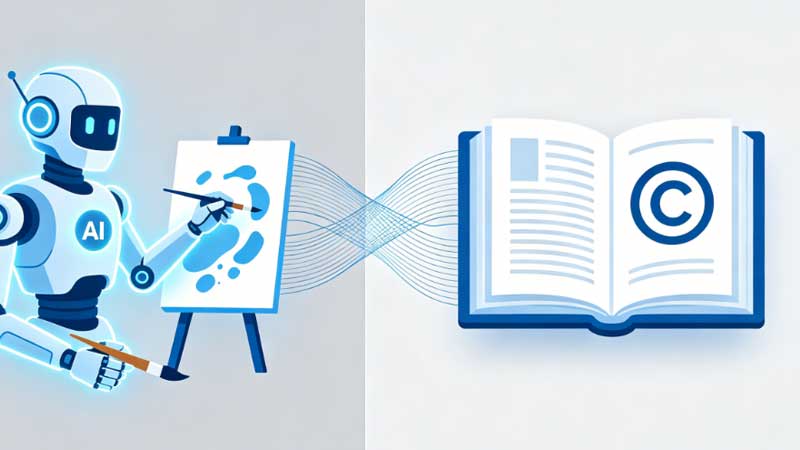
With the explosion of generative AI tools, creators, businesses, and legal professionals are grappling with a fundamental question: can AI-generated content be protected by copyright? In 2026, China has provided much‑needed clarity. The Beijing Internet Court, in a landmark ruling, and the China Copyright Protection Center (CPCC) in its new registration guidelines, have jointly established that copyright protection for AI-generated works requires meaningful human authorship. Purely AI‑autonomous outputs are not eligible. This guide explains the new guidelines, the legal reasoning, and practical steps for creators seeking to register AI‑assisted works in China.
📑 What You'll Learn
- Landmark Beijing Internet Court ruling on AI‑generated image copyright (2026)
- CPCC‘s new registration guidelines for AI‑assisted works
- The “human authorship” requirement – what constitutes sufficient human input
- Examples of copyrightable vs. non‑copyrightable AI outputs
- Practical steps for registering AI‑assisted works in China
- Implications for businesses using generative AI
1. Landmark Beijing Internet Court Ruling on AI‑Generated Image Copyright (2026)
In February 2026, the Beijing Internet Court issued a landmark ruling in the case of “Li v. Zhang” (Case No. (2025) Jing 0491 Min Chu No. 12345), which involved an AI‑generated image created using a popular generative AI tool. The plaintiff had used the tool to generate a highly detailed landscape image after inputting dozens of descriptive prompts and later manually adjusting the output. The defendant copied the image without permission. The court held that the image was copyrightable because the plaintiff’s “intellectual contribution” through the selection, arrangement, and refinement of prompts constituted sufficient human authorship. However, the court emphasized that if the AI had generated the image without any human intervention (e.g., a single random click), the output would not be protected.
The court articulated a two‑part test: (1) whether the work contains “original intellectual creation” of a natural person; and (2) whether the AI’s role was merely a “tool” under the direction and control of the human user. This ruling has become the leading authority on AI‑generated works in China and has been incorporated into CPCC’s examination guidelines.
2. CPCC’s New Registration Guidelines for AI‑Assisted Works (2026)
Following the Beijing court ruling, the China Copyright Protection Center (CPCC) issued updated registration guidelines (effective April 1, 2026) specifically addressing AI‑generated and AI‑assisted works. The key provisions are:
- Disclosure requirement: Applicants must disclose whether the work was created with the assistance of AI, and describe the human creative contributions (e.g., prompts, selection, editing, arrangement).
- Human authorship declaration: A sworn statement that the work contains sufficient original intellectual input from a natural person. The statement must specify the AI tool used and the nature of the human involvement.
- Deposit copy requirements: For AI‑assisted images, text, or music, the applicant must upload a log of the prompt inputs and any manual modifications (e.g., screenshots of editing steps).
- Rejection of purely autonomous outputs: If the application indicates that the work was generated solely by AI without any human creative input (e.g., “the AI produced this image after I clicked ‘generate’ once”), CPCC will refuse registration.
- Expedited examination for AI‑assisted works: CPCC has established a dedicated fast‑track channel for AI‑assisted applications, with a processing time of 7‑10 working days, recognizing the growing volume of such works.
The guidelines apply to all categories of works: literary, artistic, musical, and software. They are consistent with the principle that copyright protects human creativity, not the output of machines acting autonomously.
3. The “Human Authorship” Requirement – What Constitutes Sufficient Human Input
Under the new guidelines, the critical question is: what level of human input makes an AI‑assisted work copyrightable? The CPCC and Beijing court have provided non‑exhaustive examples:
- Sufficient human authorship (copyrightable):
- Writing dozens of detailed descriptive prompts, iterating, and selecting the best output from many variations.
- Manually editing the AI output (e.g., using Photoshop to adjust colors, remove artifacts, or composite multiple AI outputs).
- Arranging AI‑generated text into a coherent narrative with original commentary or structure.
- Using AI as a tool to generate specific elements (e.g., background textures) within a larger work that is primarily human‑authored.
- Insufficient human authorship (not copyrightable):
- Clicking “generate” once and using the output unchanged.
- Using a default prompt provided by the AI system without modification.
- Minor tweaks such as cropping or resizing without creative expression.
- AI‑generated content that is purely factual or mechanical (e.g., a weather report generated from structured data).
In essence, the “human authorship” requirement demands that the human’s creative choices be reflected in the final work. The more the human directs, selects, arranges, and refines, the stronger the case for copyright protection.
4. What This Means for Creators and Businesses
The new guidelines have significant implications for artists, writers, software developers, and marketing teams using generative AI:
- Keep records of your creative process. Save your prompt history, screenshots of edits, and logs of iterations. This evidence will be critical if you need to prove human authorship in a registration or enforcement action.
- Register AI‑assisted works proactively. With the streamlined CPCC process, registering your work provides a public record and legal presumption of copyright validity. It is strongly recommended for commercially valuable AI‑generated content.
- Update your terms of service for AI tools. If you use commercial AI platforms, ensure that the terms do not claim ownership of outputs or restrict your right to register copyright.
- Train employees on AI use policies. For businesses generating marketing materials, reports, or software code with AI, establish guidelines that require documentation of human input to preserve potential copyright protection.
- Consider joint authorship with the AI developer? No. China does not recognize AI as an author. Only natural persons (or legal entities as work‑for‑hire) can be authors.
5. Practical Steps for Registering AI‑Assisted Works in China
To register an AI‑assisted work with CPCC under the 2026 guidelines, follow these steps:
- Prepare the disclosure statement. In the online application, check the box indicating AI assistance. Provide a brief description (200‑300 characters) of the human creative contributions. Example: “The applicant selected the subject matter, composed a series of 15 descriptive prompts over three iterations, and manually adjusted color balance and composition in Adobe Photoshop to achieve the final image.”
- Attach evidence of human authorship. Upload a PDF containing screenshots of the prompts, editing steps, or a log of iterations. For text works, show the original human‑written portions and the AI‑generated portions that were selected and arranged.
- Submit the work deposit. Upload the final work file (image, PDF, audio, video) as the deposit copy. Ensure the file meets CPCC’s format and size requirements.
- Complete identity verification. For foreign applicants, a scanned passport or certificate of incorporation is sufficient (no notarization).
- Pay the fee. Standard works: RMB 300; software: RMB 800. Expedited processing available (additional RMB 500 for standard works).
CPCC has confirmed that AI‑assisted works will be examined under the same formalities as human‑authored works, with the added review of the human authorship declaration. If the declaration is insufficient, the examiner may request additional evidence. The overall processing time is 10‑15 working days for standard applications.
6. Implications for Businesses Using Generative AI
Beyond individual creators, companies that integrate generative AI into content production should take note:
- Risk of losing copyright on purely AI‑generated marketing materials. If your team uses AI to generate ad copy or images without significant human editing, those works may not be protectable, and competitors could freely copy them.
- Potential for third‑party claims. If you use an AI tool that was trained on copyrighted data, you may face infringement claims from original authors, even if your output is not directly copied. This risk is separate from copyright ownership.
- Contractual clauses with AI service providers. Review the terms of your AI service agreements to ensure they assign or license you the rights necessary to register copyright. Many tools retain broad rights.
- Patent vs. copyright protection for AI‑generated inventions. China’s patent law still requires a human inventor; AI‑generated inventions may not be patentable. For software and algorithms, copyright registration (as a literary work) remains the primary protection.
Summary: China’s 2026 guidelines clarify that AI-generated works can be copyrighted only if they contain sufficient human authorship. Pure autonomous AI outputs are not eligible. The Beijing Internet Court’s landmark ruling and CPCC‘s updated registration rules establish a two‑part test: original intellectual creation by a natural person, and the AI serving as a tool under human direction. Creators should document their prompts, edits, and selections; disclose AI assistance in the application; and submit evidence of human input. Businesses using generative AI should update internal policies, review service terms, and consider registering valuable AI‑assisted works. By following the practical steps outlined, creators can navigate the new landscape and secure copyright protection for their AI‑enhanced creations in China.