
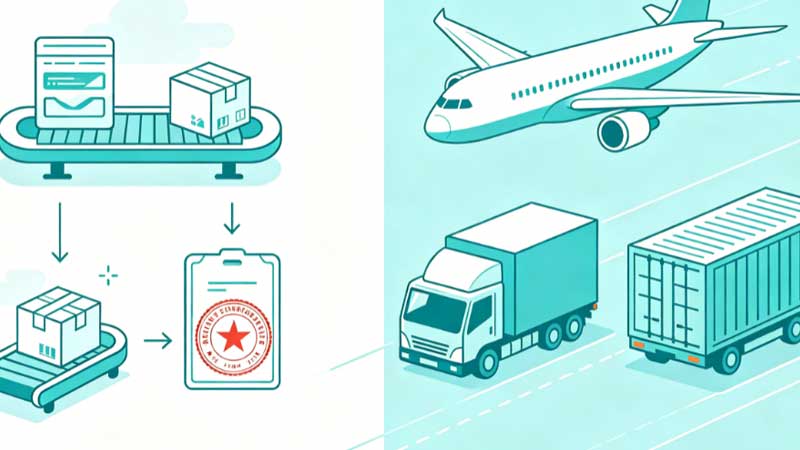
The General Administration of Customs of China (GAC) has released updated clearance guidelines for cross-border e-commerce (CBEC) imports under customs codes 9610 (B2C retail express) and 1210 (bonded warehouse). Effective July 1, 2026, the new procedures reduce clearance time by up to 50% and simplify personal parcel documentation requirements. For cross-border sellers and logistics providers, understanding these changes is essential to avoid delays and ensure smooth customs release. This guide explains the key simplifications, documentation requirements, and practical steps for compliance.
1. Key Changes – Reduced Clearance Time & Simplified Documentation
The 2026 CBEC clearance guidelines introduce two major simplifications:
- Reduced clearance time: For 9610 (B2C retail express) shipments, standard clearance time is reduced from 48‑72 hours to 24‑48 hours. For 1210 (bonded warehouse) shipments, clearance time is reduced from 24‑48 hours to 12‑24 hours. Low-risk sellers with a clean compliance record may qualify for “express clearance” in under 12 hours.
- Simplified personal parcel documentation: For parcels valued under RMB 5,000, customs now requires only three data elements: recipient name and ID number, product description (HS code at 6-digit level), and declared value. Previously, additional documents (commercial invoice, packing list) were required for every parcel.
For bonded warehouse (1210) shipments, the new rules also allow bulk customs declaration for multiple orders from the same seller to the same destination region, reducing administrative costs.
2. 9610 (B2C Retail Express) – New Procedures
9610 clearance applies to small parcels shipped directly from overseas warehouses to Chinese consumers via express carriers (e.g., DHL, FedEx, EMS). Under the 2026 guidelines:
- Pre‑clearance data transmission: Sellers must transmit order, logistics, and payment data to customs before shipment (unchanged). However, the data fields have been reduced from 18 to 12.
- Consolidated declaration for low‑value parcels: For multiple parcels from the same seller to the same consignee, customs allows consolidated declaration, reducing per‑parcel processing time.
- Green channel for repeat customers: Parcels addressed to recipients with a history of compliant imports (no customs violations) receive automated clearance with minimal document review.
For a seller shipping 1,000 parcels daily, the new procedures reduce customs processing time by approximately 40%, significantly improving delivery speed and customer satisfaction.
3. 1210 (Bonded Warehouse) – Bulk Declaration & Faster Release
1210 clearance applies to goods stored in China‘s bonded warehouses (e.g., in FTZs) before being sold to consumers. The 2026 guidelines introduce:
- Bulk customs declaration: Sellers can file a single customs declaration for up to 500 individual orders, rather than filing separately for each order. This reduces declaration processing time by up to 70%.
- Automated tax calculation: The system automatically calculates consolidated taxes (duties + VAT + consumption tax) based on the HS code and declared value. Sellers no longer need to manually compute taxes for each order.
- Batch electronic payment: Sellers can pay taxes monthly rather than per order, improving cash flow.
- Pre‑stocked clearance: For best‑selling products, sellers can pre‑clear inventory in the bonded warehouse, enabling immediate release upon order placement.
These changes are particularly beneficial for high‑volume sellers on platforms like Tmall Global and JD Worldwide, where daily orders can reach tens of thousands.
4. Documentation Requirements – Simplified Personal Parcel Info
Under the new guidelines, personal parcel documentation has been significantly simplified for low‑value shipments (≤ RMB 5,000):
- Required data elements (reduced from 12 to 3):
- Recipient name and national ID number (or passport number for foreigners).
- Product description with 6‑digit HS code.
- Declared value in RMB (including shipping cost).
- Optional (but recommended): Order number, tracking number, and payment transaction ID. These fields help resolve disputes but are not mandatory for clearance.
For parcels valued above RMB 5,000 (high value), full documentation (commercial invoice, packing list, and purchase contract) is still required.
For bonded warehouse (1210) shipments, the recipient‘s identity verification is performed at the time of order placement (via the e‑commerce platform). Customs directly accesses the platform’s verified data, eliminating the need for separate recipient document submission.
5. Compliance Requirements – What Sellers Must Still Do
Despite simplifications, sellers must still meet certain compliance obligations:
- Enterprise registration: Sellers must complete CBEC enterprise filing through the Single Window (跨境电商企业备案).
- Data transmission: Order, logistics, and payment data must be transmitted to customs before shipment (for 9610) or before order fulfillment (for 1210).
- HS code accuracy: Incorrect HS codes remain the leading cause of clearance delays. Sellers should use the dedicated CBEC HS code catalogue (2026 edition) for classification.
- Annual consumption limit: The per‑consumer annual limit remains RMB 26,000. Sellers must track cumulative consumer purchases and reject orders that exceed the limit.
- Return processing: Returned goods must be processed within 30 days; otherwise, taxes already paid cannot be refunded.
Violations – such as under‑declaring values or shipping prohibited items – result in fines, suspension of CBEC eligibility, and potential blacklisting.
6. Practical Compliance Roadmap for CBEC Sellers
To take advantage of the simplified clearance procedures, follow this five‑step roadmap:
- Complete CBEC enterprise filing (Immediate). If not already registered, complete the filing through the Single Window. Ensure your e‑port card has CBEC data permissions enabled.
- Verify HS codes using the 2026 CBEC catalogue (Month 1). Download the dedicated CBEC HS code list from the GAC website. Re‑classify all products accordingly.
- Integrate with customs data transmission systems (Month 1‑2). For 9610 sellers, ensure your ERP or platform can transmit order, logistics, and payment data to the Single Window. For 1210 sellers, implement bulk declaration functionality.
- Train staff on new documentation rules (Month 2). Ensure customer service and logistics teams understand the reduced data requirements and can assist recipients with identity verification.
- Monitor clearance times and compliance metrics (Ongoing). Track clearance time per order type (9610 vs. 1210). Investigate any delays exceeding 48 hours for 9610 or 24 hours for 1210.
Summary: GAC‘s new 9610/1210 clearance guidelines, effective July 1, 2026, reduce clearance time by up to 50% and simplify personal parcel documentation to three data elements (recipient ID, HS code, declared value). For 9610 (B2C express) shipments, clearance time is reduced to 24‑48 hours; for 1210 (bonded warehouse) shipments, clearance time is reduced to 12‑24 hours. Bulk declaration for 1210 allows up to 500 orders per declaration, reducing processing time by 70%. Sellers must still complete CBEC enterprise filing, transmit order data, maintain HS code accuracy, and track annual consumption limits. By implementing the new procedures, cross‑border sellers can significantly improve delivery speed and reduce administrative costs.