
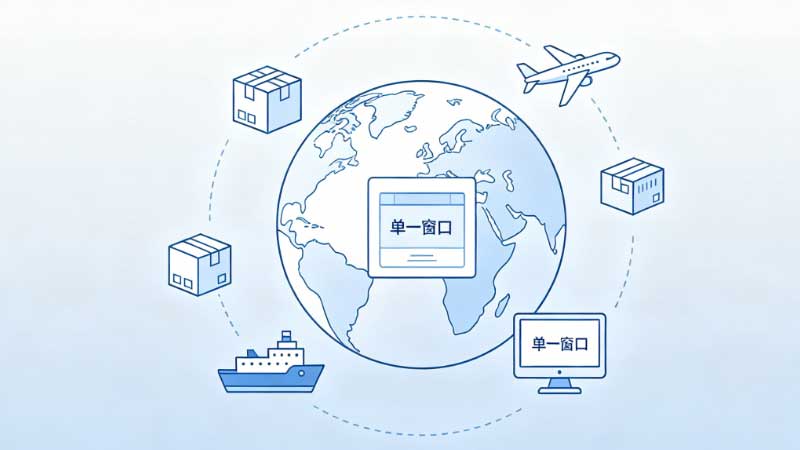
For cross‑border e‑commerce sellers shipping goods from China to overseas consumers or via overseas warehouses, the filing process has become fully integrated into the China International Trade Single Window (单一窗口) as of 2026. The General Administration of Customs (GAC) has consolidated all cross‑border e‑commerce regulatory filings – including enterprise registration, customs declaration codes (9610, 9710, 9810), electronic order data transmission, and tax refund eligibility – into a unified digital platform. Overseas sellers, domestic e‑commerce agents, and logistics providers must complete mandatory filings through the Single Window before they can legally export goods. This guide provides a comprehensive overview of the 2026 cross‑border e‑commerce filing requirements, step‑by‑step procedures through the Single Window, and key compliance red lines for overseas sellers.
📑 What You'll Learn
- Mandatory Single Window filing for all cross‑border e‑commerce enterprises
- Understanding customs codes: 9610 (B2C express), 9710 (B2B direct), 9810 (overseas warehouse)
- Step‑by‑step enterprise registration via Single Window
- Electronic order data, logistics, and payment data transmission requirements
- Credit rating prerequisites and customs registration
- Tax refund filing and simplified procedures for qualified sellers
- Consequences of non‑filing and enforcement trends
- Practical compliance checklist for cross‑border sellers
1. Mandatory Single Window Filing for Cross‑Border E‑Commerce Enterprises
Since the full implementation of GAC Announcement No. 167 of 2024 and its integration into the Single Window 2.0 platform, all enterprises engaging in cross‑border e‑commerce exports must complete their enterprise qualification filing exclusively through the China International Trade Single Window. The standalone “overseas warehouse business model filing” has been eliminated, but the underlying requirement to register as a “cross‑border e‑commerce enterprise” has been embedded into the Single Window’s unified registration process. Any seller – whether a domestic trading company, a logistics provider, or an overseas entity using a local agent – cannot begin exporting without a valid filing in the system.
The Single Window filing captures essential information: enterprise name, unified social credit code, customs registration number, import‑export scope, and the selected cross‑border e‑commerce business types (9610, 9710, 9810, or multiple). Once approved, the enterprise receives a unique identifier that must be referenced in every subsequent customs declaration.
2. Understanding Customs Codes: 9610, 9710, and 9810
Cross‑border e‑commerce exporters must select the correct regulatory code based on their business model. The three primary codes are:
- 9610 – Cross‑border E‑commerce B2C Retail Export (跨境电商零售出口): For goods sold directly to individual overseas consumers via e‑commerce platforms, shipped in small packages (generally value ≤ RMB 5,000 per transaction). This code requires electronic transmission of order, logistics, and payment data (three‑data matching).
- 9710 – Cross‑border E‑commerce B2B Direct Export (跨境电商B2B直接出口): For goods sold to overseas businesses directly, shipped in bulk without intermediate warehousing. Requires standard customs declaration with supporting commercial contracts.
- 9810 – Cross‑border E‑commerce Export to Overseas Warehouse (跨境电商出口海外仓): For goods pre‑shipped to an overseas warehouse (e.g., Amazon FBA, third‑party logistics warehouses) before being sold to consumers. Requires transmission of warehouse receipt or inventory data.
Selecting the wrong code at the time of declaration is a common filing error that results in customs rejection, shipment holds, and delayed tax refunds. Sellers uncertain of their model should consult their customs broker or the Single Window helpdesk before submitting a declaration.
3. Step‑by‑Step Enterprise Registration via the Single Window
The electronic filing process for cross‑border e‑commerce enterprises is now fully integrated into the Single Window platform. The steps are as follows:
- Step 1 – Obtain an electronic port card (e‑port card) or digital certificate: If your enterprise does not already have an e‑port card, apply through the Single Window portal. The legal representative must complete real‑name identity verification (facial recognition or in‑person visit).
- Step 2 – Log into the Single Window (www.singlewindow.cn): Use the e‑port card (legal person card) or digital certificate to access the platform.
- Step 3 – Navigate to “Cross‑border E‑commerce” → “Enterprise Filing”: Locate the dedicated cross‑border e‑commerce module under “Customs Services” or “Enterprise Qualification.”
- Step 4 – Complete the enterprise information form: Enter basic company details (name, tax ID, registered address), select the applicable cross‑border e‑commerce business types (9610, 9710, 9810), and upload the business license and customs registration certificate.
- Step 5 – Submit for customs review: The Single Window automatically routes the application to customs. Approval typically takes 1‑3 working days. Enterprises with a clean compliance record and general credit rating receive faster processing.
- Step 6 – Confirm filing status: After approval, the system generates an electronic confirmation. The enterprise’s unique identifier and permitted business types are displayed. Sellers may then proceed to submit declarations.
For overseas sellers without a locally incorporated entity, a “domestic agent for overseas cross‑border e‑commerce enterprises” (境外跨境电商企业境内代理人) must be designated. The agent must have a valid business license and customs registration and must be designated in the Single Window filing. The agent shares legal responsibility for compliance, including tax and customs obligations.
4. Electronic Order, Logistics, and Payment Data Transmission Requirements
For 9610 (B2C retail) exports, the Single Window requires the transmission of “three‑data matching” – electronic order data, logistics data, and payment data – before customs clearance. This requirement ensures that the transaction is genuine and traceable. Sellers using e‑commerce platforms (e.g., Amazon, AliExpress, eBay) can typically integrate their platform APIs directly with the Single Window or with an authorized third‑party service provider. For manual submissions, the seller must upload:
- Order data (订仓单): Unique order number, product description, quantity, declared value (at dutiable value, not retail price), buyer name and address, and country of destination.
- Logistics data (物流信息): Tracking number, carrier name, shipping method, and estimated delivery time.
- Payment data (支付信息): Payment receipt from the payment gateway, showing the transaction amount, currency, and payment confirmation timestamp.
For 9710 and 9810 exports, the requirements are simplified. 9710 requires transmission of the commercial contract and invoice; 9810 requires transmission of the warehouse receipt or inventory record, along with the shipment order. In all cases, the order number must be unique – duplicate numbers cause automatic rejection. For 9810 exports, the overseas warehouse address and the warehouse operator‘s registration number must be included in the transmission.
5. Credit Rating Prerequisites and Customs Registration
To file as a cross‑border e‑commerce enterprise, the filing entity (or its domestic agent) must satisfy specific credit and registration prerequisites:
- Valid customs registration (10‑digit customs code): The enterprise must have completed customs filing and obtained a customs code. The customs registration status must be active and not suspended.
- Electronic port card (e‑port card) with cross‑border e‑commerce data permissions: The e‑port card must have the “Cross‑border E‑commerce” data permission unlocked. Some older cards may need to be upgraded.
- Minimum “general credit” rating: Enterprises rated as “失信” (untrustworthy) are not eligible to file cross‑border e‑commerce declarations. A “general credit” rating or higher is required.
- Tax credit rating of A or B (for sellers claiming export tax refunds): To be eligible for VAT export rebates, the enterprise‘s tax credit rating must be A or B. C or D rated enterprises may still export but cannot claim refunds.
First‑time filers should verify their customs registration status and e‑port card functionality before attempting to file. Any compliance violation (e.g., late tax filing, customs penalty) may downgrade the credit rating and disqualify the enterprise from cross‑border e‑commerce filing.
6. Tax Refund Filing and Simplified Procedures for Qualified Sellers
Cross‑border e‑commerce exporters that are general‑rate taxpayers may claim VAT export refunds (export tax rebates) on eligible goods. Under the 2026 Single Window integration, the tax refund application is now partially automated:
- For 9610 exports, the Single Window automatically matches order, logistics, and payment data with the tax authority‘s records, reducing manual documentation.
- For 9810 exports, the “refund upon departure” policy (离境即退税) allows sellers to apply for VAT refunds as soon as the goods clear Chinese export customs, without waiting for overseas customs clearance.
- For 9710 exports, the standard tax refund process applies, with supporting documentation (contract, invoice, customs declaration) submitted electronically.
To be eligible, the seller must have a valid general taxpayer status and a tax credit rating of A or B. The refund application is submitted through the e‑Tax Bureau portal, which receives data from the Single Window. Refunds for qualifying enterprises are processed within 5‑10 working days. Sellers with Class I tax credit ratings may receive refunds in as little as 5 days.
7. Consequences of Non‑Filing and Enforcement Trends
Failure to complete the mandatory Single Window filing or transmitting incomplete/incorrect data carries severe consequences:
- Shipment rejection: Customs will refuse to clear any goods for which the enterprise’s filing is incomplete or missing. The shipment may be detained at port, incurring demurrage charges.
- Credit rating downgrade: Enterprises that repeatedly fail to comply or that submit false declarations may have their credit rating downgraded, affecting all future customs clearance and tax benefits.
- Fines and penalties: Mis‑declared HS codes, undervalued goods, or false declarations subject sellers to fines ranging from 30% to 200% of the evaded tax. Intentional tax evasion may trigger criminal prosecution.
- Blacklisting: Serious or repeat violations can lead to blacklisting, where the enterprise is barred from using the cross‑border e‑commerce channel entirely.
In 2026, customs authorities have intensified random inspections and automated data cross‑checks. The Single Window system automatically flags discrepancies between order data, logistics data, and payment data, as well as inconsistencies with tax records. Sellers should maintain accurate records and ensure that declared values match actual transaction amounts.
8. Practical Compliance Checklist for Cross‑Border Sellers
To ensure a compliant 2026 cross‑border e‑commerce filing through the Single Window, sellers and agents should follow this checklist:
- [ ] Domestic entity established or China agent designated, with valid business license and customs registration number (10‑digit customs code).
- [ ] Electronic port card (e‑port card) issued and cross‑border e‑commerce data permissions activated – verify functionality before filing.
- [ ] Single Window filing completed: enterprise type selected (跨境电商企业).
- [ ] For overseas sellers without local entity: domestic agent designated in the Single Window system.
- [ ] All registered information matches business license exactly – no differences in company name, legal representative, address, or tax ID.
- [ ] Order, logistics, and payment data transmitted (for 9610) or warehouse receipt transmitted (for 9810) before each customs declaration.
- [ ] Order numbers unique and not reused.
- [ ] For Amazon FBA sellers: FBA inbound shipment IDs can be used as order numbers for 9810 declarations.
- [ ] Customs declaration completed within required timeframe – not delayed, inconsistent, or missing required data.
- [ ] Tax refund filing completed (if applicable) and tax credit rating A or B maintained.
- [ ] Post‑clearance: filing status confirmed through the Single Window and customs credit information platform.
Summary: Cross‑border e‑commerce filing in 2026 is fully integrated into the China International Trade Single Window, requiring mandatory enterprise qualification filing, correct selection of customs codes (9610/9710/9810), and electronic transmission of order, logistics, and payment data (for 9610) or warehouse receipts (for 9810). Overseas sellers without a local entity must appoint a domestic agent. Prerequisites include a valid customs registration, an e‑port card with cross‑border e‑commerce permissions, and a minimum general credit rating. Tax refund eligibility requires A or B tax credit rating. Failure to file or transmit correct data results in shipment rejection, fines, credit downgrades, and potential blacklisting. By following the compliance checklist and working with experienced customs brokers, cross‑border e‑commerce sellers can secure smooth clearance and tax efficiency in China‘s rapidly growing e‑commerce export market.