
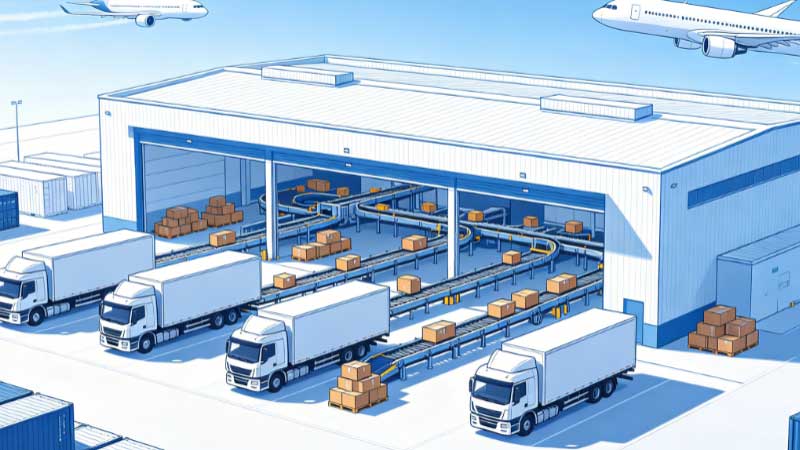
Cross‑border e‑commerce logistics has entered a new era with the opening of dedicated 9610 consolidation hubs in Shenzhen and Yiwu. These facilities, launched in April 2026, are specifically designed to handle high‑volume small parcel exports under China‘s 9610 customs clearance model (B2C retail express). The hubs feature automated sorting systems, integrated customs clearance, and direct airline connectivity. As a result, transit times from seller to global destinations (US, Europe, Southeast Asia) have been reduced by 2‑3 days – now averaging 5‑8 days to the US West Coast and 6‑10 days to Europe. For cross‑border e‑commerce sellers on platforms like AliExpress, Amazon, eBay, and Shopify, these hubs offer faster delivery, lower costs, and improved tracking visibility. This guide explains the new hub capabilities, logistics process, and practical benefits for sellers.
1. New 9610 Consolidation Hubs – Shenzhen & Yiwu
The two new dedicated e‑commerce consolidation hubs are located in China‘s e‑commerce capitals:
- Shenzhen Hub (Bao‘an District): 50,000m² facility near Shenzhen Bao’an International Airport. Daily processing capacity: 1.5 million parcels. Specializes in electronics, apparel, and accessories to US and European destinations.
- Yiwu Hub (Zhejiang Province): 80,000m² facility in Yiwu‘s international logistics park. Daily processing capacity: 2 million parcels. Specializes in small commodities, household goods, toys, and gifts – primarily to Europe, Southeast Asia, and the Middle East.
Both hubs are integrated with China Customs‘ 9610 electronic clearance system, enabling pre‑declaration, automated data matching, and rapid release. Carriers operating at the hubs include FedEx, DHL, UPS, SF Express, and China Post EMS, with dedicated cargo flights from Shenzhen to Los Angeles, Chicago, Amsterdam, and Liege.
2. Reduced Transit Times – 2-3 Days Faster
Since the hubs became operational, average transit times have decreased significantly:
- To US West Coast (Los Angeles, San Francisco): Previous: 7‑10 days. Current: 5‑7 days. Savings: 2‑3 days.
- To US East Coast (New York, Chicago): Previous: 9‑12 days. Current: 7‑9 days. Savings: 2‑3 days.
- To Europe (Germany, UK, France, Netherlands): Previous: 8‑12 days. Current: 6‑9 days. Savings: 2‑3 days.
- To Southeast Asia (Singapore, Malaysia, Thailand): Previous: 5‑7 days. Current: 3‑5 days. Savings: 2 days.
- To Australia (Sydney, Melbourne): Previous: 8‑10 days. Current: 6‑8 days. Savings: 2 days.
These improvements are driven by earlier cut‑off times (6 PM vs. 4 PM), faster customs clearance (pre‑declaration with AI risk assessment), and direct cargo flights from hub airports (no transshipment via third‑country hubs).
3. Cost Savings – Lower Per-Parcel Fees
Volume consolidation at the hubs has reduced per‑parcel logistics costs. Current rate ranges (for parcels under 2kg):
- To US (economy, 7‑9 days): $4.50 – $7.00 per parcel (down 15‑20% from 2025).
- To US (expedited, 5‑7 days): $7.00 – $11.00 per parcel (down 10‑15%).
- To Europe (economy, 8‑10 days): $5.00 – $8.00 per parcel (down 15‑20%).
- To Europe (expedited, 6‑8 days): $8.00 – $12.00 per parcel (down 10‑15%).
- To Southeast Asia (economy, 4‑6 days): $3.00 – $5.00 per parcel (down 20‑25%).
Sellers shipping over 1,000 parcels per month qualify for volume discounts (additional 5‑10% off). The hubs also offer consolidated billing (weekly or monthly) and lower minimum volume requirements.
4. Integrated Customs Clearance – Faster 9610 Processing
The hubs feature on‑site customs clearance for 9610 shipments, eliminating the need for separate customs brokerage. Key features:
- Pre‑declaration: Sellers transmit order, logistics, and payment data to customs before parcels arrive at the hub. Customs clearance begins while parcels are being sorted.
- AI risk assessment: Low‑risk parcels (95% of shipments) receive automated release within 2 hours of arrival.
- Electronic tie‑in: No physical document submission required. All data is transmitted electronically.
- Consolidated declaration: Up to 500 parcels can be grouped into a single customs declaration, reducing processing fees.
- Express lane for compliant sellers: Sellers with less than 0.5% customs rejection rate receive priority processing (1‑hour release).
Average customs clearance time at the hubs is 2‑4 hours, compared to 6‑12 hours at standard facilities.
5. Enhanced Tracking and Visibility
The hubs offer improved tracking capabilities:
- Real‑time parcel tracking: Sellers and buyers can track parcels from hub arrival to last‑mile delivery via carrier portals or third‑party tracking (e.g., 17TRACK, ParcelsApp).
- Exception alerts: Automated notifications for customs holds, delivery exceptions, or address corrections.
- Proof of delivery (POD): Electronic POD with recipient signature (digital) available within 24 hours of delivery.
- Returns integration: Return labels can be generated directly from the hub portal, with returned parcels processed within 5‑7 days.
For sellers using integrated platforms (Shopify, WooCommerce, Magento), tracking data is automatically synced to the order management system.
6. Practical Steps for E-commerce Sellers
To take advantage of the new 9610 consolidation hubs, follow this five‑step roadmap:
- Verify 9610 filing eligibility (Immediate). Ensure your enterprise has completed 9610 filing (cross‑border e‑commerce enterprise type) through the Single Window. Foreign sellers must appoint a China agent.
- Integrate with hub carrier partners (Week 1). Connect your e‑commerce platform to one of the hub carriers (FedEx, DHL, UPS, SF Express, EMS) via API. Most carriers offer plug‑ins for Shopify, WooCommerce, and Magento.
- Transmit order data in advance (Before parcels arrive). Use the carrier‘s API to transmit order, logistics, and payment data to customs before shipping parcels to the hub. This enables pre‑clearance.
- Ship parcels to the hub (Daily). Use the hub‘s consolidated shipping service – parcel collection from seller‘s warehouse or drop‑off at local collection points. Cut‑off time: 6 PM for next‑day flight.
- Track and optimize (Ongoing). Monitor transit times, customs clearance rates, and delivery exceptions. Use data to adjust shipping methods (economy vs. expedited) based on destination and order value.
Summary: The new 9610 consolidation hubs in Shenzhen and Yiwu have reduced small parcel transit times to global destinations by 2‑3 days – now 5‑8 days to the US and 6‑10 days to Europe. Combined daily processing capacity: 3.5 million parcels. Cost savings: 10‑20% lower per‑parcel fees compared to 2025. Integrated customs clearance (on‑site, AI‑powered) reduces clearance time to 2‑4 hours. Enhanced tracking provides real‑time visibility and exception alerts. To benefit, e‑commerce sellers must complete 9610 filing, integrate with hub carriers, and pre‑declare customs data. By following the practical steps – verifying eligibility, API integration, pre‑clearance, and tracking – sellers can significantly improve delivery speed, reduce costs, and enhance customer satisfaction.