
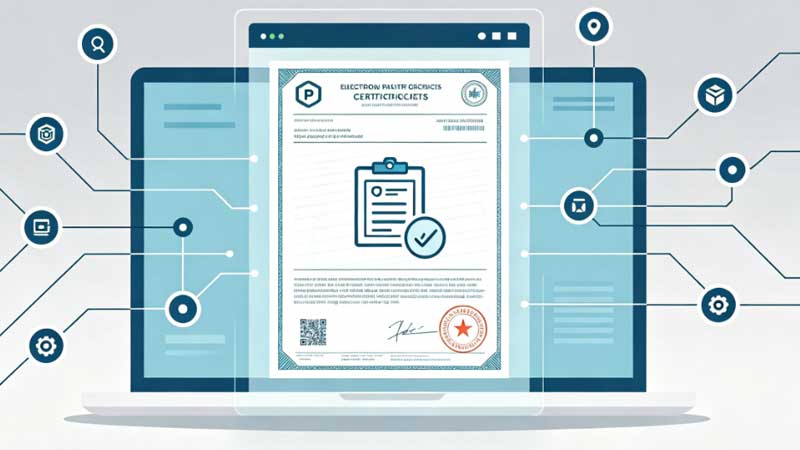
The China Council for the Promotion of International Trade (CCPIT) has launched a fully digital Certificate of Origin (CO) system, effective August 1, 2026. The new electronic CO platform reduces processing time from 1‑2 days to as little as 2 hours for standard applications, and 30 minutes for expedited requests. Digital certificates are secured by blockchain technology, making them tamper‑proof and instantly verifiable by customs authorities in over 50 countries. For eligible destinations (including RCEP members, EU, UK, Australia, and New Zealand), no paper original is required – the electronic CO alone is sufficient for customs clearance. This guide explains the new system, application process, and benefits for exporters.
1. Key Features – Instant Issuance, Blockchain Verification, Paperless
CCPIT‘s digital CO system offers several transformative features:
- Instant issuance (2 hours standard, 30 minutes expedited): Applications submitted before 2 PM are processed the same day. Expedited requests (additional RMB 200) are processed within 30 minutes.
- Blockchain verification: Each digital CO is recorded on a blockchain, creating an immutable audit trail. Customs authorities can verify authenticity instantly via a QR code or API integration.
- Paperless acceptance in 50+ countries: Participating countries (including all RCEP members, EU, UK, Australia, New Zealand, and 15 others) accept the digital CO without a paper original. The PDF or blockchain‑verified CO is sufficient for customs clearance.
- QR code for instant verification: Each CO includes a QR code. Scanning the code displays the CO on the CCPIT verification portal, showing issuance date, product details, and blockchain hash.
- Batch processing for high‑volume exporters: Exporters with 100+ COs monthly can use the API to integrate their ERP directly with CCPIT‘s system, enabling fully automated issuance.
- Lower fees: Digital COs cost RMB 30 (vs. RMB 50 for paper). Expedited fee: additional RMB 20.
The system applies to all CO types: general CO, RCEP CO, Asia‑Pacific Trade Agreement (APTA) CO, and China‑ASEAN FTA CO.
2. Supported Certificate Types – RCEP, General, FTA-Specific
The digital CO system supports all major certificate types used by Chinese exporters:
- General CO (贸促会一般原产地证): For non‑preferential trade or for countries without FTAs. Digital CO accepted by 50+ countries.
- RCEP CO: For trade with RCEP members (Japan, South Korea, Australia, New Zealand, ASEAN). Digital CO accepted by all RCEP members.
- China-ASEAN FTA CO (Form E): For trade with ASEAN countries. Digital CO accepted by all ASEAN members.
- China-Australia FTA CO: Digital CO accepted by Australian customs.
- China-New Zealand FTA CO: Digital CO accepted by New Zealand customs.
- APTA CO: For trade with India, South Korea, Bangladesh, Sri Lanka, Laos. Digital CO accepted by all APTA members.
For countries that still require paper originals (e.g., some Middle Eastern, African, and South American countries), exporters can still request paper COs, but the digital version can be used for pre‑clearance.
3. Application Process – Step by Step
The digital CO application is conducted entirely online through CCPIT‘s e‑CO portal (https://eco.ccpit.org). Steps:
- Register for a CCPIT e‑CO account (One‑time). Exporters need a valid business license and customs registration number. Foreign companies must appoint a China‑based agent.
- Complete the online application form (5‑10 minutes). Required fields: exporter name and address, consignee, HS code (6‑10 digits), product description, quantity, invoice value, and origin criteria (e.g., “Wholly Obtained” or “RVC 40%”).
- Upload supporting documents (Optional, for origin verification). For RCEP COs, proof of origin (supplier declarations, production records) must be retained but not uploaded unless requested.
- Submit and pay fee (RMB 30). Payment via online banking, Alipay, or WeChat Pay.
- Receive digital CO within 2 hours (standard) or 30 minutes (expedited). Download PDF and QR code. The CO is also stored in the CCPIT blockchain for verification.
- Send digital CO to buyer or customs broker. Email the PDF or share the QR code. No courier or paper copy needed for eligible destinations.
For high‑volume exporters (100+ COs monthly), API integration is available. The technical documentation is available on the CCPIT portal.
4. Blockchain Verification – How It Works
Each digital CO is recorded on a permissioned blockchain operated by CCPIT in partnership with AntChain. Verification process:
- Scan the QR code on the digital CO using any smartphone. The QR code links to CCPIT‘s verification portal.
- The portal displays: CO number, issue date, exporter/importer details, product list, origin criteria, and blockchain transaction hash.
- Compare with blockchain record: The hash can be checked against the public blockchain ledger to ensure the CO has not been altered.
- API integration for customs: Customs authorities in 50+ countries have integrated their systems with CCPIT‘s blockchain. When a CO number is entered, the system automatically retrieves and verifies the CO.
Blockchain verification eliminates the risk of counterfeit COs and reduces the need for manual checks.
5. Participating Countries – Where Digital CO is Accepted
As of August 2026, the digital CO is accepted for customs clearance in the following countries without a paper original:
- RCEP members (15): Japan, South Korea, Australia, New Zealand, Brunei, Cambodia, Indonesia, Laos, Malaysia, Myanmar, Philippines, Singapore, Thailand, Vietnam, China.
- EU (27): All member states accept digital COs for non‑preferential trade.
- UK, Switzerland, Norway, Iceland, Liechtenstein.
- Turkey, Ukraine, Georgia, Armenia, Azerbaijan.
- Egypt, South Africa, Kenya, Nigeria, Morocco.
- Chile, Peru, Costa Rica, Mexico.
For countries not on this list, importers may still require paper originals. Exporters should verify requirements with their buyers before shipping.
6. Benefits for Exporters – Faster Clearance, Lower Costs
The digital CO system offers significant advantages for Chinese exporters:
- Faster customs clearance: Digital COs can be transmitted to the buyer electronically before goods arrive, enabling pre‑clearance. Average clearance time reduced by 1‑3 days.
- Lower administrative costs: No courier fees, no paper storage. RMB 30 vs. RMB 50 per CO = 40% savings.
- Reduced risk of lost COs: Digital COs are stored in the cloud and blockchain. No risk of courier loss or damage.
- Improved cash flow: Faster clearance reduces demurrage and storage fees.
- Enhanced credibility: Blockchain verification assures buyers that the CO is authentic.
- Environmental benefits: Paperless process reduces carbon footprint.
For a company issuing 500 COs annually, savings exceed RMB 10,000 in fees plus significant administrative time.
7. Practical Compliance Roadmap for Exporters
To start using CCPIT‘s digital CO system, follow this five‑step roadmap:
- Register for a CCPIT e‑CO account (Immediate). Online registration takes 1‑2 working days. Foreign companies must appoint a China agent.
- Train staff on the online application process (Week 1). CCPIT provides free training videos and a test environment.
- Integrate API (for high‑volume exporters) (Month 1). Work with your IT team to connect ERP to CCPIT‘s system. Technical specs available on the portal.
- Notify buyers of digital CO acceptance (Immediate). Send a template email to all buyers in eligible countries: “We now issue CCPIT blockchain‑verified digital COs. No paper original required.”
- Monitor customs acceptance (Ongoing). If a buyer‘s customs authority rejects the digital CO, contact CCPIT for a paper original (available on request).
Summary: CCPIT‘s fully digital Certificate of Origin system (effective August 1, 2026) offers instant issuance (2 hours standard, 30 minutes expedited), blockchain verification, and paperless acceptance in over 50 countries including RCEP members, EU, UK, Australia, and New Zealand. Digital COs cost RMB 30 (vs. RMB 50 for paper) and are secured by blockchain technology – each CO has a QR code for instant verification. Supported certificate types include general CO, RCEP CO, China‑ASEAN FTA CO, and APTA CO. Exporters can apply online through CCPIT‘s e‑CO portal, with batch processing and API integration for high‑volume users. Benefits include faster customs clearance (pre‑clearance enabled), lower costs (40% savings), reduced risk of lost COs, and improved credibility. By registering for a CCPIT e‑CO account, training staff, and notifying buyers, exporters can transition to fully digital, paperless CO issuance and gain a competitive edge in international trade.