
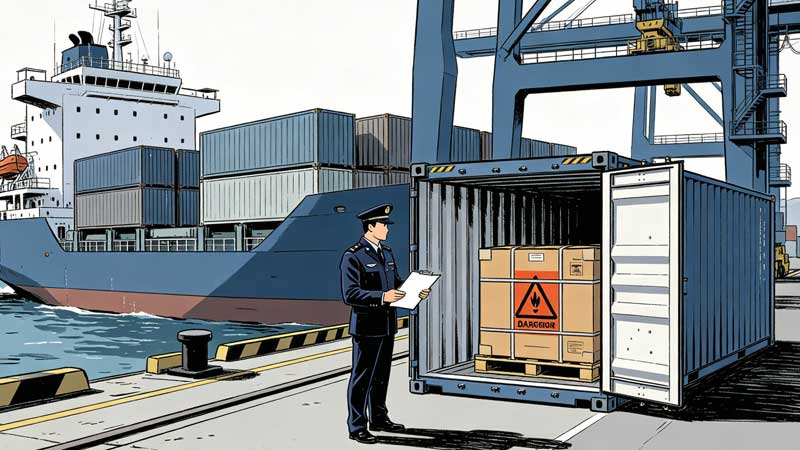
Since the beginning of 2026, shippers, freight forwarders, and customs brokers handling dangerous goods (DG) by sea have faced an unprecedented tightening of documentation checks at Chinese ports. Major hubs including Shanghai, Ningbo, Shenzhen, and Qingdao have significantly upgraded their risk-based screening systems, with many shipments being flagged for document inconsistencies, UN number mismatches, or outdated MSDS formats. According to industry reports, Shanghai's Yangshan Port saw a 15% increase in DG cargo inspection rates compared to 2025, and demurrage costs from customs holds have become a growing concern for exporters and importers alike[reference:0]. The driving force behind this intensified scrutiny is the full enforcement of IMDG Code Amendment 42-24 combined with China's new Hazardous Chemicals Safety Law (effective May 1, 2026). This guide examines why Chinese customs has tightened DG documentation checks, what specific requirements shippers must meet, and how to navigate the new compliance landscape.
1. Regulatory Drivers Behind the 2026 Tightening
Three major regulatory developments have converged in 2026 to create a more stringent DG documentation environment.
1.1 IMDG 42-24: From Transition Period to Mandatory Enforcement
The International Maritime Dangerous Goods (IMDG) Code Amendment 42-24 was adopted by IMO Maritime Safety Committee resolution MSC.556(108) in May 2024 and became mandatory for China on January 1, 2026. The amendment introduced significant changes: eleven new dangerous goods entries (including UN 3551/3552 for sodium-ion batteries and UN 0514/3559 for fire suppression device dispersants) and amendments to 58 existing entries. The update also revised UN 3171, now limited only to vehicles powered by wet batteries, sodium metal batteries, or sodium alloy batteries, while lithium-ion powered vehicles, lithium metal battery vehicles, and sodium-ion powered vehicles were reclassified under UN 3556, UN 3557, and UN 3558 respectively[reference:1]. For sodium-ion batteries, new UN 3551 and UN 3552 entries were added to incorporate the growing shipments of these batteries into the framework.
After a one-year transition period, 42-24 is now fully enforced with zero tolerance for non-compliance. Multiple ports have integrated the new rules into their daily inspection standards, and post-grace-period shipments flagged with classification errors face immediate rejection or detention[reference:3]. This means that any DG documentation referencing the previous 2022 edition is now automatically invalid.
1.2 Hazardous Chemicals Safety Law: Enhanced Customs Authority
The new Hazardous Chemicals Safety Law, effective May 1, 2026, has fundamentally reshaped customs oversight of dangerous goods. It is the first foundational law specifically for hazardous chemicals in China, establishing full life-cycle management from production to disposal. Article 7 explicitly grants customs the authority to inspect import/export hazardous chemicals and their packaging[reference:4]. The law also introduces a dual penalty system ("double punishment") under which both the company and directly responsible individuals can be fined[reference:5].
For DG shippers, this means that customs now has clear legal authority to detain shipments, impose administrative penalties, and enforce document compliance at all ports. The law's penalty framework imposes fines of up to RMB 100,000 for document violations (e.g., missing Chinese SDS or non-compliant labels), and up to RMB 200,000 for unrectified offenses[reference:6]. For dangerous goods misdeclared as non-hazardous, the consequences are significantly more severe.
2. How Customs DG Screening Works in 2026
China Customs has fully digitized its DG screening process. The system performs risk-based automated reviews that can flag shipments before human intervention[reference:7].
2.1 Automated Online Screening
The customs system cross-references HS codes, cargo descriptions, UN numbers, and attached documents in real time. If any inconsistency is detected – such as a missing MSDS or a single mismatched UN number – the system can automatically issue a hold[reference:8].
2.2 Documentary Check vs. Physical Inspection
Two distinct types of examination occur at Chinese ports. A documentary check hold occurs when the system identifies a paperwork inconsistency (e.g., mismatched UN number, missing MSDS). The container is not physically opened, and resolution requires identifying the discrepancy and submitting corrected documents. In contrast, a physical inspection hold occurs when customs selects the container for opening and examination, which triggers additional handling and storage fees[reference:9].
3. Core DG Documentation Requirements Under 2026 Rules
Under the current regime, four core documents are essential for DG clearance and must be complete, consistent, and compliant with the latest standards[reference:10].
3.1 Transportation Identification Report (运输鉴定报告)
The Transportation Identification Report must be issued by a CNAS-accredited lab within China. It must clearly specify the UN number, dangerous goods class (e.g., Class 3 flammable liquids, Class 8 corrosives), packing group (I, II, or III), and emergency measures. Reports from non-accredited foreign labs are no longer accepted[reference:11].
3.2 Hazardous Characteristics Classification Report
The Hazardous Characteristics Classification Report applies to chemicals listed in the updated Dangerous Chemicals Directory (2025 edition). It must comply with the GB 30000.1-2025 classification standards[reference:12].
3.3 Safety Data Sheet (SDS) / Material Safety Data Sheet (MSDS)
The Safety Data Sheet must follow the standard 16-section GHS format and be provided in Chinese (bilingual versions are acceptable but Chinese must be present). For chemical categories requiring bilingual versions, an English-only SDS is now rejected automatically. Additionally, any SDS that cleared customs in 2025 is not automatically accepted in 2026; updated content may be required[reference:13].
3.4 Certificate of Origin
For dangerous goods imported from Southeast Asia, a FORME certificate compliant with GAC Announcement No. 12 of 2026 may be required[reference:14].
4. MSDS/SDS Format Scrutiny: What Triggers Rejection
In 2026, China Customs' automated screening system checks MSDS format, not just content. The following defects will trigger automatic rejection[reference:15]: SDS not in the standard 16-section GHS format; English-only submission for chemical categories requiring a bilingual version; missing Chinese translation of key sections (emergency measures, toxicological information); outdated classification based on GHS Revisions prior to Rev. 7; and missing or inconsistent UN number across documents.
5. Mandatory Online DG Filing Requirements
China now requires electronic submission of all DG documentation through designated platforms. For sea freight DG shipments, consignors must file a Dangerous Goods Declaration electronically through the shipping line's booking system or via the customs "single window" platform. Shipping lines such as Maersk, MSC, and COSCO have implemented internal screening systems that verify DG documentation before booking confirmation. Failure to provide complete, consistent online documents at the time of booking will result in automated refusal of space[reference:16]. For sodium-ion battery shipments (UN 3551, UN 3552), the lithium battery mark has been renamed to "Lithium or Sodium Ion Battery Mark," and this new marking must appear on the DG Declaration.
6. Severe Consequences of DG Misdeclaration and Non-Compliance
Penalties for DG misdeclaration have increased significantly. Under the new legal framework, misdeclaration – including declaring dangerous goods as general cargo, misclassifying hazard classes, or under-reporting risks – triggers multiple penalties. Shipping lines impose direct fines: for example, Maersk now fines non-compliant DG declarations at USD 15,000 per container in China (compared to USD 5,000 globally)[reference:18]. Government authorities impose additional administrative penalties: under the Hazardous Chemicals Safety Law, fines range from RMB 30,000 to RMB 200,000 depending on severity. In cases of serious violations, the responsible manager may face personal fines and a five-year industry ban. The consignor may also be blacklisted, with all future shipments flagged for 100% inspection. In extreme cases, such as undeclared explosives, criminal liability may apply.
7. International vs. China-Specific Requirements
Shippers must understand the distinction between global DG rules and China's additional requirements. UN 38.3 test reports must be updated to Revision 8. The SDS must comply with GHS Rev. 11. The package must bear the newly updated dangerous goods mark (for lithium/sodium batteries). Additional documentation required uniquely for China includes a Hazardous Characteristics Classification Report (if the product is listed in the Dangerous Chemicals Directory) and a Transportation Identification Report from a CNAS-accredited lab. In addition, Maritime Safety Administration (MSA) requirements for vessels apply alongside customs requirements: shippers must submit advance manifests and cargo safety declarations.
8. Practical Compliance Roadmap for DG Shippers
- Review and update all DG documentation (Immediately): Ensure all MSDS/SDS documents follow the 16‑section GHS format and are bilingual (Chinese + English). Update classification to align with IMDG 42-24 and GHS Rev. 11. Verify that UN numbers match the latest entries (e.g., sodium‑ion batteries under UN 3551/3552, not UN 3171).
- Verify lab accreditation (Month 1): All test reports (Transportation Identification Report, UN 38.3, Hazardous Characteristics Report) must be from CNAS‑accredited labs. Foreign lab reports without CNAS recognition are no longer accepted.
- Implement internal document consistency check (Ongoing): Ensure UN numbers, proper shipping names, packing groups, and descriptions match exactly across the MSDS, DG Declaration, Bill of Lading, and package label.
- Maintain digital records for at least 7 years: Customs now requires documentation to be retained for 7 years, up from the previous 5 years[reference:19].
- Engage a China customs broker with DG expertise: Work with a broker who has direct access to the customs screening system and can identify discrepancies before submission.
9. Frequently Asked Questions
Q: Will customs automatically reject an MSDS based on GHS Rev. 7 rather than Rev. 11?
A: Yes. If the MSDS does not incorporate the latest hazard classifications (including new categories for desensitized explosives and endocrine disruptors), it will be flagged during automated screening[reference:20].
Q: Do I need to re-certify UN 38.3 for older battery models?
A: Yes if the original test report was based on UN 38.3 Rev. 6 or Rev. 7. From January 1, 2026, only Rev. 8 reports are accepted. You must have your battery models re‑tested under Rev. 8.
Q: Are shipping lines imposing stricter rules on top of customs requirements?
A: Yes. Major carriers have implemented internal screening protocols that pre‑screen DG declarations before booking. Even if customs clears a shipment, a carrier may refuse dangerous goods if its internal system flags a discrepancy.
Summary: 2026 marks a new era of tightened dangerous goods documentation enforcement at Chinese ports. With IMDG 42-24 mandatory from January 1, 2026, the Hazardous Chemicals Safety Law effective May 1, 2026, and new MSDS format screening at customs, shippers face unprecedented scrutiny. Common triggers for detention include outdated UN numbers, inconsistent documentation across files, non-compliant MSDS formats, missing CNAS-accredited test reports, and misdeclaration of dangerous goods. By updating all documentation, engaging qualified test labs, maintaining document consistency, and working with experienced customs brokers, shippers can avoid costly holds, fines, and delays. The stakes have never been higher – but the solutions are well within reach for those who prepare thoroughly.