
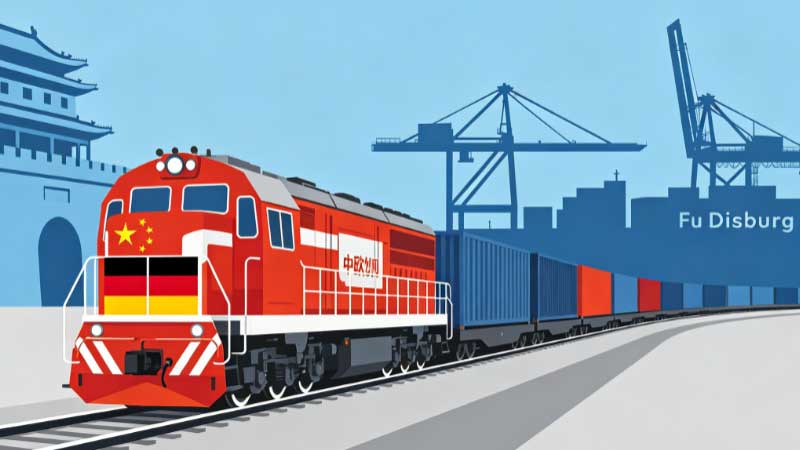
China-Europe railway freight capacity has expanded significantly in 2026 with the launch of a new direct service from Xi’an to Duisburg, Germany – Europe‘s largest inland port. The service offers daily departures (up from 5 weekly previously), with transit time reduced to 16 days (down from 18‑20 days). The route is particularly competitive for electronics, auto parts, and machinery – offering rates 30‑40% lower than air freight and transit times 50‑60% faster than ocean freight (which takes 35‑45 days). For importers and exporters moving time‑sensitive but non‑urgent goods, the expanded rail service provides an optimal balance of cost and speed. This guide explains the new service, rate comparisons, and practical steps for shippers.
1. New Service Details – Daily Departures, 16-Day Transit
The expanded Xi‘an‑Duisburg direct service, operated by a consortium of China Railway Container Transport (CRCT), DB Cargo, and other partners, offers the following specifications:
- Departure frequency: Daily (365 days per year, except Chinese New Year week).
- Origin terminal: Xi‘an International Port (西安国际港站) – one of China’s largest inland rail hubs.
- Destination terminal: Duisburg DIT (Duisburg Intermodal Terminal), Germany.
- Transit time: 16 days door‑to‑terminal (Xi‘an to Duisburg). Additional 1‑3 days for customs clearance and final delivery within Europe.
- Route: Xi’an → Alashankou (China-Kazakhstan border) → Kazakhstan → Russia → Belarus → Poland → Germany.
- Capacity per train: 50‑55 FEU (forty‑foot equivalent units) or 100‑110 TEU.
Intermediate stops include Almaty (Kazakhstan), Moscow (Russia), Minsk (Belarus), and Małaszewicze (Poland), but the core transit does not require unloading.
2. Competitive Rates – Electronics and Auto Parts Focus
The new service offers competitive rates for specific cargo types, with discounts for volume shippers. Current rate ranges (per FEU, all‑inclusive of rail and terminal charges):
- Electronics (computers, phones, circuit boards): $5,500 – $7,500 per FEU.
- Auto parts (engines, transmissions, components): $6,000 – $8,000 per FEU.
- Machinery and industrial equipment: $6,500 – $9,000 per FEU.
- General cargo (clothing, furniture, consumer goods): $7,000 – $10,000 per FEU.
- Per‑kg rates (LCL – less than container load): $1.20 – $2.00 per kg, depending on volume.
Compared to ocean freight ($2,000‑3,500 per FEU but 35‑45 days), rail is 2‑3x more expensive but 2‑3x faster. Compared to air freight ($8‑12 per kg), rail is 4‑6x cheaper for the same transit time advantage.
3. Best Suited Cargo – When to Choose Rail
The Xi‘an‑Duisburg rail service is ideal for cargo that meets the following criteria:
- Time‑sensitive but not urgent: Products with a shelf life of 30‑60 days (e.g., seasonal electronics, automotive parts for just‑in‑time manufacturing).
- High value per kg: Goods valued at $20‑50 per kg (e.g., laptops, industrial sensors, medical devices) where air freight costs are prohibitive but ocean transit is too slow.
- Stable demand, predictable volumes: Daily departures allow regular, reliable scheduling.
- Climate‑sensitive goods: Rail offers better temperature control than ocean (insulated containers available).
Cargo less suited for rail: low‑value bulk commodities (coal, grain, scrap metal), hazardous goods (special permits required), and perishables with<15 day shelf life.
4. Documentation and Customs Clearance – What to Prepare
Rail freight requires similar documentation to ocean freight, with a few rail‑specific requirements:
- Rail waybill (SMGS or CIM/SMGS consignment note): Must be completed in triplicate (Chinese, Russian, English). The CIM/SMGS single document is accepted for most routes.
- Commercial invoice and packing list: Standard format, with HS codes at 6‑digit level.
- Certificate of origin: Required for preferential tariff treatment under China‑EU trade agreements.
- Export customs declaration (China): Filed electronically via the Single Window before train departure.
- Import customs declaration (EU): Can be filed in advance (pre‑clearance) to reduce dwell time at Duisburg.
- Rail‑specific permit: For hazardous goods, heavy loads, or oversized cargo.
Customs clearance at the destination (Duisburg) typically takes 1‑2 days. The entire process from Xi‘an departure to customer delivery in Central Europe averages 20 days.
5. Advantages Over Ocean and Air Freight
The expanded rail service offers distinct advantages over traditional modes:
- Vs. Ocean Freight: 2‑3x faster transit (16 vs. 40 days); lower inventory carrying costs; reduced risk of port congestion; more predictable schedules; less exposure to canal closures (Panama, Suez).
- Vs. Air Freight: 4‑6x lower cost; lower carbon footprint; suitable for larger, heavier items; less restrictive on hazardous goods.
- Vs. Ocean + Air combination: Simpler logistics (single mode, single carrier); no transshipment delays.
For electronics and auto parts manufacturers, the rail service has become the preferred mode for routine shipments to Europe.
6. Practical Steps for Shippers
To start using the Xi‘an‑Duisburg rail service, follow this five‑step roadmap:
- Determine if rail is suitable for your cargo (Immediate). Calculate total landed cost: rail rate + inventory carrying cost (value × days saved × cost of capital). For high‑value, time‑sensitive goods, rail often beats ocean despite higher freight cost.
- Engage a rail freight forwarder (Week 1). Choose a forwarder with experience on the China‑Europe route and dedicated space on the Xi‘an‑Duisburg service.
- Book space (1‑2 weeks in advance). Daily departures allow flexible booking. For volume shippers (10+ FEU/month), contract rates are available.
- Prepare rail‑specific documentation (Week 2). Ensure the CIM/SMGS waybill is completed correctly. Work with your forwarder to avoid errors.
- Ship and track (Ongoing). Most carriers offer real‑time GPS tracking. Monitor progress and pre‑clear EU customs to minimize destination delays.
Summary: The new Xi’an-Duisburg direct rail service offers daily departures, 16‑day transit time, and competitive rates for electronics ($5,500‑7,500/FEU) and auto parts ($6,000‑8,000/FEU). Compared to ocean freight (35‑45 days, $2,500‑3,500/FEU), rail is 2‑3x faster but 2‑3x more expensive – ideal for time‑sensitive, high‑value goods. Compared to air freight ($18,000/FEU, 3 days), rail is 4‑6x cheaper. The service is best suited for electronics, auto parts, machinery, and other high‑value cargo with stable demand. Shippers should calculate total landed cost (freight + inventory carrying cost) to determine optimal mode. By following the practical steps – engaging a rail forwarder, booking space, and preparing CIM/SMGS documentation – importers and exporters can take advantage of this expanded, reliable China‑Europe rail connection.