
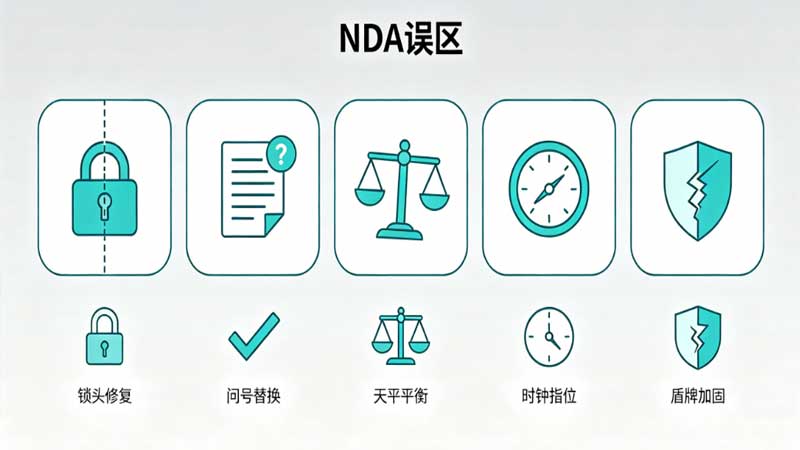
The non-disclosure agreement is the most fundamental document in any company's trade secret protection program. It is typically the first legal instrument signed by new employees, often incorporated into employment contracts or presented as a standalone document during onboarding. For foreign companies operating in China, the NDA carries particular weight: it establishes the contractual foundation for confidentiality obligations, defines the scope of protected information, and serves as critical evidence in any subsequent enforcement action. Yet a startling number of foreign companies operating in China use employee NDAs that would fail under Chinese legal standards. These are not marginal drafting imperfections. They are fundamental structural errors—importing common law concepts that have no equivalent in Chinese law, omitting elements that Chinese courts require for enforceability, or using language so vague that it provides no meaningful protection. When trade secret misappropriation occurs, these defective NDAs leave companies without the contractual foundation they assumed they had. This guide identifies the five most common and consequential NDA drafting errors foreign companies make in their China employee agreements, explains why each error undermines enforceability under Chinese law, and provides practical guidance for creating enforceable NDAs that will withstand scrutiny in Chinese courts and administrative proceedings.
📑 What You'll Learn
- Why foreign-style NDAs often fail under Chinese legal standards
- Mistake 1: Overbroad and vague definitions of confidential information
- Mistake 2: Missing statutory requirements for trade secret identification
- Mistake 3: Inadequate confidentiality measures documentation
- Mistake 4: Unenforceable post-employment restrictions
- Mistake 5: Missing or defective dispute resolution provisions
- Practical fixes and enforceable template language
1. Why Foreign-Style NDAs Fail Under Chinese Legal Standards
The most fundamental China NDA mistake foreign companies make is assuming that an NDA drafted for another jurisdiction will function equivalently in China. Many multinational companies use global template NDAs—often drafted under US or European law, translated into Chinese, and incorporated into local employment contracts with minimal adaptation. This approach creates systematic enforceability problems because Chinese trade secret law operates under different principles than common law confidentiality doctrine.
The key structural difference concerns how protected information is defined and established. In common law systems, confidentiality obligations can attach to information through agreement alone—the parties agree that certain information is confidential, and the agreement itself creates the obligation. Information need not meet specific statutory criteria to be protected by contractual confidentiality. In China, trade secret protection operates under the statutory framework of the Anti-Unfair Competition Law, which defines a trade secret as information that is not publicly known, has commercial value, and is subject to reasonable protective measures by the rights holder. A contractual designation of information as confidential, standing alone, does not satisfy these statutory requirements. An NDA that simply declares "all information disclosed during employment is confidential" without establishing that the information meets the statutory criteria, and without documenting the protective measures taken, may be unenforceable for information that does not independently qualify as a statutory trade secret.
A second structural difference concerns the role of the NDA in enforcement proceedings. In common law litigation, the NDA itself is often the primary source of the confidentiality obligation, and proving breach of the NDA is sufficient to establish liability. In Chinese trade secret litigation, the NDA is evidence of the protective measures the rights holder took—one element of establishing that the information qualifies as a statutory trade secret—but it is not independently sufficient. Chinese courts evaluate the overall reasonableness of the protective measures, considering the NDA alongside technical measures, physical security, access controls, and other protections. An NDA that is not integrated into a comprehensive protection program may fail to support a trade secret claim even if its contractual language is perfectly drafted.
A third structural difference concerns remedies. Foreign NDAs often include liquidated damages provisions, broad injunctive relief, and attorney fee provisions that may not be enforceable under Chinese law or may be enforceable only to a more limited extent than the drafting suggests. Including unenforceable provisions does not necessarily invalidate the entire NDA, but it creates false confidence and may complicate enforcement strategy.
2. Mistake 1: Overbroad and Vague Definitions of Confidential Information
The most common employee NDA drafting error is defining confidential information so broadly and vaguely that the definition provides no meaningful guidance to the employee and no enforceable foundation for the employer. Many foreign companies use sweeping language declaring that "all information relating to the company's business" or "any information the employee learns during employment" constitutes confidential information. This approach creates multiple problems under Chinese law.
The first problem is notice inadequacy. Chinese courts evaluating trade secret claims consider whether the employee had adequate notice of what information was considered confidential. A definition that encompasses "all information relating to the business" gives the employee no meaningful notice of what specific categories of information are protected. The employee cannot reasonably distinguish between information that is genuinely confidential and information that is merely incidental to employment. Courts have held that overbroad definitions fail to provide the clear notice that Chinese law requires for enforceable confidentiality obligations.
The second problem is statutory non-compliance. Under the amended Anti-Unfair Competition Law, a trade secret must have commercial value and must not be publicly known. A definition that includes "all information relating to the business" inevitably encompasses information that lacks commercial value, that is publicly known, or that the employee brought to the employment from prior experience. By attempting to protect everything, the definition protects nothing effectively—courts may decline to enforce the NDA for any specific information because the overbroad definition fails to establish that the particular information at issue was genuinely confidential.
The fix is to draft definitions that are specific, categorical, and linked to commercial value. Instead of "all information relating to the business," an enforceable China employee NDA should identify specific categories of protected information: technical information including manufacturing processes, formulae, algorithms, and R&D data; business information including customer lists, pricing methodologies, supplier relationships, and strategic plans; and financial information including cost structures, margin data, and investment plans. Each category should be described with sufficient particularity that an employee can understand what falls within it. The definition should also explicitly exclude information that is publicly known, independently developed by the employee without use of company resources, or rightfully obtained from third parties without confidentiality obligations.
3. Mistake 2: Missing Statutory Requirements for Trade Secret Identification
The second major NDA drafting error is the failure to include provisions that satisfy the statutory requirements for trade secret identification under the amended Anti-Unfair Competition Law. The law requires that trade secrets be subject to "reasonable measures" to maintain confidentiality, and the NDA is a critical component of demonstrating those measures. However, a generic confidentiality clause is insufficient; the NDA must contain specific provisions that Chinese courts recognize as satisfying the statutory requirements.
The most commonly missing provision is a trade secret identification and acknowledgment mechanism. Chinese courts look for evidence that the employer specifically identified the information it considers to be trade secrets and that the employee acknowledged the identification. An NDA that simply states a general confidentiality obligation without any process for identifying specific trade secrets fails this requirement. The fix is to include a provision requiring the employer to maintain a trade secret inventory or register, and requiring the employee to acknowledge in writing the trade secrets to which the employee has access. This acknowledgment can be updated periodically or upon access to new categories of trade secrets. The acknowledgment creates a contemporaneous record establishing that the employee was on notice of the specific information considered confidential—precisely the evidence Chinese courts require.
A second commonly missing provision is the return and deletion certification. Chinese courts consider whether the employer took measures to ensure return of confidential information upon employment termination. An NDA that requires return of company property but does not specifically address digital information, copies, derivatives, and retained knowledge is incomplete. The fix is to include a detailed return provision requiring the employee to return all documents, files, devices, and copies containing confidential information; to permanently delete all confidential information from personal devices and cloud storage; and to certify in writing that the return and deletion have been completed. The certification creates documentary evidence of compliance that can be critical in subsequent enforcement.
A third commonly missing provision addresses third-party disclosure during employment. Many NDAs focus on post-employment disclosure but neglect the equally important issue of disclosure to unauthorized recipients during employment. The fix is to include provisions restricting internal disclosure to personnel with a need to know, requiring authorization for external disclosure, and establishing protocols for disclosure to contractors, consultants, and business partners under protective agreements.
4. Mistake 3: Inadequate Confidentiality Measures Documentation
The third common China employee NDA mistake is treating the NDA as a standalone document rather than as one component of a documented confidentiality program. Under Chinese law, the NDA is evidence of protective measures, but it is evaluated alongside other measures the employer implemented. An NDA that recites comprehensive obligations but is not supported by evidence that those obligations were operationalized through actual practices may be found insufficient.
The problem manifests in several ways. Companies may have excellent NDAs on file but no documentation of the access controls, technical protections, physical security measures, and training programs that give the NDA its practical effect. When trade secret litigation arises, the company can produce the signed NDA but cannot demonstrate that the confidentiality obligations were implemented through operational practices. Chinese courts, evaluating the overall reasonableness of protective measures, may find that the NDA alone is insufficient.
The fix is to integrate the NDA into a documented confidentiality management system. The NDA should reference the company's confidentiality policies and procedures, and the employee should acknowledge receiving and understanding those policies. The company should maintain records of confidentiality training provided to the employee, access control logs showing that the employee's access to confidential information was limited to what was necessary for their role, and periodic reminders or re-acknowledgments of confidentiality obligations. These operational records transform the NDA from a one-time contractual formality into evidence of an ongoing, systematically implemented protection program—precisely the showing Chinese courts find persuasive.
Documentation is particularly important for departing employees. The exit process should include a formal confidentiality exit interview, a final review of confidentiality obligations, a signed reaffirmation of those obligations, and the return and deletion certification discussed above. The exit documentation creates a contemporaneous record that is extremely valuable in subsequent enforcement—it establishes that the employee's obligations were specifically reinforced at the point of departure, when the risk of misappropriation is highest, and that the employee acknowledged those obligations with full awareness of their continued application.
5. Mistake 4: Unenforceable Post-Employment Restrictions
The fourth critical NDA drafting error concerns post-employment restrictions that exceed what Chinese law permits or that fail to satisfy statutory requirements for enforceability. Foreign companies often import post-employment restrictive covenants from their home jurisdiction NDAs without adapting them to Chinese legal standards, creating provisions that are unenforceable in whole or in part.
Non-compete provisions are the most common problem area. Chinese law permits post-employment non-compete obligations for senior management, senior technical personnel, and other personnel with access to trade secrets, but these obligations are subject to specific statutory requirements. The non-compete period cannot exceed two years. The employer must pay monthly compensation during the restricted period, at a rate not less than the employee's average monthly salary over the twelve months preceding termination, with some localities requiring higher minimums. A non-compete that exceeds two years, that fails to provide for compensation, or that provides compensation below the statutory minimum is unenforceable. Many foreign company NDAs include non-compete provisions that violate one or more of these requirements, rendering the entire non-compete unenforceable.
Non-solicitation provisions present a different set of issues. Chinese law does not have a specific statutory framework for employee non-solicitation clauses comparable to the non-compete framework. The enforceability of non-solicitation provisions is less certain and depends on their reasonableness in scope, duration, and geographic reach. Overbroad non-solicitation clauses—prohibiting contact with any company employee for any reason, or extending for unreasonably long periods—face enforceability risk. The fix is to draft non-solicitation provisions that are reasonable in scope, focused on employees with whom the departing employee had material working relationships, and limited in duration to a period proportionate to the employer's legitimate business interest in protecting workforce stability.
Confidentiality obligations themselves, as distinct from non-compete and non-solicitation restrictions, can extend indefinitely under Chinese law—trade secret confidentiality survives employment termination without temporal limit. However, the NDA should clearly distinguish between indefinite confidentiality obligations covering trade secrets and time-limited post-employment restrictive covenants. Conflating the two creates confusion and may lead courts to apply restrictive covenant limitations to confidentiality obligations that should be unlimited.
6. Mistake 5: Missing or Defective Dispute Resolution Provisions
The fifth major employee NDA drafting error concerns dispute resolution provisions that are missing, ambiguous, or that select forums and governing law in ways that undermine enforceability. Dispute resolution provisions may seem like boilerplate, but in China NDAs they carry particular strategic significance.
Governing law and forum selection is the most consequential issue. Some foreign companies specify their home jurisdiction law and courts for NDA disputes, assuming this provides familiarity and predictability. However, Chinese courts may decline to enforce foreign governing law provisions in employment-related disputes, particularly where the employee is a Chinese national working in China. Even if the governing law provision is respected, enforcing a foreign court judgment against a defendant and assets in China requires navigating the judgment recognition process, which adds time, cost, and uncertainty. The practical fix is to specify Chinese law as governing law and Chinese courts or arbitration as the dispute resolution forum for NDAs with China-based employees. This ensures that the NDA will be interpreted under the legal framework that actually governs trade secret protection in China and that judgments will be directly enforceable without recognition proceedings.
Arbitration versus litigation is a strategic choice that should be made deliberately. Arbitration offers confidentiality—proceedings and awards are not public, which can be valuable in trade secret cases where the dispute itself may reveal sensitive information. Arbitration awards are generally final with limited appeal rights, providing faster resolution. However, arbitration may not offer the full range of interim remedies—preliminary injunctions, evidence preservation orders, asset freezes—that courts can provide. Litigation in Chinese courts offers these interim remedies but involves public proceedings. Many companies choose litigation for employee NDAs precisely because the availability of preliminary injunctive relief is critical in trade secret cases. The NDA should reflect a deliberate choice based on the company's enforcement priorities.
A third common defect is the absence of provisions addressing urgent relief. Trade secret misappropriation often requires immediate court action to prevent irreparable harm. An NDA that does not expressly authorize the employer to seek emergency interim relief from courts, regardless of the general dispute resolution forum, may face procedural obstacles when urgent action is needed. The fix is to include a provision expressly preserving the employer's right to seek preliminary injunctions, evidence preservation orders, and other emergency relief from any court of competent jurisdiction, notwithstanding any arbitration clause or other dispute resolution provision.
7. Practical Fixes and Enforceable Template Language
Correcting these NDA drafting errors requires more than isolated clause revisions. An effective enforceable China NDA should be restructured around Chinese legal requirements from the ground up. Here is a practical framework for the key provisions:
- Defined confidential information. Replace overbroad language with specific categories: technical information (manufacturing processes, formulae, algorithms, source code, R&D data, technical drawings, testing methodologies), business information (customer and supplier lists, pricing and margin data, marketing strategies, business plans, contract terms), and financial information (cost structures, investment plans, valuation data, transaction records). Include explicit exclusions for publicly known information, independently developed knowledge, and rightfully obtained third-party information.
- Trade secret identification and acknowledgment. Include a provision requiring the company to maintain a trade secret register and requiring the employee to sign written acknowledgments upon being granted access to specific trade secrets. The acknowledgment should identify the trade secret, confirm its confidential status, and record the date of access.
- Protective measures integration. Reference the company's confidentiality policies, IT security policies, and physical security protocols. Require the employee to acknowledge receiving, understanding, and agreeing to comply with these policies. Provide for periodic confidentiality training and re-acknowledgment.
- Return and deletion. Include detailed provisions requiring return of all company property and confidential information in any form, permanent deletion from personal devices and cloud storage, and written certification of completion. Specify that the obligation extends to copies, derivatives, notes, and summaries.
- Post-employment obligations. Distinguish between indefinite trade secret confidentiality, time-limited non-compete complying with statutory compensation and duration requirements, and reasonable non-solicitation. State compensation terms for non-compete obligations explicitly.
- Dispute resolution and remedies. Specify Chinese governing law. Select court litigation or arbitration deliberately. Include acknowledgment that monetary damages may be inadequate and express consent to injunctive relief. Preserve the right to seek emergency court relief regardless of the general dispute resolution forum.
The most perfectly drafted China employee NDA is only as effective as its implementation. The NDA should be presented and explained to the employee, not buried in a stack of onboarding documents. The employee should have an opportunity to ask questions. The signed NDA should be securely stored and readily retrievable for enforcement purposes. And the NDA should be reviewed and updated periodically to reflect changes in the law, the company's business, and the employee's role. An NDA that was enforceable when signed may become less effective if the legal framework evolves or if the employee's access to confidential information expands without corresponding updates to the agreement.
Summary: Foreign companies consistently make five critical NDA drafting errors in their China employee agreements that undermine enforceability under Chinese legal standards. The first error is overbroad and vague definitions of confidential information that fail to provide the clear notice Chinese courts require; the fix is specific categorical identification with explicit exclusions. The second error is missing statutory trade secret identification mechanisms; the fix is including acknowledgment provisions, return and deletion certifications, and internal disclosure protocols that satisfy the "reasonable measures" requirement. The third error is treating the NDA as a standalone document rather than integrating it into a documented confidentiality management system with training records, access logs, and formal exit procedures. The fourth error is unenforceable post-employment restrictions—non-competes exceeding the two-year statutory maximum or lacking required compensation, overbroad non-solicitation provisions, and failure to distinguish between indefinite trade secret confidentiality and time-limited restrictive covenants. The fifth error is defective dispute resolution provisions specifying foreign governing law or forums that complicate enforcement, failing to make deliberate choices between arbitration confidentiality and court interim remedies, and omitting preservation of emergency relief rights. Creating an enforceable China NDA requires restructuring around Chinese legal requirements: specific defined categories, trade secret acknowledgment mechanisms, protective measures integration, detailed return and deletion provisions, compliant post-employment restrictions, and strategically chosen dispute resolution with emergency relief preservation. Proper implementation—explaining the NDA to employees, securely storing signed agreements, and periodically updating them—is as important as proper drafting. Foreign companies that invest in China-compliant employee confidentiality agreements build the contractual foundation that Chinese courts require for effective trade secret enforcement.