
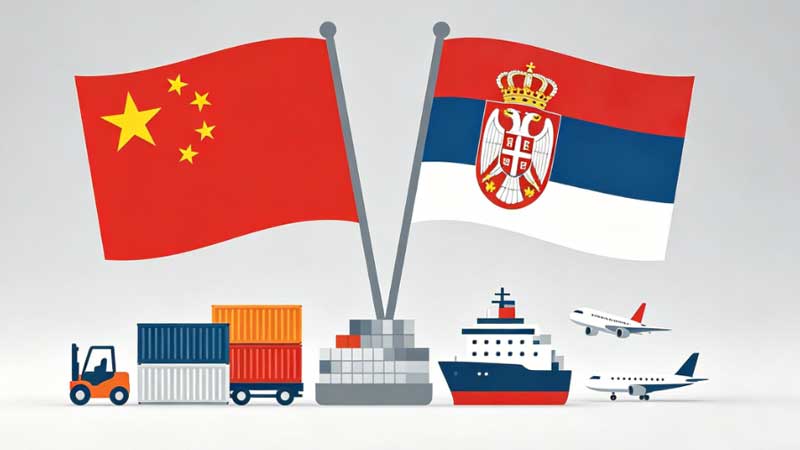
The China-Serbia Free Trade Agreement (FTA) entered into force on July 1, 2026, marking China‘s first FTA with a Central and Eastern European country. The agreement eliminates tariffs on over 90% of bilateral trade products within the first 5 years, with immediate duty‑free treatment for many machinery, electronics, and auto parts. Exporters can now apply for a new preferential tariff certificate – the China-Serbia FTA Certificate of Origin (Form CS). This guide explains the tariff reduction schedule, eligible product categories, certificate application process, and practical steps for exporters.
1. Tariff Reduction Schedule – Immediate and Phased Cuts
The China-Serbia FTA covers approximately 20,000 product lines. Key tariff reduction categories:
- Immediate duty‑free (July 1, 2026): Over 5,000 products including machinery (CNC machines, industrial robots, pumps), electronics (semiconductors, PCBs, batteries), auto parts (engines, transmissions, sensors), and textiles.
- 5‑year phase‑out (by July 1, 2031): Approximately 5,000 products including chemicals, plastics, steel products, and certain agricultural goods (e.g., fruits, vegetables). Tariffs reduced by 20% annually until reaching 0%.
- 10‑year phase‑out (by July 1, 2036): Approximately 2,000 sensitive products including some agricultural products (dairy, meat, wine) and certain industrial goods. Tariffs reduced by 10% annually.
- Excluded products (no tariff reduction): Approximately 2,000 products including tobacco, certain alcoholic beverages, and products covered by other bilateral agreements.
For machinery and electronics exports from China to Serbia, duty rates dropped from 5‑15% to 0% immediately upon the FTA‘s effective date.
2. Eligible Product Categories – Best Opportunities for Exporters
The FTA offers significant opportunities for Chinese exporters in the following categories (duty‑free immediately):
- Machinery (HS 84-85): Industrial robots (8479.50), CNC machines (8458), pumps (8413), compressors (8414), bearings (8482). Pre‑FTA duty: 5‑12%. Post‑FTA: 0%.
- Electronics (HS 85): Semiconductors (8542), printed circuit boards (8534), batteries (8506‑8507), electric motors (8501), transformers (8504). Pre‑FTA duty: 6‑10%. Post‑FTA: 0%.
- Auto parts (HS 87): Engines (8408), transmissions (8483), brakes (8708), sensors (9029). Pre‑FTA duty: 8‑15%. Post‑FTA: 0%.
- Textiles and apparel (HS 50-63): Fabrics, garments, home textiles. Pre‑FTA duty: 10‑15%. Post‑FTA: 0%.
- Furniture (HS 94): Wooden furniture, metal furniture, office furniture. Pre‑FTA duty: 8‑12%. Post‑FTA: 0%.
- Medical devices (HS 90): Surgical instruments (9018), X-ray equipment (9022), dental equipment. Pre‑FTA duty: 4‑8%. Post‑FTA: 0%.
Importers from Serbia to China also benefit from duty reductions on wine, agricultural products, and certain industrial goods. Chinese importers of Serbian products should also apply for the FTA certificate.
3. Origin Rules – Regional Value Content (RVC) and CTC
To qualify for preferential tariff treatment, products must meet the FTA‘s origin rules:
- Regional Value Content (RVC) threshold: 40% for most products. Value from China or Serbia (or cumulated with other parties if allowed) counts toward the threshold.
- Change in Tariff Classification (CTC): For products not meeting RVC, CTC rules apply. The product‘s HS code at the 4‑digit heading level must change from its non‑originating materials.
- Specific Process Rules (SPR): For certain products (e.g., chemicals, textiles), specific production processes must be performed within China or Serbia.
- Cumulation allowed: For products with materials from both China and Serbia, value from both countries counts toward RVC. No cumulation with third countries.
Exporter declaration: The FTA certificate requires the applicant to state the origin criteria met (e.g., “RVC 45%” or “CTC”).
4. Certificate of Origin – New Form CS
Exporters must apply for a new preferential tariff certificate – the China-Serbia FTA Certificate of Origin (Form CS). Key details:
- Issuing authority: CCPIT (China Council for the Promotion of International Trade) or local customs authorities.
- Format: Available in paper and digital (blockchain‑verified) formats. Digital COs are accepted by Serbian customs.
- Processing time: CCPIT digital CO: 2 hours (standard), 30 minutes (expedited). Paper CO: 1‑2 days.
- Validity period: 12 months from the date of issue.
- Back‑to‑back COs: For goods transiting through third countries, back‑to‑back COs are allowed (referencing the original Chinese CO).
- Self‑certification: Approved exporters may self‑certify origin without a third‑party CO. The self‑certification statement must appear on the commercial invoice.
The CO must be presented to Serbian customs at the time of import declaration.
5. Application Process – Step by Step
Exporters can apply for the Form CS CO through CCPIT‘s e‑CO portal (https://eco.ccpit.org). Steps:
- Register for a CCPIT e‑CO account (One‑time). Chinese exporters need a valid business license and customs registration number.
- Select “China-Serbia FTA CO (Form CS)” as certificate type.
- Complete the online application (5‑10 minutes). Required fields: exporter/importer names and addresses, HS code (6‑10 digits), product description, quantity, invoice value, origin criteria (e.g., “RVC 45%” or “CTC”).
- Upload supporting documents (Optional). For origin verification, retain production records and supplier invoices (not uploaded unless requested).
- Submit and pay fee (RMB 30). Digital CO fee is RMB 30 (paper CO: RMB 50).
- Receive digital CO within 2 hours. Download PDF with QR code. Email to buyer or share QR code.
For high‑volume exporters, API integration is available.
6. Documentation and Compliance – What Importers Need
To claim FTA preferential duty rates, importers (both Chinese and Serbian) must retain the following documentation:
- FTA Certificate of Origin (Form CS): Original or digital copy with QR code.
- Commercial invoice: Must reference the CO number.
- Packing list: Matching CO quantities.
- Bill of lading or air waybill: Showing shipment dates within CO validity period.
- Origin verification documents (if requested): Customs may request production records, supplier invoices, and cost breakdowns for up to 5 years after import.
Failure to provide a valid CO results in standard MFN duty rates being applied. Retroactive claims for preferential treatment are allowed within 1 year of import.
7. Practical Compliance Roadmap for Exporters
To maximize FTA benefits under the China-Serbia FTA, follow this six‑step roadmap:
- Review your product portfolio (Immediate). Identify HS codes that became duty‑free or have reduced rates. Use the FTA tariff calculator on the CCPIT website.
- Analyze origin compliance (Month 1). Calculate RVC for your products. For products not meeting RVC, consider sourcing more components from Serbia or adjusting production processes.
- Register for CCPIT e‑CO account (Week 1). Most Chinese exporters already have accounts; if not, register online.
- Apply for Form CS CO for first shipment (Week 2). Submit application online. Receive digital CO within 2 hours.
- Notify buyers of FTA benefits (Immediate). Send template email: “Your imports from China now qualify for duty‑free treatment under the China-Serbia FTA.”
- Monitor customs acceptance (Ongoing). Keep records of COs and supporting documents for 5 years. Address any origin verification requests promptly.
Summary: The China-Serbia Free Trade Agreement (effective July 1, 2026) eliminates tariffs on over 90% of bilateral trade products, with immediate duty‑free treatment for machinery, electronics, auto parts, textiles, furniture, and medical devices. Exporters can apply for a new preferential tariff certificate – the China-Serbia FTA Certificate of Origin (Form CS) – through CCPIT‘s digital CO system (2‑hour issuance, RMB 30 fee). Origin rules: Regional Value Content threshold of 40% or Change in Tariff Classification. Digital COs (blockchain‑verified) are accepted by Serbian customs. Importers must retain COs and supporting documents for 5 years. By reviewing product portfolios, analyzing origin compliance, registering for CCPIT e‑CO, applying for Form CS, and notifying buyers, Chinese exporters can maximize duty savings under the new FTA and gain a competitive edge in the Serbian market.