
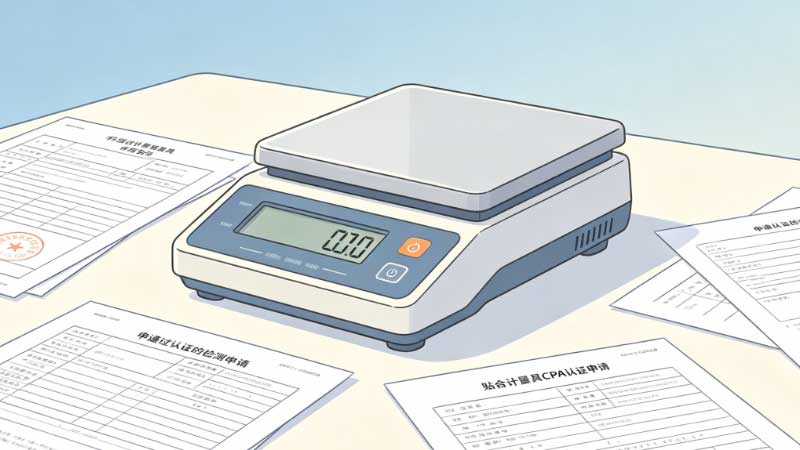
Obtaining a CPA (Pattern Approval) certificate is mandatory for foreign manufacturers of measuring instruments that fall under China's compulsory management catalogue. Yet, according to SAMR data, nearly 40% of first‑time CPA applications from overseas applicants are rejected or returned for major corrections – causing delays of 6‑12 months and significant financial losses. Understanding the top reasons for CPA application rejection can help you avoid these pitfalls and achieve first‑time approval. This guide analyzes the most common failure modes across documentation, pattern evaluation, sample submission, and administrative procedures – and provides actionable solutions.
1. Incomplete or Inconsistent Technical Documentation
Documentation errors account for over 30% of CPA rejections. Common mistakes include:
- Missing Chinese translations: All technical documents (specifications, user manuals, test reports, drawings) must be in simplified Chinese or accompanied by certified translations. Machine translations are not accepted.
- Inconsistent product specifications: The product name, model number, measurement range, accuracy class, and nominal diameter must match across the application form, technical dossier, and product labels. Even minor discrepancies (e.g., “DN50” vs “DN 50”) cause rejection.
- No applicable JJG or JJF standard referenced: The application must cite the correct verification regulation or pattern evaluation outline. Using an outdated or incorrect standard (e.g., applying JJG 162-2019 for an ultrasonic water meter that requires JJG 162-2026) invalidates the submission.
- Incomplete manufacturing or quality documentation: The dossier must include detailed production flowcharts, quality control procedures, and calibration records for the testing equipment used during development.
How to fix: Create a master document checklist based on the pattern evaluation outline for your instrument type. Hire a professional technical translator. Have a second person review all documents for consistency. Use a single source of truth for product specifications.
2. Pattern Evaluation Failures – Accuracy and Flow Range
The pattern evaluation laboratory will test sample units against the relevant JJG or JJF standard. Common failures include:
- Accuracy outside permissible error: For water meters, the error at Q₁, Q₂, Q₃ must fall within ±2% (cold water) or ±3% (hot water). Instruments that pass factory calibration but fail due to temperature sensitivity or transducer misalignment are common.
- Insufficient measurement range (Q₃/Q₁ ratio): For ultrasonic water meters, JJG 162-2026 requires Q₃/Q₁ ≥250. Meters with lower ratios fail outright.
- Pressure leakage or sealing failure: The instrument must withstand the specified test pressure without leakage. Weak seals or improper assembly cause failure.
- Environmental test failure: Instruments must pass dry heat, damp heat, vibration, and EMC tests per the applicable JJF. Many designs fail due to inadequate circuit protection or poor component selection.
How to fix: Conduct pre‑compliance testing at a CNAS‑accredited lab. Use the same test conditions (temperature, humidity, mounting orientation) as the official evaluation. Keep detailed logs of test parameters. If initial tests fail, redesign the affected components (e.g., upgrade transducers, improve sealing, add ESD protection) and retest before formal submission.
3. Battery Life Non‑Compliance (Battery‑Powered Instruments)
For battery‑operated measuring instruments – especially water meters, gas meters, and data loggers – the pattern evaluation now includes minimum battery life testing. Under JJG 162-2026, ultrasonic water meters must have a battery service life of at least 7 years. Common failures:
- Battery capacity insufficient: Using low‑capacity cells (e.g., 3.6 Ah instead of the required ≥19 Ah) leads to failure.
- High power consumption in sleep mode: Inefficient signal processing or communication modules drain the battery prematurely.
- No battery life projection report: The applicant fails to submit a theoretical battery life calculation based on current consumption profiles and cell specifications.
How to fix: Use high‑capacity industrial batteries (e.g., ER34615 with ≥19 Ah). Optimize firmware to minimize wake‑up frequency and communication power. Include a detailed battery life calculation report (based on measured current draw in active, standby, and transmission modes) with the application. Perform accelerated aging tests to validate the 7‑year claim.
4. Software and Data Logging Deficiencies
Modern measuring instruments increasingly rely on embedded software for measurement calculation, data storage, and communication. Rejections occur when:
- Data logging frequency does not meet standard: JJG 162-2026 requires at least 1 measurement per second under normal operation and 4 per second during verification. Slower sampling rates fail.
- Insufficient data retention capacity: The meter must store at least two years of daily consumption data and 24 months of monthly totals. Meters with limited memory fail.
- No power‑fail data protection: Data stored in volatile memory without battery backup is lost during battery replacement, violating the standard.
- Software version not declared or not locked: The submitted sample must have the exact firmware version that will be used in production. Any mismatch is considered a non‑conformity.
How to fix: Design the instrument with non‑volatile memory (EEPROM or flash) and ensure that the measurement frequency meets the standard. Test the data retention period by simulating daily logging over the required timeframe (use accelerated time simulation). Document the firmware version and include a software declaration in the technical dossier.
5. Unrepresentative or Modified Test Samples
Some applicants submit “golden samples” that are not representative of normal production. Rejections occur when:
- Samples are hand‑selected or specially calibrated: The pattern evaluation laboratory may detect anomalies (e.g., unusually low error variance) and reject the samples as not typical.
- Samples missing key accessories: Instruments that require external power adapters, communication modules, or mounting brackets must include them. Missing items delay testing.
- Samples not from the same batch: The submitted units must be from the same production batch to ensure consistency.
How to fix: Take samples directly from normal production runs (randomly selected). Do not perform any special calibration or tuning. Include all required accessories. Keep a sample retention batch for reference.
6. Design Changes Without Re‑application
A CPA certificate is specific to the approved product design. Any change that could affect metrological performance – such as a different transducer, altered flow path, changed battery type, or updated firmware – requires a new pattern evaluation or a supplementary approval. Common violations:
- Changing the battery brand or capacity without notifying SAMR.
- Switching to a different ultrasonic transducer supplier.
- Modifying the measurement algorithm in firmware.
How to fix: Establish a change control process. Any modification that could affect accuracy or durability must be submitted to SAMR for review. Minor changes may be approved through a “change notice” with supplementary testing; major changes require a full new CPA application.
7. Missing or Expired Local Agent Authorization
Foreign manufacturers without a legal entity in China must appoint a local agent to submit the CPA application. Rejections occur when:
- No power of attorney (POA) or expired POA.
- The agent does not have the appropriate business scope (e.g., “metrology instrument consulting”).
- The agent‘s contact information or address does not match the official registration.
How to fix: Select an agent with proven experience in CPA applications. Execute a notarized POA with a validity period covering the entire certification process. Verify the agent’s business license and ensure their details are consistent across all documents.
8. Real‑World Case: Ultrasonic Water Meter Rejected for Battery Life
A European manufacturer submitted a CPA application for an ultrasonic water meter. The product passed accuracy and flow range tests but failed the battery life requirement. The laboratory measured the quiescent current draw at 120 µA, which would drain a 3.6 V, 19 Ah battery in less than 6 years (calculated at 19 Ah / 0.00012 A / 24h / 365d ≈ 6.8 years, just below the 7‑year threshold). The manufacturer had to redesign the power management circuit, reducing sleep current to 90 µA, then resubmit samples for a partial re‑evaluation – costing 4 months and $15,000 in additional testing. Lesson: always perform battery life calculations using worst‑case current measurements and add a margin.
Pre‑Submission Checklist for CPA Success
- [ ] Product falls under compulsory management catalogue – verified.
- [ ] Application submitted to SAMR national level (not provincial).
- [ ] Technical documents complete, in Chinese, and consistent.
- [ ] Pattern evaluation outlines (JJG/JJF) correctly referenced.
- [ ] Sample units representative of normal production, all accessories included.
- [ ] For battery‑powered instruments: battery life calculation ≥ standard requirement (e.g., 7 years) with margin.
- [ ] Software version documented, data logging frequency and retention meet standards.
- [ ] IP rating and EMC test reports (if applicable) included.
- [ ] Local agent POA valid, notarized, and translated.
- [ ] Any design changes since previous submission documented and approved.
Summary: Top CPA application rejection reasons – incomplete documentation, pattern evaluation failures (accuracy, flow range, environmental tests), insufficient battery life, software/data logging non‑compliance, unrepresentative samples, unauthorized design changes, and agent errors – are all preventable with thorough preparation. By following the pre‑submission checklist, engaging CNAS‑accredited labs for pre‑testing, and working with an experienced local agent, foreign manufacturers can achieve first‑time CPA approval. Proactive compliance is the fastest path to market access for measuring instruments in China.