
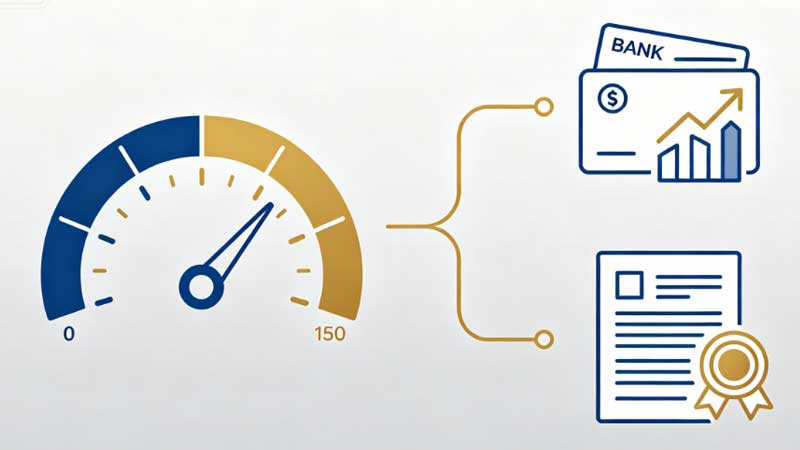
For wholly foreign‑owned enterprises (WFOEs) and other businesses in China, the company‘s credit score is not an abstract regulatory metric—it directly determines how many VAT invoices you can issue, whether a bank will open a new account for you, and how quickly you can access working capital. Under China’s Tax Payment Credit Management Measures (纳税缴费信用管理办法), effective July 1, 2025, and the cross‑enforcement of the Abnormal Operations List (经营异常名录) under SAMR, credit ratings have become the invisible license for daily financial operations. A high credit rating unlocks three months‘ worth of VAT invoices upfront and preferred bank services. A low rating or a listing on the Abnormal Operations List can freeze your ability to issue invoices, block new bank accounts, and even trigger the freezing of existing accounts. This guide explains how your company’s credit score affects bank account and invoice operations, the legal thresholds for each rating, and the practical steps to repair damaged credit.
📑 What You'll Learn
- The five‑tier tax credit rating system (A, B, M, C, D) and their meanings
- How credit rating affects VAT invoice volume and advance invoicing rights
- How credit rating affects bank account opening, loan eligibility, and existing account services
- The Abnormal Operations List (经营异常名录) and its impact on bank accounts
- Documentation and verification banks require based on credit rating
- Credit repair pathways for downgraded ratings and abnormal listings
- Practical compliance roadmap for WFOEs in 2026
1. The Five‑Tier Tax Credit Rating System (纳税缴费信用等级)
Under the Tax Payment Credit Management Measures (2025) and the Tax Credit Rating Management Measures (Trial), enterprises are evaluated annually (typically in April for the previous tax year) and assigned one of five credit ratings: A, B, M, C, or D. The rating is determined by a point‑based system, with points deducted for late filings, inaccurate tax returns, overdue payments, and other violations. The thresholds are as follows:
- A‑grade (excellent): Score ≥ 90 points. No recorded tax violations within the evaluation period. These enterprises enjoy the highest level of convenience services.
- B‑grade (good): Score between 70 and 90 points. Some minor violations have occurred but were corrected. Basic convenience services are available, with moderate invoice limits.
- M‑grade (new enterprise): Applies to new enterprises that have been registered for less than one year and have no tax‑related violations. M‑grade offers limited convenience, mainly invoice issuance rights but not the full benefits of A/B grades.
- C‑grade (caution): Score between 40 and 70 points. Multiple violations or unresolved issues. Invoice limits are tightly controlled, and many convenience services are suspended.
- D‑grade (critical): Score below 40 points, or subject to a major tax violation (tax evasion, fraud, etc.). D‑rated enterprises face the most severe restrictions across invoicing, banking, and government procurement.
For a WFOE, the tax credit rating directly affects daily operations. The rating is determined annually based on the previous tax year‘s compliance record. An enterprise that has corrected its violations may see its rating improve in the next annual evaluation, but the improvement is incremental: D to C typically requires six consecutive months of compliance after the downgrade, not an immediate jump to A.
2. How Credit Rating Affects VAT Invoice Issuance
The tax authority grants invoice issuance rights based on the enterprise’s credit rating. The key differences in invoice volume, advance invoicing, and verification requirements are as follows.
- A‑rated enterprises: May request up to three months‘ worth of VAT invoices (both special and regular) at a single time. They are eligible for advance invoicing (申领发票) without pre‑payment of estimated tax for the invoiced amount. Invoice verification is automated and expedited. A‑rated enterprises also qualify for accelerated VAT refunds for exports.
- B‑rated enterprises: May request up to two months‘ worth of VAT invoices. They enjoy advance invoicing rights but may face periodic verification checks. Invoice volumes are moderately capped based on their estimated monthly sales.
- M‑rated enterprises (new WFOEs): May request up to one month‘s worth of VAT invoices. They do not have automatic advance invoicing rights; the tax authority may require a small pre‑payment or bank guarantee for the first few months. However, the invoice issuance window is sufficient for normal start‑up operations.
- C‑rated enterprises: May request up to half a month‘s worth of VAT invoices (e.g., 15 days of estimated sales). Invoice issuance is subject to strict pre‑payment controls, meaning the enterprise may be required to pay the estimated output VAT before the invoice is released. The tax authority also requires manual review for any increase in invoice volume.
- D‑rated enterprises: Invoice issuance is effectively controlled on a tutored basis (辅导期). D‑rated enterprises are often placed in a “probation period” where the tax authority limits invoice volumes to a few days‘ worth of estimated sales and requires pre‑payment of VAT before each invoice batch. In extreme cases, the tax authority may suspend the enterprise‘s right to issue VAT invoices altogether. This suspension effectively halts the enterprise’s ability to conduct business, as customers generally require VAT invoices for payment.
For a WFOE that is downgraded to D due to a material error, the immediate operational impact is severe. Without the ability to issue VAT invoices, the enterprise cannot collect receivables from its B2B customers. This creates a cash flow crisis that may be worse than the underlying tax violation. The only way to restore invoice issuance rights is to correct the violation, pay any outstanding taxes and surcharges, and apply for credit repair to upgrade the rating.
3. How Credit Rating Affects Bank Account Operations
Credit rating directly influences a company‘s ability to open new bank accounts, maintain existing accounts, and access financial products such as working capital loans. China’s commercial banks are required to integrate the tax credit rating into their customer due diligence (CDD) processes under PBOC anti‑money laundering regulations and the joint credit risk management framework between the tax authority and banking regulators.
- A‑rated enterprises: Banks generally offer preferential services: expedited account opening (within 3‑5 working days); higher transaction limits without manual review; access to unsecured working capital loans at prime interest rates; and automated overdraft facilities. A‑rated enterprises also have faster foreign exchange remittance processing for dividends and service fee payments.
- B‑rated enterprises: Standard account opening services (5‑10 working days) with normal transaction limits. They are eligible for secured loans but may not qualify for unsecured credit lines. Foreign exchange remittance processing is standard (1‑2 days).
- M‑rated enterprises (new WFOEs): Banks treat M‑rated enterprises cautiously. Account opening is generally permitted, but the bank may impose a “probation period” of 3‑6 months during which transaction limits are low and foreign exchange remittances are manually reviewed. New WFOEs should be prepared to provide additional documentation (e.g., the parent company‘s audited financials, a detailed business plan) to satisfy the bank’s CDD requirements.
- C‑rated enterprises: Banks may refuse to open new accounts or renew existing accounts. Existing accounts may be placed under enhanced monitoring, with transaction limits reduced and foreign exchange remittance processing delayed for manual review. C‑rated enterprises may be denied any form of unsecured credit.
- D‑rated enterprises: Banks have the discretion to close existing accounts or refuse to renew them. Most banks will not open new accounts for D‑rated enterprises. The tax authority shares the D‑rating information with the People‘s Bank of China (PBOC), which notifies all commercial banks. D‑rated enterprises are automatically flagged in the anti‑money laundering system, making it extremely difficult to maintain any banking relationship. The combination of D rating and an Abnormal Operations Listing (see Section 4) makes it virtually impossible to access banking services.
For a WFOE that is downgraded to D, the immediate risk is not just the loss of invoice rights—the company may also find its bank accounts frozen or closed. Without a bank account, the enterprise cannot receive customer payments, pay suppliers, or remit dividends to its foreign parent. The practical effect is a complete shutdown of financial operations.
4. The Abnormal Operations List (经营异常名录) and Its Impact on Banking
The Abnormal Operations List is a separate credit management system administered by the State Administration for Market Regulation (SAMR). An enterprise is added to the list for various violations, including missing the annual report deadline (June 30) for two consecutive years, filing false or inaccurate information, or failing to comply with an AMR inspection order. Inclusion on the Abnormal Operations List has severe consequences for banking operations, regardless of the enterprise’s tax credit rating.
- Bank account opening: Almost all commercial banks will refuse to open a new corporate bank account for an enterprise on the Abnormal Operations List. The bank‘s automated system checks the AMR’s public database before accepting an application; a listing triggers an automatic rejection.
- Existing bank account services: Banks have the right, under anti‑money laundering regulations and internal risk policies, to restrict services for enterprises on the Abnormal Operations List. Common restrictions include: freezing of online banking access; reduction of daily transaction limits; suspension of foreign exchange remittance processing; and, in some cases, freezing the account entirely pending removal from the list.
- Loan applications: Any active loan application (including working capital lines) will be suspended or denied.
For a WFOE, the combination of a low tax credit rating (C or D) and an Abnormal Operations Listing is effectively a double blacklisting. The enterprise cannot issue VAT invoices (due to low tax rating) and cannot use its bank account (due to the AMR listing). The enterprise is financially paralyzed. The only way to restore services is to correct the underlying violation (file the overdue annual report or correct the false information) and then apply for credit repair to be removed from the Abnormal Operations List. After removal, the bank may reinstate services, but the process can take several weeks.
5. Credit Repair Pathways for Downgraded Ratings and Abnormal Listings
An enterprise with a downgraded tax credit rating (C or D) or an Abnormal Operations Listing can restore its standing through the formal credit repair process. However, the repair pathways differ depending on the agency responsible for the violation.
Tax credit rating repair (C/D upgrade to B/A): Under the Tax Credit Rating Management Measures (Trial), a D‑rated enterprise may apply to the tax authority for a rating upgrade after six consecutive months of compliance (no missed filings, no late payments, no other violations). The upgrade is not automatic; the enterprise must file a formal application with supporting documentation (proof of timely payments, corrected filings). The upgrade will be from D to C, not directly to A. An enterprise that has been subject to a major tax violation (fraud, evasion) may remain D for a longer period, even with corrected behavior. For C‑rated enterprises, the upgrade path is to B after three consecutive months of compliance.
Abnormal Operations List removal: Under the Market Supervision Credit Repair Management Measures (SAMR Decree No. 107), an enterprise may apply for removal from the Abnormal Operations List immediately after correcting the underlying violation. For a missed annual report, the enterprise must first file the overdue report online through the National Enterprise Credit Information Publicity System (NECIPS). After the report is filed, the enterprise submits a credit repair application to the local AMR. The application can be submitted online via the “Credit China” portal. The required materials include: a credit repair application form; proof that the overdue report has been filed; proof of payment of any fine (if applicable); a credit commitment letter. The AMR must review the application and make a decision within a specified period (typically 30‑60 days). After removal, the enterprise‘s status is restored to “normal,” and banks may resume normal services.
Credit repair for tax rating: The tax authority has its own credit repair application process, separate from the AMR. The enterprise must log into the local e‑Tax Bureau portal, navigate to the credit repair module, and submit the application along with evidence of corrected behavior. The tax authority will issue a decision within 30 working days. The upgraded rating takes effect from the date of the decision.
6. Practical Compliance Roadmap for WFOEs in 2026
To maintain a strong credit rating and avoid disruptions to your bank account and invoice operations, follow this step‑by‑step compliance roadmap:
- File the annual report on time (by June 30 each year): Missing the annual report deadline is the most common cause of an Abnormal Operations Listing. Set calendar reminders for March to begin gathering data (financials, employee count, paid‑in capital). File the NECIPS annual report and the Foreign‑related Annual Report (FAR) by June 15 to leave a buffer.
- Maintain accurate and timely tax filings (monthly/quarterly): For VAT, file monthly or quarterly returns on time (typically by the 15th of the following month). For CIT, file quarterly prepayments and the annual reconciliation by May 31. Even a single late filing can deduct points from your credit rating, pushing an A‑rated enterprise down to B.
- Pay all taxes, late fees, and penalties by the statutory deadlines: A missed payment of VAT or CIT triggers an automatic point deduction. If the payment is delayed by more than 3 months, the rating may be automatically downgraded to C or D. Set up automatic bank payments for recurring tax obligations.
- Monitor your tax credit rating annually (usually April): After the annual credit rating evaluation (typically in April), log into the e‑Tax Bureau portal to view your rating. If the rating has been downgraded, investigate the reason (check the point deduction log). Immediately correct any identified errors or violations.
- Check for Abnormal Operations Listing quarterly: Access the NECIPS portal (www.gsxt.gov.cn) and search for your enterprise‘s name. If you see a status of “列入经营异常名录” (included in Abnormal Operations List), investigate the reason (usually an overdue annual report or unresponded‑to AMR notice). File any overdue reports and then apply for credit repair.
- Engage a local compliance partner for complex cases: If your enterprise has been downgraded to D or placed on the Abnormal Operations List, engage a tax consultant or legal advisor to guide you through the credit repair process. The documentation requirements are strict, and errors in the application can delay resolution by months.
Summary: Your company’s credit score—comprising the tax credit rating (A/B/M/C/D) and the Abnormal Operations List status—directly determines your ability to issue VAT invoices and maintain bank accounts. A‑rated enterprises enjoy three months of advance invoicing and expedited banking services, while D‑rated enterprises face invoice controls, potential bank account closures, and a six‑month compliance period before any rating upgrade. Inclusion on the Abnormal Operations List blocks new account openings and can freeze existing accounts. Credit repair is available for both systems, but requires correcting the underlying violation and filing a formal application. By maintaining timely tax filings, paying all obligations on time, and submitting annual reports before June 30, WFOEs can preserve a high credit rating and avoid costly disruptions to their daily financial operations.