
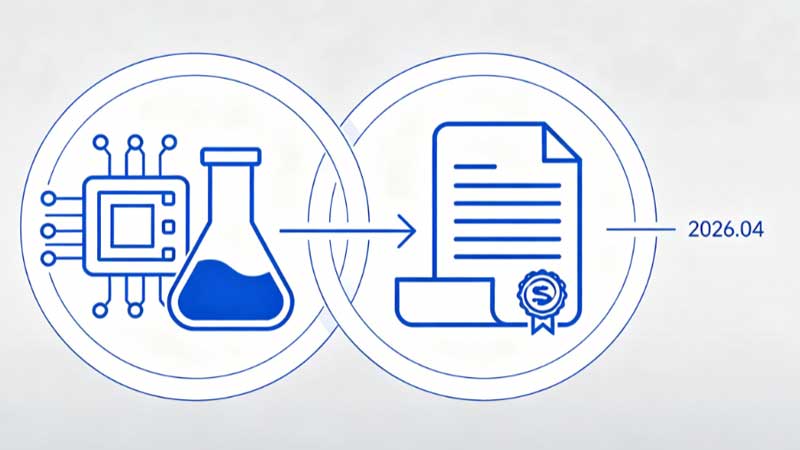
Effective April 1, 2026, China‘s Ministry of Commerce (MOFCOM) has implemented sweeping changes to the dual-use items export control regime. The revised “Catalogue of Dual-Use Items and Technologies Subject to Export Control” now includes advanced semiconductors (below 14nm process technology), artificial intelligence technologies (specifically those used for surveillance, autonomous systems, and high‑performance computing), quantum computing components, and certain additive manufacturing equipment. For foreign companies exporting these items from China, or for Chinese companies exporting to foreign entities, obtaining a dual-use export license is now mandatory. This guide explains the expanded scope, the new end-user certificate requirements, the application process, and practical steps for compliance.
📑 What You'll Learn
- Expanded controlled items: advanced semiconductors, AI technologies, quantum computing
- New end-user certificate (EUC) requirements – what foreign applicants must provide
- Step‑by‑step dual-use export license application process
- License processing timeline and fees (2026 rates)
- Penalties for non‑compliance – fines, blacklisting, and criminal liability
- Practical compliance roadmap for exporters
1. Expanded Controlled Items: Advanced Semiconductors, AI Technologies, Quantum Computing
The 2026 revision of the dual-use items catalogue (MOFCOM and GAC Announcement No. 12 of 2025, effective April 1, 2026) adds several critical technology categories that were previously not subject to export licensing. The key additions include:
- Advanced semiconductors: Integrated circuits manufactured using process nodes below 14nm (including 10nm, 7nm, 5nm, and 3nm technologies). Also covered are semiconductor manufacturing equipment capable of producing such chips (e.g., extreme ultraviolet lithography systems, etching equipment, deposition tools).
- AI technologies: Specifically, AI algorithms and software designed for surveillance systems (facial recognition, behavior analysis, mass data monitoring), autonomous control systems (unmanned vehicles, drones, robotics), and high‑performance computing clusters (systems capable of delivering more than 100 double-precision petaflops).
- Quantum computing components: Qubit devices, quantum control systems, and quantum random number generators.
- Additive manufacturing equipment: Metal 3D printers capable of producing complex aerospace or defense components, and associated software.
- High‑performance computing components: Graphics processing units (GPUs) with double-precision performance exceeding 10 teraflops, and high-bandwidth memory (HBM) used in AI training systems.
These items are now subject to export controls regardless of destination, with the most stringent licensing requirements applying to exports to countries or entities identified as posing a national security risk (as determined by MOFCOM on a case‑by‑case basis).
2. New End-User Certificate (EUC) Requirements – What Foreign Applicants Must Provide
For exports of controlled dual-use items, the exporter (or the foreign importer, depending on the arrangement) must submit a notarized and legalized End-User Certificate (最终用户证明) to MOFCOM. The 2026 rules have significantly tightened the EUC requirements:
- Mandatory notarization and legalization (or apostille): The EUC must be signed by the foreign end‑user’s legal representative, notarized in the end‑user‘s home country, and legalized (or apostilled for Hague Convention members). Machine‑generated or electronic signatures are not accepted; original wet signatures are required.
- Detailed end‑use declaration: The EUC must specify the exact purpose of the controlled items (e.g., “use in AI training for medical imaging research” rather than generic “R&D”). Vague statements are rejected.
- Prohibition on re‑export without consent: The EUC must include a clause prohibiting the re‑export, transfer, or resale of the controlled items to any third party without prior written approval from MOFCOM.
- Annual reporting obligation: For multi‑year projects or repeated exports, the end‑user must submit an annual report confirming continued compliance with the terms of the EUC. Failure to file results in automatic suspension of future licenses.
- Country‑specific restrictions: For end‑users in certain countries (as identified by MOFCOM’s restricted party list), additional certifications may be required, including a site inspection by a Chinese-designated agent.
For foreign companies that are the intended end‑users of controlled Chinese dual-use items, it is imperative to engage a local legal advisor to prepare the EUC correctly. Errors or omissions are the most common cause of license application rejections.
3. Step‑by‑Step Dual-Use Export License Application Process
The dual-use export license application is submitted to MOFCOM through the online “Export Control License Application System” (https://exportcontrol.mofcom.gov.cn). The process for a standard transaction involves the following steps:
- Determine if the item is controlled. Check the 2026 dual-use items catalogue (available on the MOFCOM website). If the item is not listed, no license is required. If listed, proceed with the application.
- Prepare the application documents. The required documents include:
- Completed export license application form (online).
- Detailed product/technology description and specifications.
- End-User Certificate (EUC) as described in Section 2.
- End-Use Statement (详细最终用途说明) describing the intended application.
- Sales contract or agreement with the foreign importer.
- Importer‘s business license or certificate of incorporation (notarized copy).
- For deemed exports: an internal technology control plan and the foreign national’s employment contract.
- Submit the application online. The exporter logs into the MOFCOM portal, fills in the electronic form, uploads the documents, and pays the application fee (RMB 500 per license).
- MOFCOM review and inter-agency consultation. MOFCOM reviews the application within 20 working days for standard cases. For sensitive destinations or high‑risk items, MOFCOM may consult with the Ministry of State Security, the Ministry of Industry and Information Technology, and the People‘s Liberation Army. Such reviews can take 40‑60 working days.
- License issuance or rejection. If approved, MOFCOM issues an electronic export license, valid for 6 months (renewable once). The exporter must present the license number to customs when filing the export declaration.
- Post‑export reporting. Within 30 days of the export, the exporter must submit a customs clearance confirmation to MOFCOM. For multi‑use licenses (covering multiple shipments), a summary report is due quarterly.
Expedited processing is available for urgent cases (e.g., time‑sensitive medical equipment) upon payment of an additional fee (RMB 2,000) and submission of a justification letter, reducing the review period to 5‑10 working days.
4. License Processing Timeline and Fees (2026 Rates)
The official fee structure and processing times under the 2026 rules are as follows:
- Standard application fee: RMB 500 per license. This covers review of up to 10 product lines; additional product lines incur RMB 100 each.
- Standard processing time: 15‑20 working days for non‑sensitive items and destinations. 40‑60 working days for sensitive items (e.g., advanced semiconductors, AI) or if inter‑agency consultation is required.
- Expedited processing: Additional RMB 2,000; processing time reduced to 5‑10 working days (available only for non‑sensitive items or urgent medical/humanitarian purposes).
- License validity: 6 months from the date of issuance, renewable once for an additional 6 months (RMB 200 renewal fee).
- Annual compliance filing: For ongoing projects (e.g., long‑term technology transfer agreements), an annual compliance report must be filed (no fee, but mandatory).
MOFCOM has not published a cap on the number of licenses per exporter, but frequent applicants may be subject to enhanced compliance reviews. Foreign companies are advised to appoint a local customs broker or trade compliance consultant to manage the license application and renewal process.
5. Penalties for Non‑Compliance – Fines, Blacklisting, and Criminal Liability
Violations of the dual-use export control regulations carry severe penalties, which have been increased in the 2026 rules:
- Administrative fines: Exporting controlled items without a license, or violating the terms of a license, can result in fines of RMB 500,000 to RMB 5 million (or 3 to 5 times the value of the exported goods). The exporter may also be required to retrieve the exported items at its own cost.
- Blacklisting: The exporter and its legal representative may be added to MOFCOM‘s “Untrustworthy Entity List.” Blacklisted entities are prohibited from engaging in any export activities for a period of 1 to 5 years, and may be barred from government procurement and other business activities.
- Cancellation of export licenses: For companies that repeatedly violate the rules, MOFCOM may revoke all existing export licenses and deny future applications indefinitely.
- Criminal liability: For intentional export of controlled items to sanctioned entities or for military end‑uses without authorization, individuals may face criminal prosecution under China’s Export Control Law and Criminal Code, with penalties including imprisonment of up to 10 years and confiscation of assets.
Foreign companies should also note that China shares export control violation data with partner countries under mutual legal assistance treaties. A violation in China could affect the company‘s export privileges elsewhere.
6. Practical Compliance Roadmap for Exporters
To ensure compliance with the new dual-use export control rules, foreign companies operating in China (including WFOEs) should adopt the following six‑step roadmap:
- Conduct a product and technology classification review (Immediate). Review all products, technologies, and software developed or manufactured in China against the 2026 dual-use items catalogue. Pay special attention to semiconductors below 14nm, AI algorithms, quantum components, and high‑performance computing hardware.
- Establish an internal export control compliance program. Designate a compliance officer responsible for classifying items, screening end‑users, and maintaining records. For deemed exports (technology transfers to foreign nationals), implement an internal technology control plan that restricts access to controlled technologies.
- Screen end‑users against restricted party lists. Before exporting any controlled items or sharing technology with foreign nationals, screen the end‑user against MOFCOM’s restricted party list, the UN sanctions list, and any other applicable lists. Maintain records of the screening results.
- Prepare end-user certificates and end-use statements in advance. For anticipated exports, draft the EUC and end-use statement with the cooperation of the foreign importer. Allow time for notarization and legalization (typically 2‑4 weeks).
- File license applications early. For controlled items, file the license application at least 60 days before the planned export date to allow for potential delays, especially for sensitive items that require inter‑agency consultation.
- Maintain records for at least 5 years. Retain all license applications, approvals, end-user certificates, and shipping documents. MOFCOM has the right to audit licensees at any time.
For foreign companies that are importers of Chinese dual-use items (rather than exporters), the same compliance expectations apply. You are responsible for providing accurate EUCs and ensuring that re‑exports are prohibited without MOFCOM approval.
Summary: Effective April 1, 2026, China‘s dual-use export control rules now cover advanced semiconductors (below 14nm), AI technologies, quantum computing components, and high‑performance computing hardware. Exporters must obtain a license from MOFCOM before shipping controlled items from China or transferring controlled technology to foreign nationals within China. The application requires a notarized and legalized End-User Certificate, a detailed end‑use statement, and supporting documents. Standard processing takes 15‑20 working days; sensitive items may take 40‑60 days due to inter‑agency consultation. Penalties for non‑compliance include fines up to RMB 5 million, blacklisting, and criminal liability. Exporters should conduct a product classification review, establish an internal compliance program, screen end‑users, prepare EUCs in advance, file applications early, and retain records for 5 years. By following the practical roadmap, companies can navigate the expanded controls and avoid severe penalties.