
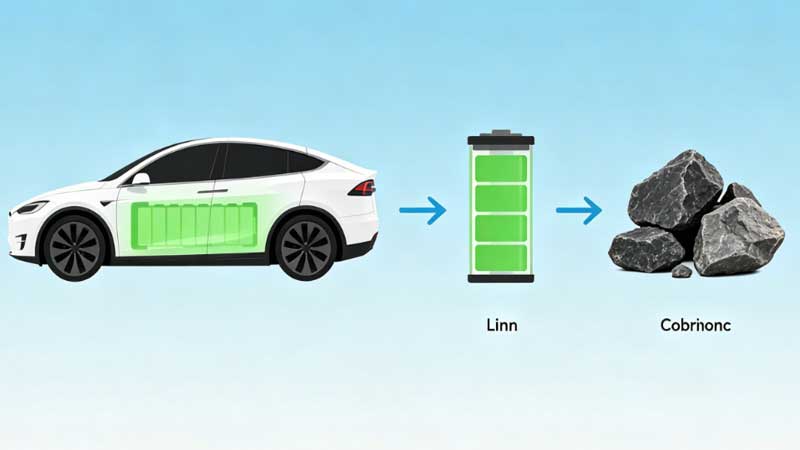
China's dominance in electric vehicle production rests on a foundation that is, paradoxically, dependent on imported raw materials. The country produces approximately 70% of the world's EV batteries but mines less than 15% of the lithium, less than 2% of the cobalt, and a minority share of the nickel that those batteries require. This structural dependence on imported battery raw materials has created a strategic vulnerability that China's trade policy is now directly addressing. The 2026 China tariff schedule includes a landmark adjustment: import duties on lithium, cobalt, and nickel raw materials have been reduced to zero. This is not a temporary suspension or a selective exemption. It is a comprehensive elimination of import duties across the spectrum of battery-grade raw materials—lithium carbonate and hydroxide, cobalt sulfate and oxide, nickel sulfate and intermediate products, and related precursor materials. For battery manufacturers importing these materials, the duty elimination translates directly into reduced input costs, improved margins, and enhanced competitiveness in both domestic and export markets. This guide analyzes the specific tariff changes, the products and HS codes affected, the policy rationale driving the adjustment, and the financial implications for businesses in the EV battery supply chain.
📑 What You'll Learn
- The specific tariff changes: affected HS codes and previous rates
- Policy rationale: why China is eliminating battery material duties
- Financial impact for battery manufacturers and supply chain implications
- Compliance requirements for claiming zero-duty treatment
- Strategic opportunities beyond immediate cost savings
1. The Specific Tariff Changes: Affected Products and HS Codes
The zero tariff on battery raw materials is implemented through the 2026 customs tariff schedule, which adjusts the Most Favored Nation duty rates for the specified products to zero percent. The change applies to imports from all WTO member countries, not merely from free trade agreement partners. This is a unilateral MFN rate reduction, not a preferential rate under an FTA—meaning that importers do not need certificates of origin or other FTA documentation to claim the zero rate. The zero rate applies automatically to all qualifying imports regardless of origin.
The affected product categories span the full range of battery-grade raw materials. Lithium products affected include lithium carbonate, classified under HS heading 2836.91, which previously carried an MFN duty rate of 5% and is now reduced to 0%. Lithium hydroxide, classified under HS heading 2825.20, previously at 5.5%, is now at 0%. Both products are essential precursors for lithium-ion battery cathode materials and represent the largest-volume battery raw material imports by Chinese manufacturers.
Cobalt products receiving zero-duty treatment include cobalt oxides and hydroxides under HS heading 2822.00, cobalt sulfates under HS heading 2833.29, and cobalt intermediates including cobalt hydroxide cake under various headings. Previous duty rates on these products ranged from 3% to 5.5%. Cobalt is a critical component of high-energy-density battery cathodes, and China's domestic cobalt mining output is negligible relative to its battery manufacturing demand—making imported cobalt essentially irreplaceable for Chinese battery production.
Nickel products affected include nickel sulfate under HS heading 2833.24, nickel oxides and hydroxides, and nickel mattes and intermediate products used as feedstocks for battery-grade nickel chemical production. Previous duty rates ranged from 2% to 5%. Nickel is increasingly important in EV battery chemistries as manufacturers shift toward higher-nickel cathode formulations that increase energy density and reduce cobalt content.
The tariff elimination also extends to certain precursor and intermediate materials used in battery material production, and to specific graphite products used in battery anodes. The full list of affected HS codes spans approximately 30 commodity classifications at the 8-digit and 10-digit levels. Importers should verify the specific HS classifications for their imported materials against the updated tariff schedule to confirm zero-duty eligibility.
2. Policy Rationale: Why China Is Eliminating Battery Material Duties
The EV battery raw material tariff elimination is not an isolated trade policy adjustment. It is a strategic intervention within China's broader industrial policy framework supporting electric vehicle industry development. Understanding the policy rationale helps battery manufacturers anticipate future regulatory developments and align their sourcing strategies with China's long-term industrial objectives.
The primary policy driver is supply chain security. China's EV battery industry produces over 500 GWh of battery capacity annually and is expanding rapidly to meet both domestic EV demand and growing export markets. This production capacity requires enormous volumes of lithium, cobalt, and nickel raw materials that domestic mining cannot supply. China's lithium mines, primarily located in Qinghai, Sichuan, and Jiangxi provinces, produce only a fraction of the lithium chemicals consumed by the battery industry. The country's cobalt resources are negligible. Nickel production, while larger, is insufficient to meet battery-grade demand at current and projected consumption levels. Eliminating import duties on these materials reduces the cost of securing the imported inputs essential to battery production.
A second policy driver is cost competitiveness in export markets. Chinese battery manufacturers compete globally with producers in Korea, Japan, and emerging production centers in Europe and North America. Raw material costs represent a substantial portion of total battery production cost—typically 40% to 60% depending on battery chemistry. Eliminating duties on imported raw materials reduces input costs for Chinese manufacturers, improving their cost competitiveness in export markets where they compete against producers who may have access to domestically sourced materials or different duty structures.
A third driver is the encouragement of upstream processing investment within China. While the raw materials themselves are imported, the processing of lithium concentrates into battery-grade lithium carbonate and hydroxide, the refining of cobalt intermediates into cobalt chemicals, and the production of nickel sulfate from intermediate feedstocks are value-added processes that China has encouraged to locate domestically. The zero-duty policy on raw material inputs, combined with China's established processing infrastructure and technology, creates incentives for these processing activities to remain in or relocate to China rather than being conducted in raw material source countries.
A fourth driver is alignment with carbon neutrality objectives. The EV industry is central to China's strategy for reducing transportation sector carbon emissions. Reducing the cost of battery production through duty elimination lowers EV costs for consumers, supporting the domestic EV adoption that is essential to China's carbon reduction commitments. The policy thus serves both industrial and environmental objectives.
3. Financial Impact for Battery Manufacturers
The zero tariff battery materials policy translates directly into reduced input costs for battery manufacturers. The financial impact can be calculated with reasonable precision based on import volumes, previous duty rates, and raw material price levels. For manufacturers importing significant volumes of battery raw materials, the annual savings are substantial.
Consider a mid-sized battery cathode material producer importing 5,000 metric tons of lithium carbonate annually. At current lithium carbonate prices of approximately RMB 120,000 per metric ton, the annual import value is approximately RMB 600 million. The previous 5% import duty added RMB 30 million to the annual raw material cost. Under the zero-duty policy, this cost is eliminated—a direct RMB 30 million annual saving that flows to the manufacturer's bottom line or can be invested in price competitiveness.
For a larger integrated battery manufacturer importing lithium, cobalt, and nickel materials across the full battery raw material spectrum, the savings are correspondingly larger. A manufacturer importing 10,000 tons of lithium chemicals, 3,000 tons of cobalt chemicals, and 5,000 tons of nickel chemicals annually, with previous weighted-average duty rates of approximately 4.5% across the materials portfolio, would save approximately RMB 50-80 million annually depending on prevailing raw material prices. At the industry level, with China importing millions of tons of battery raw materials annually, the aggregate duty savings to the battery industry are measured in billions of RMB.
The savings extend beyond direct duty elimination. Importers previously had to finance the duty payment at the time of import, tying up working capital that could otherwise be deployed in operations or investment. The elimination of duty payment improves cash flow by reducing the upfront capital required for each import transaction. Importers also benefit from simplified customs documentation—without duty calculation and payment, the customs clearance process is marginally faster and administratively simpler, though the primary benefit remains the duty savings themselves.
The impact on battery costs and, ultimately, EV prices should not be overstated—raw material duties were a relatively small component of total battery cost, and the duty elimination does not address the far larger factor of raw material price volatility driven by global supply and demand. However, in an industry where manufacturers operate on thin margins and compete on cost, the elimination of a 3-5.5% duty on major input materials is a meaningful competitive advantage for Chinese manufacturers relative to competitors in jurisdictions without similar duty relief.
4. Compliance Requirements and Implementation
While the lithium cobalt nickel duty free policy applies automatically to qualifying imports, battery manufacturers must ensure that their import operations are properly configured to claim the zero rate and that their compliance documentation supports the classification of imported materials under the affected HS codes.
The first compliance requirement is correct HS classification. The zero-duty rate applies to specific HS codes identified in the tariff schedule. If imported materials are classified under an HS code not covered by the duty elimination, the zero rate will not apply even if the materials are functionally battery-grade raw materials. Manufacturers should review their current HS classifications for all imported battery raw materials to confirm alignment with the codes specified in the tariff adjustment. Where classification is ambiguous—for example, where an intermediate product could be classified under multiple headings—professional classification analysis should be obtained to support classification under the zero-duty code.
The second requirement is customs declaration accuracy. Import declarations must correctly identify the applicable HS code and claim the corresponding duty rate. The customs broker filing declarations on behalf of the importer must be instructed to apply the zero-duty rates for qualifying products. Importers should verify that their brokers have updated their systems and rate tables to reflect the 2026 tariff schedule changes. A declaration that continues to apply the previous duty rate because the broker's systems were not updated will result in overpaid duties—a financial loss that is the importer's responsibility.
The third requirement is documentation supporting the material specifications. While the zero-duty rate does not require FTA certificates of origin, customs may request documentation establishing that the imported materials match the description of the HS classification claimed. This includes product specifications, certificates of analysis, material safety data sheets, and commercial documentation describing the product's chemical composition and grade. Maintaining organized, accessible documentation for each import transaction supports compliance and facilitates response to any customs inquiries.
The fourth requirement is post-clearance reconciliation. Importers should reconcile customs declarations against the tariff schedule to confirm that zero rates were correctly applied. Any discrepancies—shipments where the previous duty rate was charged despite the zero-rate adjustment—should be identified and addressed through customs communication or amended declaration procedures. Proactive reconciliation prevents the accumulation of overpaid duties across multiple shipments.
5. Strategic Opportunities Beyond Cost Savings
The EV battery supply chain duty reduction creates strategic opportunities for battery manufacturers beyond the immediate input cost savings. Forward-thinking manufacturers can leverage the duty elimination to strengthen their competitive position and supply chain resilience.
- Supply chain diversification. The zero-duty policy applies to imports from all origins, not merely from established supplier countries. This creates an opportunity to diversify raw material sourcing to new supplier countries that may offer competitive pricing or supply security advantages. Manufacturers can evaluate sourcing options without duty rate differentials affecting the cost comparison between origins.
- Inventory and working capital optimization. With reduced import costs, manufacturers may adjust inventory strategies—potentially increasing raw material inventory levels to buffer against supply disruptions or price volatility, knowing that the duty cost previously associated with holding imported inventory has been eliminated. Improved working capital from eliminated duty payments can be redeployed to other operational needs.
- Contract renegotiation with raw material suppliers. The duty elimination changes the total landed cost calculation for imported materials. Manufacturers with long-term supply contracts that reference duty-inclusive pricing should review contract terms and, where appropriate, negotiate adjustments reflecting the changed duty treatment. Suppliers may resist price adjustments, but manufacturers should ensure that the benefit of duty elimination accrues to them as the importing party rather than being captured by suppliers through unchanged pricing.
- Downstream pricing and market positioning. The cost savings from duty elimination can be deployed strategically—retained as margin improvement, invested in R&D or capacity expansion, or passed through to customers as price reductions to gain market share. The strategic choice depends on the manufacturer's competitive position, market dynamics, and growth objectives. Manufacturers should make this choice deliberately rather than allowing the savings to be absorbed without strategic direction.
The 2026 zero tariff on battery raw materials represents a significant policy intervention supporting China's EV battery industry. For battery manufacturers, the duty elimination provides immediate cost savings, improved cash flow, and strategic flexibility. Manufacturers who proactively manage the compliance requirements, verify correct HS classification, and strategically deploy the resulting cost advantages will capture the full value of the policy change.
Summary: The 2026 China tariff schedule eliminates import duties on lithium, cobalt, and nickel raw materials, reducing rates to zero percent across approximately 30 HS codes covering battery-grade lithium carbonate and hydroxide, cobalt oxides and sulfates, nickel sulfate and intermediates, and related precursor materials. Previous duty rates of 2% to 5.5% are eliminated under unilateral MFN treatment, requiring no FTA documentation—the zero rate applies automatically to imports from all WTO member countries. The policy serves four strategic objectives: securing imported raw material supply for an industry structurally dependent on foreign resources, improving global cost competitiveness of Chinese battery manufacturers, encouraging domestic value-added processing of imported materials, and supporting EV adoption as part of carbon neutrality goals. Financial impact is substantial: a mid-sized cathode producer importing 5,000 tons of lithium carbonate annually saves approximately RMB 30 million; larger integrated manufacturers save RMB 50-80 million annually; industry-wide savings are measured in billions of RMB. Compliance requirements include verifying HS classification under the specified zero-duty codes, updating customs broker rate tables for 2026, maintaining documentation supporting material specifications, and conducting post-clearance reconciliation. Strategic opportunities beyond cost savings include supply chain diversification across origins, inventory optimization, supplier contract renegotiation, and deliberate deployment of savings toward margin improvement, R&D investment, or market share expansion. The EV battery raw material tariff elimination represents a significant policy intervention that battery manufacturers should leverage proactively to strengthen their competitive position.