
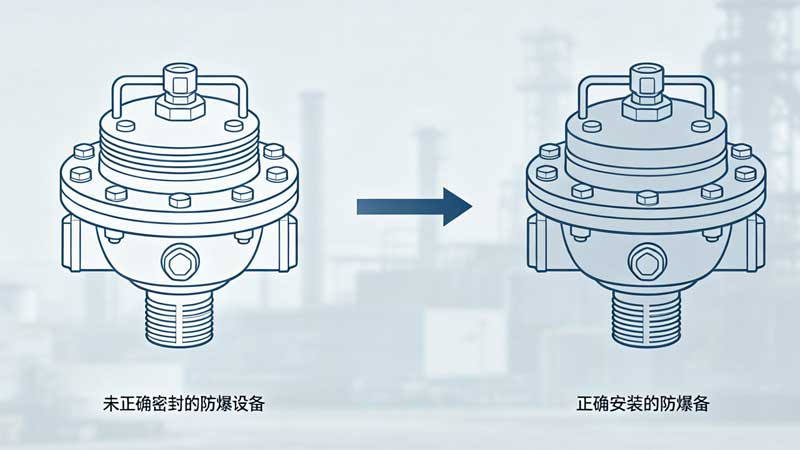
Applying for CNEx (China National Ex Certification, also known as CCC Ex) is a rigorous process. Even with the 2026 harmonization of GB/T 3836 with IEC 60079, a significant number of applications from foreign manufacturers are delayed or rejected due to preventable mistakes. According to CQC data, over 30% of first‑time CNEx applications require corrective actions, adding 2‑4 months to the approval timeline. Understanding the most common Ex‑proof application mistakes can help you avoid costly delays and achieve first‑time certification. This guide covers the top errors observed by certification bodies and testing labs, plus practical strategies to prevent them.
1. Submitting Outdated IECEx Test Reports
The 2026 CNEx standards require that any IECEx report used as evidence must be based on IEC 60079 editions 7.0 or later (published after 2020). Common mistakes:
- Submitting an IECEx report based on IEC 60079-0:2017 or older. These reports are not accepted, even if the certificate is still valid.
- Assuming that a recent IECEx certificate automatically uses the latest standards – some labs still issue certificates under older editions.
- Not requesting the “full test report” (long form) from the IECEx lab. The summary certificate alone is insufficient for CNEx gap analysis.
How to avoid: Before starting, verify that your IECEx report explicitly references IEC 60079-0:2023 (or later) and the relevant part standards. Request the complete test dossier – including raw data, setup photos, and calibration certificates – from your original ExTL. If your product is certified to an older edition, budget time and cost to upgrade to the latest IEC standards before applying for CNEx.
2. Missing China‑Specific Tests (Fungus, Altitude, Seal Aging)
Even with harmonized standards, several China‑unique tests remain. These are often overlooked:
- Fungus resistance (GB/T 2423.16): Required for equipment used in humid or tropical environments – essentially all of southern China. The 28‑day mold growth test is not part of IECEx.
- Altitude derating: If your product may be used above 2,000 meters, creepage and clearance distances must be multiplied by 1.1 to 1.3. Many applicants fail to declare maximum altitude, leading to automatic application of the derating factor (which may cause failure).
- Seal aging (elastomer compatibility): O‑rings and gaskets must undergo accelerated aging at 100°C for 7 days followed by a leakage test. IECEx labs typically do not perform this.
How to avoid: Include these tests proactively in your delta test plan. Work with your CNEx lab to confirm which of these apply based on your intended installation locations. Budget an extra $3,000‑$6,000 and 3‑4 weeks for these additional tests.
3. Incomplete or Poorly Translated Documentation
Documentation errors are a leading cause of CNEx application delays. Common issues:
- Machine‑translated manuals and labels: Chinese authorities reject translations from Google Translate, DeepL, or similar. Technical terms (e.g., “flameproof enclosure,” “intrinsic safety”) are often mistranslated.
- Missing Chinese warnings: Required warnings like “严禁带电开盖” (Do not open while energized) must appear on the product or packaging. Many foreign manufacturers omit them.
- Inconsistent model numbers: The product model number on the application form, label, test report, and user manual must be identical. Even a space or hyphen difference causes rejection.
- Incomplete technical drawings: Dimensional drawings must include all critical dimensions (creepage, clearance, wall thickness for flameproof joints). Missing dimensions force the lab to request supplements.
How to avoid: Use a certified technical translation service with experience in Ex equipment. Provide a glossary of key terms to ensure consistency. Create a master data sheet for model numbers and use copy‑paste across all documents. Have a second engineer review all drawings before submission.
4. Failure to Appoint a Qualified Local Agent
Foreign manufacturers cannot hold a CNEx certificate directly; a local legal entity (agent) must act as the certificate holder. Common mistakes:
- No agent appointed at the time of application – the submission cannot proceed.
- Choosing an agent without experience in Ex equipment – some general compliance agents do not understand explosion‑proof requirements, leading to incorrect filings.
- Missing or expired power of attorney (POA) – the POA must be notarized, translated into Chinese, and valid for the duration of the application.
- Agent’s business license does not cover “explosion‑protected equipment” – some agents have restricted business scopes.
How to avoid: Select an agent with a track record in CNEx/CCC Ex certification. Verify that their business license includes the relevant scope. Prepare a notarized POA (original copy) well in advance. Keep contact details of the agent’s responsible person for the application.
5. Ignoring the Factory Inspection Requirement
Even if your product passes all tests, CNEx requires an initial factory inspection (and annual follow‑ups). Common pitfalls:
- Assuming remote inspection is always allowed – for Ex equipment, on‑site inspection is often required, especially for flameproof “d” and intrinsic safety “i” categories. Remote inspection is only permitted for low‑risk products.
- Incomplete quality records – inspectors require 12‑24 months of production records (incoming inspection, in‑process checks, final test logs). Many foreign factories lack organized records.
- Untrained personnel – staff responsible for Ex assembly (e.g., flameproof joint assembly, potting) must have documented training. Missing training records are a frequent non‑conformity.
- No traceability system – CNEx requires that each certified product can be traced to its batch and components. Lack of serial numbers or batch coding is a major gap.
How to avoid: Conduct an internal mock audit using the CNEx factory inspection checklist (available from your certification body). Train all relevant staff and maintain digital or paper training logs. Implement a traceability system (e.g., serialized labels, batch codes) before the inspection.
6. Mismatch Between Certified Product and Production Version
Many manufacturers submit “golden samples” that are not representative of regular production. Common issues:
- Hand‑selected components – using specially sourced or hand‑tuned parts (e.g., precision‑ground flameproof joints) that are not used in mass production.
- Different material suppliers – the production version uses a different brand of plastic or metal that has not been tested.
- Unapproved component changes – substituting a certified component (e.g., a different brand of cable gland) without notifying the lab.
How to avoid: Take test samples directly from normal production runs (randomly selected). Document all component suppliers in the bill of materials. Any change after certification must be submitted as a “variation application” with delta testing.
7. Missing or Incorrect Nameplate and Markings
The product nameplate is a legal document. Common errors:
- Missing CNEx certificate number – the nameplate must show the certificate number once issued. For the application, a placeholder is acceptable, but the final product must have it.
- Incorrect Ex marking format – e.g., “Ex d IIC T4 Gb” must be exactly as specified in the standard. Missing spaces or incorrect protection levels cause rejection.
- No Chinese warnings – as mentioned, required warnings must be in simplified Chinese and permanently affixed (engraved, embossed, or high‑quality label).
- Rating missing or inconsistent with test report – voltage, current, power, ambient temperature range must match the report.
How to avoid: Have the nameplate design reviewed by your CNEx lab or agent before production. Use laser engraving or metal labels with permanent adhesive. Keep a proof of the nameplate in your documentation package.
8. Failing to Plan for Annual Follow‑Up Audits
Even after certification, many manufacturers neglect ongoing compliance. Common mistakes:
- Missing the annual inspection deadline – certificates expire if the annual audit is not completed within 12 months of the previous one.
- No process for notifying changes – when a component supplier changes or a minor design modification is made, the manufacturer fails to notify the certification body.
- Lack of record retention – quality records must be kept for at least 5 years. Lost records can lead to certificate suspension.
How to avoid: Set calendar reminders for annual audits 3 months in advance. Establish a formal change control procedure that requires notification to your CNEx agent. Digitize quality records and back them up.
Practical Pre‑Submission Checklist for CNEx Success
To avoid the mistakes above, use this checklist before submitting your CNEx application:
- [ ] IECEx report based on IEC 60079:2023 editions (check dates).
- [ ] Full test report (raw data, photos, calibrations) obtained.
- [ ] Delta tests completed for fungus, altitude, seal aging (if applicable).
- [ ] All documents translated into Chinese by certified translator.
- [ ] Nameplate design approved, including Chinese warnings and correct Ex mark.
- [ ] Local agent appointed, POA notarized and translated.
- [ ] Factory inspection ready: records, training logs, traceability system.
- [ ] Samples taken from normal production, not specially prepared.
Summary: Common Ex‑proof application mistakes – outdated IECEx reports, missing China‑specific tests, poor translations, no local agent, factory inspection gaps, golden samples, nameplate errors, and neglected follow‑ups – can all be avoided with careful preparation. By following the checklist and working with an experienced CNEx agent, foreign manufacturers can achieve first‑time approval, saving months of delays and significant costs. Start your application right – every mistake prevented is weeks of time saved.