
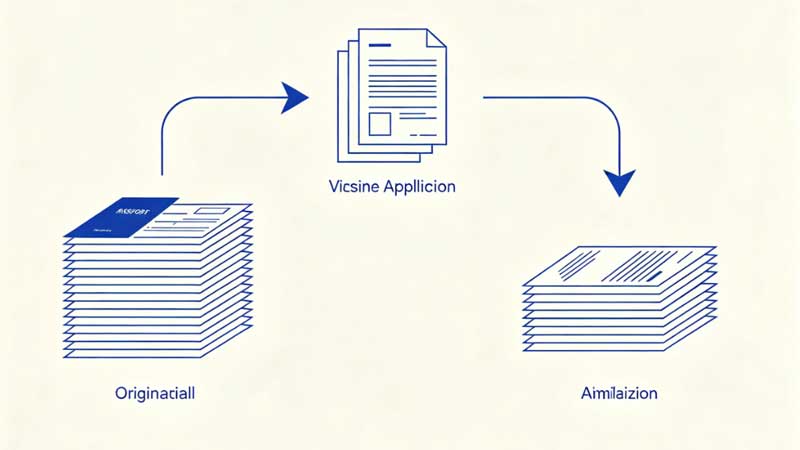
The National Immigration Administration (NIA) has released simplified regulations for family visa (S1/S2) applications, effective January 1, 2026. The new rules significantly reduce documentation requirements for spouses and children of foreign residents and Chinese citizens in China. Marriage certificates and birth certificates from certain nationalities no longer require full notarization, legalization, or apostille – a simple copy with a sworn translation may suffice. For other nationalities, the authentication process has been streamlined, reducing processing time from 4‑6 weeks to 2‑3 weeks. This guide explains the new documentation requirements, eligible nationalities, application process, and practical steps for family members.
1. Visa Types – S1 (Long-Term) vs. S2 (Short-Term)
China offers two family visa categories:
- S1 visa (长期私人事务类签证): For family members (spouse, children, parents) of foreign residents holding work or residence permits in China (valid for 180 days to 5 years). Allows multiple entries and stays longer than 180 days.
- S2 visa (短期私人事务类签证): For family members (spouse, children, parents) visiting for short periods (up to 180 days). Single, double, or multiple entries available.
The 2026 simplifications apply to both S1 and S2 applications, with S1 applicants benefiting from reduced documentation for long‑term stays.
2. Reduced Documentation – Marriage & Birth Certificates
The most significant change is the reduction in authentication requirements for marriage and birth certificates:
- For nationals of visa‑waiver countries and certain other nationalities (e.g., Japan, South Korea, Singapore, UAE, Qatar, Serbia, Bosnia, Albania): Marriage certificates and birth certificates no longer require notarization, legalization, or apostille. A simple copy of the original certificate, plus a sworn translation into Chinese, is sufficient.
- For nationals of Hague Apostille Convention member countries (except those listed above): Marriage and birth certificates require only apostille (no consular legalization). Apostille processing time: 2‑3 weeks.
- For nationals of non‑Hague countries (e.g., Vietnam, Thailand, India, South Africa): Full consular legalization still required (notarization + embassy legalization). However, the process has been streamlined with an online appointment system, reducing processing time from 6‑8 weeks to 4‑5 weeks.
- For all nationalities: Sworn Chinese translation still required (from certified translation agency).
For spouses and children from eligible nationalities, the simplified documentation reduces preparation time from 4‑6 weeks to 1‑2 weeks.
3. Other Required Documents – Still Mandatory
Beyond marriage and birth certificates, the following documents remain mandatory (but with streamlined verification):
- Invitation letter from sponsor in China: The sponsor (foreign resident or Chinese citizen) must provide a letter of invitation, including the sponsor‘s relationship to the applicant, intended stay duration, and accommodation details. The letter can be scanned and emailed – no original required.
- Sponsor‘s residence permit or ID card copy: For foreign sponsors: copy of work permit or residence permit. For Chinese citizen sponsors: copy of national ID card. No notarization required.
- Police clearance certificate (from applicant’s home country): Required for S1 applicants (long‑term stay). For nationals of visa‑waiver countries, a simple copy (no apostille) is accepted. For others, apostille or legalization required. Police clearance must be issued within 6 months of application.
- Health check certificate: Required for S1 applicants (long‑term stay). For applicants from Japan, South Korea, Singapore, and EU countries, a health check from an accredited hospital in the home country is accepted. For others, health check must be performed at a designated Chinese hospital after arrival.
- Passport (valid for at least 6 months) with blank visa pages.
- Visa application form (online).
The reduced documentation does not eliminate these requirements but simplifies the authentication process.
4. Application Process – Step by Step
The family visa application process for 2026 is as follows:
- Sponsor in China prepares invitation letter (1 day). Include sponsor‘s residence permit copy, relationship statement, and intended stay details. Scan and email to applicant.
- Applicant gathers documents (1‑3 weeks).
- Marriage certificate or birth certificate – follow simplified authentication rules based on nationality.
- Police clearance certificate (for S1 applicants).
- Health check certificate (if required).
- Passport copy.
- Applicant submits online application via China Visa Service Center (CVSC) website (1 hour). Upload documents. Pay visa fee (S1: RMB 1,500 / approx. USD 210; S2: RMB 1,000 / approx. USD 140).
- Applicant attends interview at CVSC (1 day). Submit original documents. Biometrics (fingerprints) required for first‑time applicants. No interview for children under 14.
- Processing time: Standard: 5‑7 working days (reduced from 10‑15). Expedited (additional RMB 500): 2‑3 working days.
- Visa issued and passport returned (by courier or pickup).
Total time from document preparation to visa in hand: Category A (simplified) – 2‑3 weeks; Category B (apostille) – 3‑4 weeks; Category C (legalization) – 5‑6 weeks.
5. After Arrival – Applying for Residence Permit (For S1 Visa Holders)
S1 visa holders must apply for a residence permit within 30 days of arrival in China:
- Submit to local Exit-Entry Administration Bureau. Required documents: passport with S1 visa, medical examination record (Chinese hospital), police registration form (from local police station), sponsor‘s residence permit copy, and completed residence permit application form.
- Processing time: 5‑7 working days (reduced from 10‑15).
- Residence permit validity: Up to 5 years (aligned with sponsor‘s permit).
During the residence permit period, family members can work (with a work permit) or study (with a student visa).
6. Eligible Nationalities – Full List for Simplified Authentication
The full list of nationalities eligible for simplified marriage/birth certificate authentication (copy + sworn translation only) includes:
- Visa‑waiver countries (visa‑free entry to China): Japan, South Korea, Singapore, Brunei, UAE, Qatar, Serbia, Bosnia, Albania, Belarus, Armenia, Georgia, Maldives, Mauritius, Fiji, Samoa, Tonga, Barbados, Bahamas, Grenada, San Marino, Seychelles, Suriname.
- Additional countries (negotiated agreements): Russia, Mongolia, Kazakhstan, Kyrgyzstan, Tajikistan, Uzbekistan, Pakistan, Nepal, Sri Lanka, Bangladesh, Laos, Cambodia, Myanmar.
- Hague countries (apostille required, not full legalization): All EU countries, UK, Switzerland, Norway, Australia, New Zealand, US, Canada, Brazil, Mexico, Argentina, Chile, Peru, South Africa, Israel, India (partial), etc.
- Non‑Hague countries (legalization still required): Vietnam, Thailand, Indonesia, Philippines, Nigeria, Kenya, Ghana, Egypt (full consular legalization).
Applicants from non‑listed countries should check with their local Chinese embassy for specific requirements.
7. Practical Roadmap for Family Applicants
To successfully apply for a family visa under the 2026 simplified rules, follow this six‑step roadmap:
- Determine visa type (S1 or S2) based on intended stay (Immediate). S1 for stays >180 days, S2 for stays ≤180 days.
- Check your nationality against the simplified authentication list (Immediate). If eligible, prepare marriage/birth certificate copies and sworn translation only. If not, proceed with apostille or legalization.
- Request invitation letter from sponsor in China (Week 1). Ensure sponsor includes their residence permit or ID copy.
- Prepare police clearance and health check (for S1 applicants) (Week 2‑3). For police clearance, apostille or legalization may be required depending on nationality.
- Submit online application and attend interview (Week 3‑4). Use CVSC website. Schedule interview at nearest visa center.
- After receiving S1 visa, enter China and apply for residence permit within 30 days (Week 4‑6). Complete medical check at designated hospital if not done abroad.
Summary: China‘s 2026 family visa (S1/S2) regulations simplify documentation for spouses and children, particularly for nationals of visa‑waiver countries (Japan, South Korea, Singapore, UAE, Qatar, Serbia, etc.) – marriage and birth certificates no longer require notarization, legalization, or apostille; a simple copy with sworn translation is sufficient. For Hague countries, apostille is required (2‑3 weeks). For non‑Hague countries, consular legalization is still required (4‑5 weeks). Other required documents include invitation letter, sponsor‘s residence permit copy, police clearance (for S1), and health check (for S1). Processing time for visa applications: 5‑7 working days (2‑3 days expedited). S1 holders must apply for a residence permit within 30 days of arrival (5‑7 working days). By checking nationality eligibility, gathering appropriate documents, and following the application process, family members can join their sponsors in China with reduced administrative burden.