
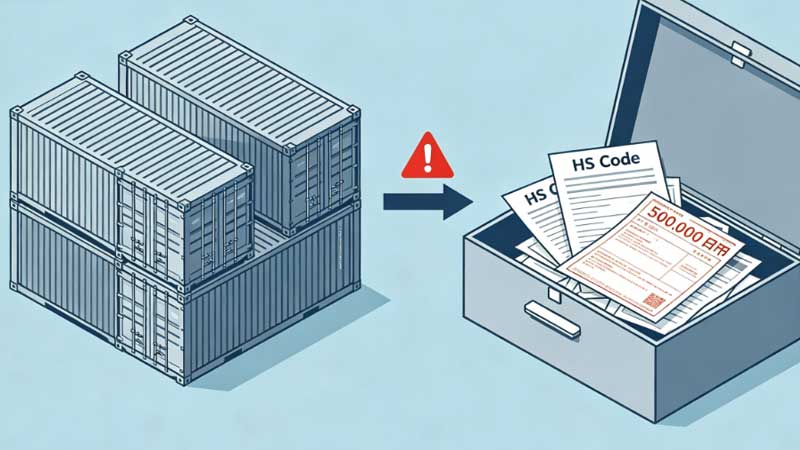
Most customs compliance failures do not announce themselves with dramatic border seizures or criminal investigations. They begin quietly, with a seemingly reasonable classification decision made years ago, applied consistently across hundreds of shipments, and never questioned—until a customs audit brings the accumulated liability crashing down. This case study examines a real HS code classification error that cost an importer ¥500,000 in fines and caused a 3-month shipment delay, all stemming from a classification decision that the importer's team believed was correct. The case illustrates how classification errors compound over time, why customs authorities pursue underpaid duties aggressively, and—most importantly—how proper classification practices could have prevented the entire episode. For importers across all product categories, the lessons from this case apply directly to their own customs compliance programs.
📑 What You'll Learn
- Case background: the product, the classification, and the audit trigger
- How the classification error was discovered and the consequences
- The penalty calculation: why the fine reached ¥500,000
- The 3-month shipment delay: operational impact beyond the fine
- Lessons learned and compliance practices that prevent recurrence
1. Case Background: The Product and the Classification Decision
The importer in this case was a mid-sized foreign-invested manufacturing enterprise producing industrial automation equipment at a facility in Jiangsu province. The company imported a specialized electronic control module from its parent company in Germany, integrating the module into automation systems sold to Chinese manufacturing customers. The module was a critical component—without it, the finished systems could not function—and the company imported approximately 200 units per month with a unit value of approximately €1,200.
The HS code classification that became the subject of dispute concerned the proper classification of this electronic control module. The module performed several functions: it processed sensor input signals, executed programmed control logic, and generated output signals to control connected machinery. It was, in essence, a programmable controller—a product category specifically provided for in the Harmonized System nomenclature. The correct classification for programmable controllers under the HS is heading 8537, which covers "boards, panels, consoles, desks, cabinets and other bases, equipped with two or more apparatus of heading 8535 or 8536, for electric control or the distribution of electricity." The applicable subheading carried an MFN duty rate of 5% at the time of import.
The importer, however, classified the module under heading 9032, which covers "automatic regulating or controlling instruments and apparatus." This heading carries a different scope and, critically, carried a lower MFN duty rate of 2.5% at the time—half the rate applicable to heading 8537. The classification decision had been made by the importer's logistics manager, who had reviewed the product specifications, consulted the HS nomenclature, and concluded that the module's control function brought it within heading 9032. The decision was made in good faith—the manager believed the classification was correct—but it was made without formal classification analysis, without seeking an advance classification ruling from customs, and without consultation with customs compliance professionals.
The classification was applied consistently across all shipments over approximately three years. During this period, the company imported roughly 7,200 units of the control module, with a total declared value of approximately €8.6 million. The consistent application of the classification meant that every shipment underpaid duties by 2.5% of the declared value—a difference that accumulated to a substantial amount over three years of regular imports.
2. How the Error Was Discovered
The customs compliance mistake came to light not through a random customs inspection of an individual shipment, but through a post-clearance customs audit—a comprehensive review of the importer's customs declarations over a multi-year period. China Customs conducts post-clearance audits as a routine enforcement activity, targeting importers based on risk assessment criteria including import volume, product category, duty rate changes, and comparison of declared classifications against industry norms.
The audit was triggered by several factors that elevated the importer's risk profile. The company's import volume had grown substantially over the three-year period, increasing the total duty at stake. The electronic control modules represented a high-value, regularly imported product category where classification errors would have significant revenue impact. Most critically, customs data analysis had identified that the importer's classification of the modules under heading 9032 was an outlier—the vast majority of importers of similar programmable controllers for industrial automation classified these products under heading 8537. The discrepancy between the importer's classification and industry practice triggered the audit selection.
During the audit, customs officers reviewed the importer's customs declarations, product specifications, technical documentation, and import records. They examined sample units of the control module to understand its function and technical characteristics. They compared the module against the HS nomenclature's heading terms and legal notes. The audit analysis concluded that the module's primary function was programmable control through the processing of input signals and generation of output signals, bringing it within the scope of heading 8537 as a programmable controller. The classification under heading 9032 was determined to be incorrect.
The audit finding was communicated to the importer through a formal audit report. The report identified the classification error, calculated the underpaid duties across all affected shipments over the three-year audit period, and provided the importer an opportunity to respond. The importer's response, while acknowledging the error, argued that the classification had been made in good faith and that the company should not be penalized for an honest mistake. Customs rejected this argument—under Chinese customs law, the importer bears the legal responsibility for correct classification, and good faith does not excuse errors that result in duty underpayment.
2. The Penalty Calculation: Why the Fine Reached ¥500,000
The ¥500,000 customs fine did not represent a single penalty applied arbitrarily. It was the cumulative result of three distinct financial consequences flowing from the classification error: back-duty assessment, administrative penalties, and customs credit rating impact. Understanding how each component contributed to the total liability is essential for importers assessing their own compliance exposure.
The back-duty assessment was the largest single component. Customs calculated the difference between the duties actually paid at the 2.5% rate and the duties that should have been paid at the 5% rate across all 7,200 units imported over the three-year audit period. With a total declared value of approximately €8.6 million, the 2.5% duty differential yielded underpaid duties of approximately €215,000—roughly ¥1.7 million at prevailing exchange rates. This amount was payable immediately upon the audit determination, with interest accruing from the date each shipment was originally cleared.
The administrative penalty was assessed under the Customs Law provisions governing duty evasion through incorrect declaration. The penalty amount is calculated as a percentage of the underpaid duties, with the specific percentage determined by the nature and circumstances of the violation. For classification errors resulting in duty underpayment, the penalty typically ranges from 30% to 200% of the underpaid duty amount, with factors including the magnitude of underpayment, whether the error appears intentional or merely negligent, and the importer's cooperation during the audit affecting the percentage applied. In this case, customs assessed a penalty of approximately 30% of the underpaid duties—roughly ¥500,000—reflecting a determination that the error was negligent rather than intentional, and that the importer cooperated during the audit process. Had customs determined that the misclassification was intentional or that the importer obstructed the audit, the penalty could have been substantially higher.
The third financial consequence was the customs credit rating downgrade. China Customs classifies importers into credit rating categories—Advanced Certified Enterprise, General Certified Enterprise, and Dishonest Enterprise—with each category carrying different levels of customs facilitation and scrutiny. The classification error and resulting penalty triggered a downgrade from General Certified Enterprise to a lower rating category. The downgrade meant increased inspection rates for all future shipments, higher documentary requirements, and loss of access to simplified clearance procedures. While these consequences do not carry a direct monetary penalty, they impose ongoing operational costs through delayed clearance, increased storage charges, and additional compliance burdens that compound over time.
4. The 3-Month Shipment Delay: Operational Impact Beyond the Fine
While the financial penalties were substantial, the 3-month shipment delay that accompanied the audit process caused operational damage that rivaled the monetary costs. The delay illustrates how customs compliance failures cascade through supply chain operations in ways that financial penalties alone do not capture.
The delay began during the audit itself. While the audit was ongoing, customs placed a hold on the importer's pending and future shipments of the control module. Customs would not clear new shipments of the same product until the classification dispute was resolved, as clearing shipments under the disputed classification would compound the compliance issue. The importer's production schedule depended on regular delivery of the control modules—without them, finished automation systems could not be completed and delivered to customers. The shipment hold, which extended for approximately six weeks during the audit investigation and determination, immediately disrupted production.
Following the audit determination, the importer faced additional delays. Customs required that all future shipments be declared under the correct HS classification. The importer's internal systems, documentation templates, and customs declaration procedures had to be updated to reflect the correct classification. Customs brokers had to be instructed and their systems updated. The transition process, while necessary, consumed additional weeks during which shipments were delayed pending correct documentation.
The operational consequences cascaded to the importer's customers. Finished automation systems could not be delivered on schedule. Customer contracts carried penalty clauses for late delivery, and several customers invoked these clauses. One major customer, facing its own production disruptions due to the delayed delivery, threatened to cancel its contract and source from a competitor. The importer was forced to negotiate with customers, offer compensation for delays, and in some cases provide temporary substitute equipment at its own expense to maintain customer relationships.
The total period from the initial audit notification to the resumption of normal import operations with correct classification spanned approximately three months. During this period, the importer's production was disrupted, customer relationships were strained, and the company's reputation as a reliable supplier was damaged. These operational consequences, while harder to quantify than the customs penalties, were in many respects more damaging to the business.
5. Lessons Learned and Prevention Strategies
This HS code fine case study yields several practical lessons for importers seeking to avoid similar compliance failures. The most fundamental lesson is that classification decisions with significant duty implications require professional analysis, not merely internal review by logistics personnel. The logistics manager who made the original classification decision was competent and acted in good faith, but lacked the specialized HS classification expertise to correctly analyze the boundary between headings 8537 and 9032—a boundary that has generated classification disputes globally precisely because it requires technical legal analysis of heading terms, section notes, and the General Interpretative Rules.
- Obtain professional classification analysis for high-value, high-volume products. Products imported regularly in significant volumes with substantial aggregate duty exposure warrant formal classification review by customs compliance professionals. The cost of professional classification analysis is measured in thousands of RMB; the cost of classification errors, as this case demonstrates, is measured in millions. For products where the correct classification is genuinely ambiguous, seek an advance classification ruling from China Customs to establish binding classification treatment.
- Benchmark classifications against industry practice. The audit in this case was triggered partly because the importer's classification was an outlier compared to other importers of similar products. Importers should periodically review their classifications against industry norms—what classifications do competitors use, what classifications do customs brokers recommend for similar products, what classifications appear in customs ruling databases. Outlier classifications are not necessarily wrong, but they should prompt careful review to confirm their correctness.
- Conduct periodic internal classification audits. Do not wait for customs to discover classification errors. Periodic internal review of HS classifications, particularly for high-volume products, can identify errors before they accumulate years of liability. Internal audit findings can be voluntarily disclosed to customs, which may reduce or eliminate penalties compared to errors discovered through customs audit. The cost of voluntary correction is almost always lower than the cost of customs-discovered errors.
- Document classification decisions with legal reasoning. When classification decisions are made, document the analysis supporting the decision—the headings considered, the GIR analysis applied, the technical characteristics relied upon, and the conclusion reached. This documentation serves multiple purposes: it provides a reference for future review, it supports consistency across shipments, and if the classification is later challenged, it demonstrates that the decision was made through a reasoned process rather than arbitrary selection.
- Respond to customs audits with experienced representation. When a customs audit occurs, engage customs compliance professionals immediately. The importer's response during the audit affects the penalty determination, the scope of the audit findings, and the operational arrangements for ongoing shipments. Experienced representation can often negotiate more favorable outcomes—reduced penalty percentages, extended payment timelines, and arrangements for continued shipments during the audit—than importers can achieve independently.
The ¥500,000 fine and 3-month delay in this case were entirely avoidable. Proper classification analysis at the outset, an advance ruling to confirm the classification, or voluntary correction upon recognizing the classification issue would have prevented the entire episode. For importers, the case demonstrates that customs compliance is not merely a regulatory obligation—it is a business imperative with direct financial and operational consequences.
Summary: This HS code classification error case study demonstrates how a single classification decision—classifying a programmable controller under heading 9032 rather than the correct heading 8537—resulted in ¥500,000 in fines, ¥1.7 million in back duties, and a 3-month shipment delay that disrupted production and damaged customer relationships. The error was made in good faith by internal logistics staff without formal classification analysis, applied consistently across 7,200 units over three years, and discovered through a post-clearance customs audit triggered by the importer's outlier classification compared to industry practice. The financial consequences comprised three components: back-duty assessment of approximately ¥1.7 million representing the 2.5% duty differential across all shipments, an administrative penalty of approximately ¥500,000 calculated at 30% of underpaid duties reflecting negligent rather than intentional error, and ongoing operational costs from customs credit rating downgrade resulting in increased inspection rates and compliance burdens. The 3-month delay resulted from shipment holds during audit investigation and the transition period for implementing correct classification procedures, causing production disruption, customer contract penalties, and reputational damage. Key prevention strategies include obtaining professional classification analysis for high-value products, benchmarking classifications against industry practice, conducting periodic internal classification audits with voluntary disclosure of errors, documenting classification decisions with legal reasoning, and engaging experienced representation when customs audits occur. The case underscores that customs compliance is a business imperative—the cost of proper classification is measured in thousands; the cost of classification errors is measured in millions.