
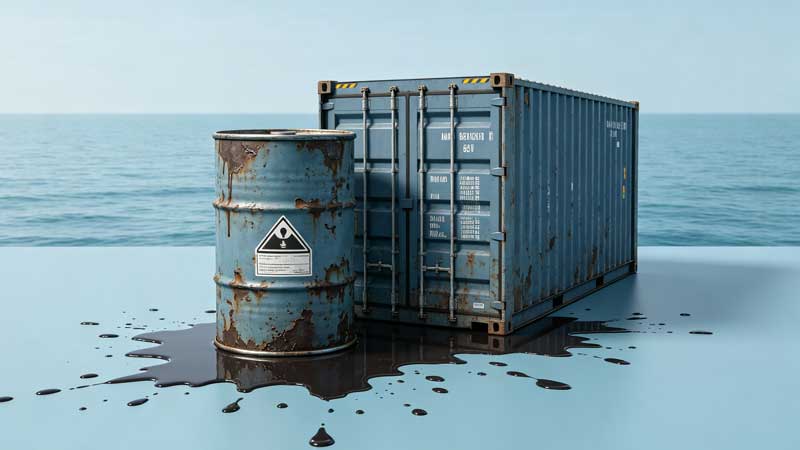
The International Maritime Dangerous Goods (IMDG) Code is the global rulebook for the safe maritime transport of hazardous materials. With the 2024 Edition (Amendment 42-24) becoming mandatory on January 1, 2026, significant changes have been introduced that directly affect how corrosive mixtures (Class 8) are classified, assigned packing groups, and documented. Adopted by IMO Maritime Safety Committee resolution MSC.556(108) in May 2024, these amendments align IMDG classification criteria with the 9th and 10th revisions of the UN Globally Harmonized System (GHS), while introducing entirely new tools for mixture assessment – such as Specific Concentration Limits (SCLs) – and refining the physical testing requirements for metal corrosion. This guide provides a comprehensive breakdown of these technical changes and a practical roadmap for chemical shippers, manufacturers, and logistics providers.
1. Mandatory Enforcement Timeline: Amendment 42-24
The IMDG Code is updated on a biennial cycle. The 2024 Edition (Amendment 42-24) was adopted by IMO Maritime Safety Committee resolution MSC.556(108) on May 23, 2024. From January 1, 2025, it could be applied voluntarily, while the previous 2022 Edition (Amendment 41-22) remained in effect. As of January 1, 2026, Amendment 42-24 is mandatory for all dangerous goods shipments by sea. With previous versions now expired and enforcement by customs authorities and port state control intensifying, any transport document referencing earlier amendments will be rejected.
2. Class 8 Corrosive Substances – The Regulatory Foundation
Class 8 covers substances and mixtures that, by chemical action, cause severe damage to living tissue (skin corrosion) or other materials (metal corrosion). Under the updated IMDG Code, classification is determined by either physical testing (using standardized protocols) or an evidence-based classification approach that prioritizes human health safety without unnecessary animal testing. A key clarification under the 2024 Edition is that data from validated in vitro tests (e.g., OECD Test Guidelines 430 and 431) may now be used to classify a substance as non‑corrosive without further animal testing.
Class 8 is divided into three packing groups based on corrosion severity:
- Packing Group I (great danger): Corrosion time < 3 minutes.
- Packing Group II (medium danger): Corrosion time 3 to 60 minutes.
- Packing Group III (minor danger): Corrosion time 1 to 4 hours.
3. The New Step‑wise Approach for Mixture Classification
A cornerstone of the 2024 Edition is the formalization of a hierarchical, step‑wise approach for classifying corrosive mixtures, harmonized with UN GHS guidance. Prior to this amendment, the classification process for mixtures was less formally structured, often leading to inconsistent application across different jurisdictions. The new three‑tier approach proceeds as follows:
- Step 1 – Test data on the mixture as a whole: Where reliable, validated test data are available for the complete mixture (i.e., it has been physically tested according to OECD guidelines), these data shall be used directly to classify the mixture and assign the packing group according to the criteria in 2.2.8.1.4.
- Step 2 – Bridging principles (when mixture data are not available): If the mixture has not been tested, but sufficient data exist on similar tested mixtures, classification may be based on bridging principles. These include the dilution principle (if a tested mixture is diluted with a non‑corrosive diluent with equivalent or lower corrosivity, the new mixture may retain the same classification), batching (production batches of the same complex mixture manufactured by the same producer may be considered substantially equivalent), concentration of mixtures (if a tested mixture classified in a higher corrosion subcategory is concentrated, the more concentrated mixture may retain the higher classification), and interpolation (if mixtures A and B are in the same corrosion category and mixture C has intermediate concentrations of active ingredients, mixture C may be considered in the same category).
- Step 3 – Calculation method (when mixture has not been tested and bridging principles are insufficient): Where the mixture has not been tested and insufficient data are available on similar mixtures, the corrosive properties of the substances in the mixture must be used to classify and assign a packing group. This is possible when all substances in the mixture (present in concentrations ≥1%) are considered for classification.
This step‑wise approach – “test, then bridge, then calculate” – is now explicitly codified in the IMDG Code, replacing the less structured guidance of previous editions. The corresponding graphical decision tree (Figure 2.8.4.1) has been updated in the 2024 Edition to reflect this hierarchical logic. A critical constraint on the calculation method is worth noting: applying the calculation method is only allowed if there are no synergistic effects that make the mixture more corrosive than the sum of its substances. This restriction applies only if packing group II or III would be assigned to the mixture. The constraint exists because the calculation method assumes additive behavior; if synergistic effects are present, the mixture could be significantly more corrosive than the additive model predicts, leading to dangerous under‑classification.
4. Specific Concentration Limits (SCLs)
The 42-24 amendment introduces an important new tool for refining mixture classification based on the specific concentration of a substance required to cause skin corrosion. The calculation method used for corrosive mixtures involves the summation of the concentrations of classified substances, adjusted by their specific concentration limits (SCL). An SCL is an alternative concentration limit assigned to a substance that determines its contribution to the classification of a mixture. SCLs may be derived from a specific concentration needed to cause corrosion, such as the lowest concentration of a substance that would require classification of a mixture containing that substance. They may also be based on potency differences relative to the generic concentration limits established by GHS.
The generic concentration limits are the default values used when no specific concentration limit is available. For corrosive substances, the standard cut‑off values are: ≥5% for Packing Group I (Category 1A), ≥5% for Packing Group II (Category 1B), and ≥5% for Packing Group III (Category 1C), although the actual classification outcome depends on the combined contribution of all corrosive ingredients. In effect, the percentage thresholds for each packing group category begin at 5% for the highest corrosion category, but the sum of contributions determines the final classification. When an SCL is assigned to a substance, this value replaces the generic concentration limit for that substance in the summation formula. This allows for more granular classification that reflects the true toxicity of the substance. SCLs are typically established based on toxicity data, such as when a substance is shown to be corrosive at concentrations lower than the generic cut‑offs. For some substances, SCLs may be set at values below the generic limit, meaning that even a small amount of that substance can contribute significantly to the mixture‘s classification. For example, a substance with an SCL of 1% for PG I indicates that if it is present at ≥1%, it must be treated as a PG I contributor, even though the generic limit for PG I is 5%.
The summation formula used is essentially a weighted average, where the concentration of each corrosive substance is normalized by its specific concentration limit. The sum of the normalized concentrations across all corrosive ingredients determines whether the mixture should be classified as corrosive and which packing group applies. Thus, the SCL concept directly influences the packing group assignment – if an SCL for PG I is applied, a lower concentration of that substance may elevate the mixture‘s classification to PG I even if the total corrosive content appears moderate.
It is also important to note that all substances classified for transport must be considered for calculation, including those present only as impurities or additives if their concentration exceeds the relevant cut‑off.
5. Metal Corrosion Testing Updates
Class 8 classification also considers corrosivity to metals. Under the updated chapter 2.8, a substance or mixture is considered corrosive to metals if, in the test conducted according to the UN Manual of Tests and Criteria, Part III, sub‑section 37.4, the corrosion rate (measured on steel or aluminum specimens) exceeds 6.25 mm/year at a test temperature of 55°C. The 2024 Edition clarifies the specimen material specifications and the duration of exposure required for validation. It is important to recognize that classification as corrosive to metals does not automatically assign a packing group; packing groups for Class 8 are determined based on skin corrosion criteria. However, the metal corrosion test result provides supplementary data that can support classification when skin corrosion data are ambiguous.
In practice, the transport of bulk chemicals that are corrosive to metals presents unique challenges for shippers, as specialized corrosion‑resistant tanks and coatings must be used. Shippers should confirm that their transport equipment meets compatibility standards.
6. Practical Implications for Documentation
Amendment 42-24 brings important updates to dangerous goods documentation. All MSDS/SDS documents must now reference IMDG Code Amendment 42-24 in Section 14 (Transport Information). Maritime Transport Certification Reports (the “SEA CERT” or “Marine Pollutant Report”) must also be updated to reflect the 2026 version, which incorporates the new classification criteria. Additionally, for marine pollutant exemptions, Special Provision SP375 was introduced and clarified in the 2024 Edition, stating that UN 3077 (solid) and UN 3082 (liquid) may be exempt from full IMDG Code requirements if shipped in packaging not exceeding 5 kg or 5 L per package, provided certain conditions are met – even if the substance is not declared as a marine pollutant. This provides greater flexibility for shippers of low‑dose, retail‑packaged goods. However, for corrosive mixtures carried in bulk, the requirement for vessel operators to maintain a transport document that includes the proper shipping name, hazard class, and packing group is unambiguous.
7. Global Harmonization and Future Outlook
The changes introduced in Amendment 42-24 are part of a broader effort by IMO to keep the IMDG Code harmonized with the most current UN publications that underpin classification and testing requirements worldwide. The next IMDG Code, Amendment 43-26, is expected to be adopted later in 2026, with voluntary application in 2027 and mandatory status in 2028. GHS Revision 10, published in 2023, will likely influence future amendments, particularly in the areas of endocrine disruptors and PBT/vPvB substances, which may eventually be integrated into maritime transport classification frameworks. Shippers should anticipate that ongoing harmonization will continue to refine the classification rules for mixtures, with an increasing shift toward evidence‑based toxicological assessment and away from purely additive models.
Summary: IMDG Code Amendment 42-24 (mandatory from January 1, 2026) introduces significant changes for Class 8 corrosive mixtures. The new step‑wise approach (“test, bridge, calculate”) provides a clear classification hierarchy. The introduction of SCLs allows for more precise mixture assessment based on specific concentration limits. The metal corrosion test criterion (6.25 mm/year at 55°C) has been refined and clarified. Shippers must update all dangerous goods documentation to reference Amendment 42-24 and ensure that classification and packing group assignment follow the new algorithms. Those who act promptly will secure smooth maritime transport; those who delay risk shipment holds, penalties, and disrupted supply chains.