
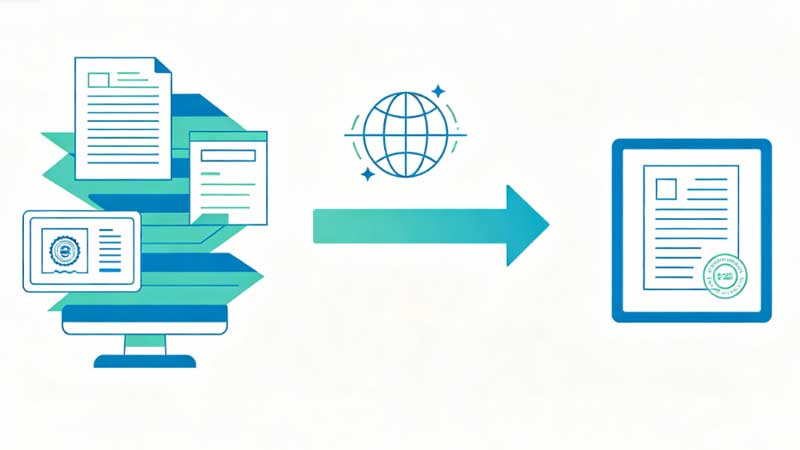
For foreign-invested enterprises and domestic companies looking to engage in import-export trade, the 2026 regulatory landscape has brought the most significant simplification in a decade. The Ministry of Commerce (MOFCOM) has fully implemented the elimination of the foreign trade operator filing requirement, a change that took effect on December 30, 2022, when the National People‘s Congress amended the Foreign Trade Law to delete Article 9. By 2026, this reform is fully enforced nationwide, and the separate MOFCOM filing step has been entirely removed from the import-export setup process. This guide provides a comprehensive overview of the new five‑step simplified procedure, the core compliance requirements, and a practical roadmap for obtaining full import-export qualifications in China.
📑 What You'll Learn
- Why MOFCOM abolished foreign trade operator filing (key 2022 legal change)
- The 2026 simplified process: 5 core steps instead of multiple approvals
- Business scope requirements: what your license must say
- Customs filing via the Single Window (10-digit customs code)
- Electronic port card (e‑port card) for customs declaration and tax refund
- Forex registration and bank account setup (decentralized to banks)
- Export tax refund filing for general‑rate taxpayers
- “One‑stop” integration services in pilot regions
- Practical compliance checklist for new importers
1. Why MOFCOM Eliminated Foreign Trade Operator Filing – The Legal Change
Since the establishment of the foreign trade operator filing system, obtaining import-export qualifications required a separate trip to the MOFCOM department to complete the filing and obtain the “Foreign Trade Operator Filing Registration Form”. However, on December 30, 2022, the National People‘s Congress passed a decision to amend the Foreign Trade Law, officially deleting Article 9, which had mandated that all foreign trade operators complete filing registration. From that date onward, MOFCOM and its local offices nationwide ceased accepting new foreign trade operator filing applications, and the requirement to submit filing materials to customs, forex, and tax authorities was also abolished. As of 2026, this change is fully implemented, and businesses no longer need to visit any MOFCOM office for a separate import‑export filing.
The core principle of the new policy is that once a company‘s business license includes the appropriate import-export scope, the company automatically possesses the legal qualification to engage in foreign trade, without requiring any separate MOFCOM approval step. This represents a fundamental shift from a prior‑approval model to a post‑supervision model.
2. The 2026 Simplified Process: 5 Core Steps to Full Import-Export Qualifications
Although the standalone MOFCOM filing step has been eliminated, enterprises still need to complete five essential steps to legally engage in import-export activities. These steps are now highly streamlined, with most procedures completed online, and the entire process typically takes 7‑10 working days. The five required steps are:
- Step 1 – Business scope verification (market supervision bureau): Confirm or update business license to include “货物进出口” (import/export of goods) and/or “技术进出口” (import/export of technology).
- Step 2 – Customs filing (China Customs): Complete filing via the Single Window to obtain the 10‑digit customs code.
- Step 3 – Electronic port card (e‑port card) application: Apply for the e‑port card used for customs declarations and tax refunds.
- Step 4 – Forex registration and foreign currency bank account setup: Complete trader name registration and open a foreign currency account for cross-border receipts and payments.
- Step 5 – Export tax refund filing (tax authority): For general‑rate taxpayers, complete the tax refund filing to claim VAT rebates on exports.
3. Step 1 – Business Scope Verification: The Only Hard Prerequisite
Under the 2026 rules, the only hard prerequisite for import-export qualification is that the company‘s business license must contain the appropriate import-export scope. Specifically, the “business scope” column must include at least one of the following three standard phrases:
- “货物进出口” (import/export of goods) – required for any physical goods trade.
- “技术进出口” (import/export of technology) – required for technology licensing or transfer.
- “进出口代理” (import-export agency) – required for trade agency services.
Vague descriptions such as “国际贸易” (international trade) or “进出口贸易” (import-export trade) are no longer accepted; only the precise statutory terms listed above are recognized by customs, foreign exchange, and tax authorities. If your current business license does not contain these terms, you must apply for a business scope change through the local Administration for Market Regulation (AMR) online portal. The change typically takes 1‑3 working days. There is no requirement for minimum registered capital, and neither MOFCOM filing nor any other approval is needed.
4. Step 2 – Customs Filing: Obtaining the 10‑Digit Customs Code
After confirming the business license scope, the next critical step is completing customs filing to obtain the 10‑digit customs code (customs registration number). This step is conducted entirely online through the China International Trade Single Window platform (www.singlewindow.cn). The process is as follows:
- Register a corporate account on the Single Window platform.
- Navigate to “Enterprise Qualification” → “Customs Enterprise General Qualification” → “Filing Application”.
- Complete the electronic “Customs Filing Information Form”, ensuring the operating category is correctly selected as “Import/Export Goods Consignor” (for general trade companies) – be careful not to mistakenly select “Customs Broker”.
- Upload scanned copies of the business license, legal representative‘s ID, and official company chop.
After submission, customs typically completes the review within 1‑3 working days. Upon approval, the system generates an electronic “Customs Filing Confirmation”, which you can download and print. The confirmation includes the 10‑digit customs code, which is used throughout all subsequent import-export processes. The 2026 rules also offer a “multi‑certificate integration” option: if you check the “customs filing” option when registering your business license, the system can automatically complete customs filing at the same time. In this case, you should still log into the Single Window to confirm that the filing has been completed and to check the accuracy of the information.
5. Step 3 – Electronic Port Card (E‑Port Card): The “Passport” for Trade Operations
After obtaining the customs code, the next essential step is applying for the electronic port card (e‑port card), which serves as the electronic identity for customs declaration, tax refund, and foreign exchange verification. The application is submitted online through the Single Window platform. New enterprises generally need to apply for two types of cards:
- Legal person card (法人卡): Used for authority management, system configuration, and approval of key operations.
- Operator card (操作员卡): Used by day‑to‑day personnel for actual customs declaration, tax refund, and other operational tasks (typically 1‑2 cards).
The online application process requires uploading the business license, customs filing confirmation, and legal representative ID. After submission, depending on local requirements, you may need to bring the original documents to an e‑port card service center for in‑person verification. Some regions support facial recognition via mobile app for remote verification. After approval and payment of the card fee (approximately RMB 300, often waived for the first set), you can collect the card on‑site or receive it by mail, with delivery typically taking 1‑3 working days. The e‑port card is essential for all electronic customs clearance and foreign trade operations.
6. Step 4 – Forex Registration and Foreign Currency Bank Account
To legally receive and make cross-border payments, enterprises must complete two related procedures: forex registration and foreign currency bank account opening. Under the 2026 rules, forex registration has been decentralized to banks. You no longer need to visit a State Administration of Foreign Exchange (SAFE) office; instead, you complete the “Trader Name Registration” directly at the bank where you plan to open a foreign currency account. The required materials generally include:
- Business license (original and copy).
- Customs filing confirmation and the 10‑digit customs code.
- Legal representative‘s ID and company chops.
- Basic RMB account information (if already opened).
After the bank completes the registration, you can open a foreign currency account at the same bank. The entire process typically takes 1‑2 working days. Once the account is opened, the company can legally receive foreign currency payments from overseas customers and make outbound payments for imports.
7. Step 5 – Export Tax Refund Filing (For General‑Rate Taxpayers)
For enterprises that are general‑rate taxpayers and plan to engage in export activities, export tax refund filing is an essential final step. This filing is completed through the provincial tax authority‘s e‑Tax Bureau portal (generally under “Export Tax Refund Management” → “Export Tax Refund Filing”). The system typically pre‑fills basic corporate information automatically; you need only confirm the accuracy of the data and submit. Once the filing is approved, the company can, after actual export customs clearance, apply for a refund of the VAT paid on the exported goods.
It is important to note that small‑scale taxpayers are not required to complete export tax refund filing but also cannot claim export VAT refunds. For general‑rate taxpayers, however, filing is mandatory; failure to file on time will result in the inability to claim refunds and may affect future export tax refund qualification.
8. One‑Stop Integrated Services in Pilot Regions
To further simplify the import-export qualification process, several regions have launched “foreign trade import-export one‑stop” integrated services. Taking Jiaozuo City, Henan Province as an example, the local government has consolidated registration, e‑port card application, customs filing, foreign currency account opening and name registration, export tax refund filing, and refund processing – six core operations spanning dozens of steps – into a single integrated service. A unified “Foreign Trade Import-Export One‑Stop Service Guide” has been prepared, clearly marking online and offline procedures for each operation, material standards, and contact information for service windows. A dedicated service counter has been established at the government service center, where enterprises can enter through one door and handle all matters at one window. These integrated service models are expected to be promoted nationwide as an important component of optimizing the business environment in 2026.
9. Practical Compliance Roadmap for New Import‑Export Enterprises
To smoothly complete all import-export qualification procedures under the 2026 rules, follow this six‑step roadmap:
- Confirm or update business scope (Immediate): Check whether the business license contains “货物进出口” or “技术进出口”. If not, apply for a business scope change (1‑3 working days).
- Complete customs filing (Months 1‑2): Log into the Single Window platform, submit the customs filing application, and obtain the customs code (1‑3 working days). Use the “multi‑certificate integration” option if available.
- Apply for e‑port card (Same window): After customs filing is complete, immediately apply for the e‑port card through the same Single Window portal. Complete online submission and any required in‑person verification (2‑4 working days).
- Complete forex registration and open foreign currency account (Month 2): Bring the required materials to the bank to complete “Trader Name Registration” and open a foreign currency account (1‑2 working days).
- Complete export tax refund filing (Month 2): For general‑rate taxpayers, complete the filing through the e‑Tax Bureau portal (0.5 working days).
- Consider third‑party assistance (Optional): To further reduce administrative burden, consider engaging a professional compliance service provider to assist with the entire process.
Summary: The 2026 import‑export qualification process has been fundamentally simplified following MOFCOM‘s elimination of the foreign trade operator filing requirement. Under the new rules, enterprises automatically qualify once their business license includes the appropriate import-export scope. The core steps remaining are: verifying or updating business scope, completing customs filing via the Single Window (obtaining the 10‑digit customs code), applying for the e‑port card, completing forex registration and opening a foreign currency account, and filing for export tax refund (for general‑rate taxpayers). The entire process typically takes 7‑10 working days and is largely conducted online. By following the compliance roadmap, foreign‑invested enterprises and domestic companies can quickly obtain full import-export qualifications and smoothly enter China‘s international trade market.