
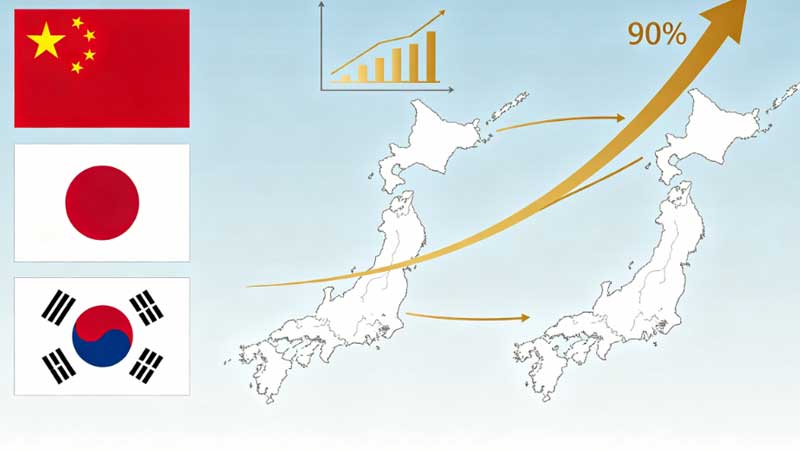
When the Regional Comprehensive Economic Partnership entered into force in 2022, it was heralded as the world's largest free trade agreement—covering nearly one-third of global GDP and population. But its practical impact on trade was always designed to be gradual. The agreement's tariff reduction schedules were structured in annual increments, with duties on traded goods decreasing year by year according to each member country's commitment schedule. The RCEP tariff cuts have now entered their fourth year, effective January 2026, and the cumulative impact has reached a significant milestone: approximately 90% of products traded between China, Japan, and Korea now enjoy zero duty treatment under the agreement. For the first time, the three Northeast Asian manufacturing powerhouses—which had no trilateral free trade agreement before RCEP—are operating under a substantially liberalized tariff regime that eliminates duties on the vast majority of their traded goods. This guide analyzes the fourth-year tariff reductions, identifies the key product categories benefiting from new or deepened duty cuts, explains the compliance requirements for claiming RCEP preferential rates, and provides practical guidance for importers and exporters seeking to maximize the benefits of Asia's most important trade agreement.
📑 What You'll Learn
- The fourth-year RCEP tariff reduction schedule and key changes
- Product categories reaching zero duty in the 2026 tranche
- China-Japan-Korea trilateral trade: the historic significance
- RCEP certificate of origin requirements and compliance
- Strategic opportunities for importers and exporters under RCEP
1. RCEP's Fourth Year: The Cumulative Impact of Annual Reductions
RCEP's tariff reduction mechanism operates on a pre-negotiated schedule where each member country committed to reducing or eliminating import duties on products originating from other RCEP parties according to a specified timeline. The schedules differ by country and by product, with some products receiving immediate duty elimination upon entry into force, others following gradual reduction trajectories, and sensitive products excluded from liberalization entirely or subject to longer phase-out periods. The annual reduction model means that each January, a new tranche of tariff cuts takes effect, progressively expanding the scope of duty-free trade.
The fourth-year reductions, effective January 2026, represent a significant deepening of tariff liberalization across the RCEP region. For many products that were subject to phased tariff elimination schedules—typically 10-year or 15-year phase-out periods—the fourth-year cut brings duties to 60% below the base rate, making the preferential RCEP rate substantially more attractive than the MFN alternative. For products on shorter phase-out schedules, the fourth year may represent the final reduction, bringing duties to zero permanently.
The cumulative impact of four years of reductions is most visible in the China-Japan-Korea zero duty statistics. Before RCEP, there was no free trade agreement linking all three countries. China and Korea had a bilateral FTA, but Japan had no FTA with either China or Korea. RCEP created the first trilateral trade liberalization framework among the three countries. In the first year, approximately 50% of products traded among the three received duty-free treatment. By the fourth year, that figure has risen to approximately 90%—a near-complete liberalization of the trilateral trade in goods. The remaining 10% of products are primarily agricultural goods, sensitive industrial products, and items explicitly excluded or subject to extended phase-out periods under individual country schedules.
For businesses trading between China, Japan, and Korea, the practical implication is that most products now qualify for zero-duty treatment under RCEP. An importer who has not reviewed their product classifications and RCEP eligibility recently may be paying duties unnecessarily on goods that now qualify for duty-free entry under the fourth-year reductions.
2. Key Product Categories Benefiting from 2026 Reductions
The RCEP fourth year tariff reductions span multiple sectors, with particularly significant impacts in industrial goods, electronics, automotive components, and selected consumer products. Understanding which categories are affected enables importers and exporters to identify opportunities for cost reduction and competitive repositioning.
In the automotive sector, the fourth-year reductions bring duties on many auto parts and components traded between Japan and China closer to zero. Japan is a major supplier of automotive components to Chinese manufacturers, and Chinese auto parts exports to Japan have grown substantially. Components including transmissions, steering systems, braking systems, and electronic control units that were previously subject to duties of 3% to 8% under MFN rates are now at or approaching zero under RCEP rates. For automotive manufacturers with integrated China-Japan supply chains, the cumulative duty savings across thousands of components represent a material reduction in production costs.
In the electronics and semiconductor sector, the fourth-year cuts deepen already significant liberalization. Electronic components, semiconductor manufacturing equipment, integrated circuits, and consumer electronics traded among RCEP members continue their progression toward full duty elimination. Korea's exports of memory chips and displays to China, Japan's exports of semiconductor materials and manufacturing equipment to both China and Korea, and China's exports of electronic finished products to both markets all benefit from the progressive tariff reductions. For electronics manufacturers, RCEP duty savings compound with the operational advantages of regional supply chain integration.
In the chemical and materials sector, the fourth-year reductions affect industrial chemicals, specialty materials, plastics, and advanced materials traded among the three countries. Japanese and Korean specialty chemical exports to China—including high-performance polymers, electronic-grade chemicals, and advanced coating materials—benefit from duty reductions that improve their cost competitiveness against non-RCEP suppliers. Chinese exports of basic chemicals and materials to Japan and Korea similarly benefit.
In the consumer goods sector, the fourth-year cuts extend zero-duty treatment to additional categories of household goods, apparel, food products, and consumer electronics. Japanese consumer brands exporting to China and Korea, Korean consumer goods entering China and Japan, and Chinese consumer products reaching Japanese and Korean markets all benefit from the progressive elimination of import duties. For consumer goods importers, the RCEP rates increasingly represent the difference between competitive and uncompetitive pricing in destination markets.
3. The China-Japan-Korea Trilateral Dynamic
The RCEP tariff cuts 2026 are historically significant for the China-Japan-Korea trading relationship. Before RCEP, the absence of a trilateral free trade framework meant that trade among the three countries was conducted primarily under MFN tariff rates, with only the China-Korea bilateral FTA providing preferential treatment for that bilateral relationship. Japan's trade with both China and Korea operated without any FTA framework at all.
This absence of trade liberalization was economically anomalous. China, Japan, and Korea are each other's largest or second-largest trading partners. Their economies are deeply integrated through supply chains that move components, materials, and finished goods across borders multiple times before reaching final consumers. The imposition of import duties at each border crossing created a cumulative tax on regional supply chain integration that raised production costs, distorted sourcing decisions, and reduced the competitiveness of the region's manufacturing output in global markets. RCEP directly addresses this distortion.
The trilateral dynamic is particularly important for intermediate goods—products that are inputs into further manufacturing rather than final consumer products. A Korean semiconductor fabricated in Seoul may be shipped to China for assembly into an electronic device, which is then exported to Japan for final sale. Under the pre-RCEP tariff structure, each cross-border movement potentially incurred import duties. Under RCEP's progressive liberalization, duties on intermediate goods have been prioritized for elimination, recognizing that duties on production inputs compound through the supply chain in ways that duties on final consumer goods do not. The fourth-year reductions further advance this intermediate goods liberalization.
For businesses operating in or sourcing from the China-Japan-Korea manufacturing triangle, the RCEP tariff reductions create opportunities to optimize supply chain configurations based on production efficiency rather than duty avoidance. Sourcing decisions that were previously influenced by tariff differentials can now be made on the basis of quality, cost, and logistics. Production location decisions can be based on workforce, infrastructure, and market access rather than on tariff-jumping motivations. The economic integration that RCEP enables goes beyond duty savings to encompass more efficient allocation of production resources across the region.
4. RCEP Certificate of Origin Requirements and Compliance
Claiming RCEP preferential tariff rates requires compliance with the agreement's rules of origin and documentation requirements. Unlike the zero-duty treatment for battery raw materials discussed elsewhere, which applies automatically under MFN rates, RCEP duty-free treatment is not automatic. Importers must actively claim RCEP preferences and support those claims with valid documentation.
The core documentation requirement is the RCEP certificate of origin. The certificate verifies that the imported goods satisfy RCEP's origin rules—that they were wholly obtained or substantially transformed within one or more RCEP member countries. RCEP offers several certification options: traditional certificates of origin issued by authorized bodies in the exporting country, approved exporter self-certification where the exporter is authorized to certify origin directly, and a declaration of origin by the exporter or producer on commercial documentation. The approved exporter self-certification mechanism, once authorized, enables exporters to certify origin without applying for individual certificates for each shipment—significantly reducing the administrative burden for regular exporters.
RCEP's product-specific origin rules determine what constitutes sufficient processing or transformation for each product category. These rules vary by product and are specified in the agreement's Annex. Common rule types include the change in tariff classification rule, which requires that the exported product be classified under a different HS heading than the non-originating materials used in its production; the regional value content rule, which requires that a specified percentage of the product's value be added within RCEP countries; and specific processing requirements for certain products. Importers and exporters must verify that their products satisfy the applicable product-specific rule before claiming RCEP preferences.
RCEP also features cumulation provisions that are particularly valuable for integrated regional supply chains. Under RCEP cumulation, materials and processing contributed in any RCEP member country count toward satisfying the origin requirements for the final product. A product manufactured in China using components from Japan and Korea, with final processing in China, can qualify as RCEP-originating because the inputs from Japan and Korea cumulate with the Chinese processing. This cumulation mechanism is what makes RCEP particularly valuable for the integrated China-Japan-Korea supply chains discussed above—it allows the regional value content to be aggregated across all three countries.
5. Strategic Opportunities and Action Steps
The RCEP fourth-year tariff cuts create strategic opportunities for importers and exporters across the Asia-Pacific region. Businesses should take specific action steps to capture the benefits of the progressive tariff liberalization.
- Conduct a comprehensive RCEP tariff rate review. Review all products imported from or exported to RCEP member countries to identify those where RCEP preferential rates are lower than currently applied MFN or other FTA rates. For products where RCEP rates have reached zero in the fourth-year tranche, the savings are immediate and permanent. For products on phased schedules where RCEP rates are declining but not yet zero, establish monitoring to capture each annual reduction.
- Compare RCEP rates against other available FTA rates. Many products may qualify for preferential treatment under multiple FTAs—RCEP, bilateral FTAs, and other regional agreements. Compare the available rates and associated compliance costs to identify the optimal FTA for each product and trading relationship. RCEP may offer the lowest rate for some products while a bilateral FTA offers advantages for others.
- Evaluate supply chain reconfiguration opportunities. For businesses with manufacturing operations or sourcing relationships in RCEP member countries, the progressive tariff reductions may enable supply chain reconfigurations that were previously constrained by duty costs. Evaluate whether alternative sourcing arrangements, production location shifts, or supply chain restructuring would be commercially advantageous under the current and projected RCEP rate schedules.
- Implement or update origin compliance procedures. Ensure that internal systems, customs broker instructions, and documentation procedures are updated to claim RCEP preferences where applicable. For exporters, evaluate whether approved exporter self-certification would reduce administrative costs. For importers, verify that suppliers are providing proper RCEP origin documentation.
The RCEP agreement is delivering on its promise of progressive trade liberalization across the Asia-Pacific region. With 90% of products now at zero duty between China, Japan, and Korea, and rates continuing to decline for the remaining products on phased schedules, the agreement has fundamentally transformed the tariff landscape for the world's most dynamic manufacturing region. Businesses that proactively manage RCEP compliance and strategically deploy the resulting duty savings will strengthen their competitive position in both regional and global markets.
Summary: The RCEP tariff cuts entering their fourth year in January 2026 mark a significant milestone: approximately 90% of products traded between China, Japan, and Korea now enjoy zero duty treatment under the agreement. This represents the first trilateral trade liberalization framework among the three Northeast Asian manufacturing powers, correcting the economically anomalous absence of free trade that existed before RCEP. The fourth-year reductions are particularly significant for automotive components, electronics and semiconductors, chemicals and advanced materials, and consumer goods. Intermediate goods liberalization is prioritized, recognizing that duties on production inputs compound through integrated regional supply chains. RCEP preferences require active claiming through certificates of origin or approved exporter self-certification, compliance with product-specific origin rules, and strategic utilization of cumulation provisions that allow value contributed across multiple RCEP countries to aggregate toward origin qualification. Strategic action steps for businesses include conducting comprehensive product-level RCEP rate reviews, comparing RCEP rates against bilateral FTA alternatives, evaluating supply chain reconfiguration opportunities enabled by duty elimination, and implementing origin compliance procedures including approved exporter programs. The RCEP agreement is delivering progressive trade liberalization that fundamentally transforms the tariff landscape for the Asia-Pacific region's manufacturing economy, enabling businesses to make sourcing and production decisions based on efficiency rather than duty avoidance.