
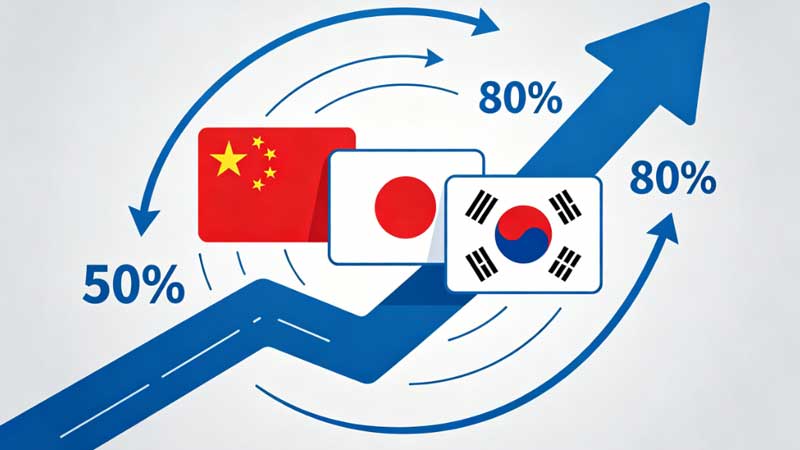
The Regional Comprehensive Economic Partnership (RCEP) has entered its third year of implementation, bringing a new round of tariff reductions effective January 1, 2026. The latest phase is particularly significant for China-Japan and China-Korea trade, with over 90% of goods now duty‑free between these major economies. For exporters and importers, the expanded tariff benefits require updated RCEP Certificates of Origin (CO) and careful compliance with origin rules. This guide explains the new tariff reductions, affected product categories, documentation requirements, and practical steps for maximizing RCEP benefits.
1. Tariff Reductions – China-Japan and China-Korea Highlights
The third‑year tariff reductions under RCEP (2026) represent the deepest cuts since the agreement took effect in 2022. Key highlights:
- China-Japan trade: Over 90% of goods between China and Japan are now duty‑free, up from 85% in 2025. This includes electronics (semiconductors, capacitors, resistors), auto parts (engines, transmissions, sensors), machinery (industrial robots, CNC machines), and chemicals (resins, plastics).
- China-Korea trade: 92% of goods are now duty‑free, up from 88% in 2025. Key categories include display panels (OLED, LCD), semiconductors, petrochemicals, and steel products.
- China-ASEAN trade: 95% of goods are duty‑free (already high under ASEAN-China FTA). RCEP adds cumulation benefits (see Section 3).
- China-Australia/New Zealand trade: 90% duty‑free, with beef, dairy, wine, and wool continuing to see phased reductions (full elimination by 2028).
The tariff elimination schedule varies by product category. Some sensitive products (e.g., rice, wheat, sugar) maintain tariffs or have longer phase‑out periods (10‑15 years).
2. Affected Product Categories – Where to Find Savings
The 2026 tariff reductions offer significant savings for importers and exporters. Key product categories with full duty elimination effective 2026:
- Electronics (China-Japan): Semiconductors (HS 8542), printed circuit boards (8534), capacitors (8532), resistors (8533), connectors (8536). Duty reduced from 5‑8% to 0%.
- Auto parts (China-Japan, China-Korea): Engines (8408), transmissions (8483), brakes (8708), sensors (9029). Duty reduced from 6‑10% to 0%.
- Machinery (China-Japan): Industrial robots (8479), CNC machines (8458), bearings (8482). Duty reduced from 5‑9% to 0%.
- Chemicals (China-Korea): Petrochemicals (3901‑3914), synthetic resins (3909), rubber products (4011). Duty reduced from 5‑8% to 0%.
- Steel products (China-Korea): Flat‑rolled steel (7208‑7212), stainless steel (7219). Duty reduced from 4‑6% to 0%.
- Textiles and apparel (China-Japan, China-Korea): Fabrics (50‑60), garments (61‑62). Duty reduced from 8‑13% to 0%.
To verify duty rates for specific HS codes, importers can use the RCEP tariff calculator on the China Free Trade Zone Service Network (ftz.mofcom.gov.cn).
3. Cumulation Rules – Key Benefit for Regional Supply Chains
One of RCEP‘s most valuable features is cumulation, which allows value added in any RCEP member country to count toward the origin requirement. Example: A Japanese company exports electronic components to China. Those components incorporate parts from South Korea. Under RCEP, the Korean value counts toward the Japanese product‘s origin requirement for preferential treatment when entering China.
Key cumulation rules for 2026:
- Regional Value Content (RVC) threshold: 40% for most products. Value from any RCEP member counts.
- Change in Tariff Classification (CTC): For products that do not meet RVC, CTC rules apply. The product‘s HS code must be different from its components‘ codes.
- Specific Process Rules (SPR): For certain products (e.g., chemicals, textiles), specific production processes must be performed within the RCEP region.
Exporters should work with their supply chain to maximize cumulation benefits. For example, sourcing components from multiple RCEP countries can help meet the 40% RVC threshold even if the final assembly country‘s domestic value is low.
4. RCEP Certificate of Origin – Key Requirements
To claim preferential tariff treatment under RCEP, exporters must provide a valid RCEP Certificate of Origin (CO). Key requirements for 2026:
- New CO format (2026 edition): The CO must use the updated template (Annex 3 of RCEP). Old format COs (pre‑2026) remain valid only if issued before January 1, 2026.
- Back‑to‑back COs (new in 2026): For goods shipped via intermediate RCEP countries, back‑to‑back COs are now accepted. Example: Goods from China shipped to Korea, then re‑exported to Japan – a Korean-issued back‑to‑back CO referencing the original Chinese CO is valid.
- Self‑certification for approved exporters: Companies approved by their national customs authority may self‑certify origin without a third‑party CO. The self‑certification statement must be included on the commercial invoice.
- Electronic COs: Digital COs are accepted. The QR code on the CO must be scannable and linked to the issuing authority‘s database.
- Validity period: RCEP COs are valid for 12 months from the date of issue (previously 6 months).
Importers must present the RCEP CO (or self‑certification statement) to customs at the time of import declaration. Failure to provide a valid CO results in standard duty rates being applied.
5. Documentation and Compliance – What Importers Need
To claim RCEP preferential duty rates, importers must retain the following documentation:
- RCEP Certificate of Origin (or self‑certification statement): Original or electronic copy.
- Commercial invoice: Must reference the RCEP CO number.
- Packing list: Matching CO quantities.
- Bill of lading or air waybill: Showing shipment dates within CO validity period.
- Origin verification documents (if requested): Importers must retain production records, supplier invoices, and cost breakdowns for 5 years to demonstrate origin compliance.
Customs may conduct post‑clearance origin verifications. If the importer cannot prove origin, preferential duty rates may be reversed, and duties + penalties assessed.
6. Practical Roadmap for Exporters and Importers
To maximize RCEP benefits under the 2026 tariff reductions, follow this six‑step roadmap:
- Review your product portfolio (Immediate). Identify HS codes that became duty‑free or have reduced rates in 2026. Use the RCEP tariff calculator.
- Analyze your supply chain for cumulation opportunities (Month 1). Map the origin of components from RCEP countries. Calculate RVC to determine if products qualify.
- Apply for approved exporter status (Month 1‑2). For companies with high export volumes, self‑certification reduces paperwork. Contact your national customs authority for application.
- Update your CO issuance process (Month 2). Train staff on the new 2026 CO format. For back‑to‑back shipments, coordinate with intermediate country authorities.
- Train your customs broker (Ongoing). Ensure your broker understands RCEP cumulation rules and can advise on origin verification.
- Monitor annual tariff reductions (Annually). RCEP tariff cuts occur each January. Review the schedule for your HS codes annually.
Summary: Under RCEP‘s third‑year tariff reductions (effective January 1, 2026), over 90% of goods between China and Japan and between China and South Korea are now duty‑free. Key affected categories include electronics, auto parts, machinery, chemicals, steel, and textiles. Cumulation rules allow value from any RCEP member to count toward origin requirements (Regional Value Content threshold: 40%). Exporters must use the updated RCEP Certificate of Origin format (2026 edition), with self‑certification allowed for approved exporters. Back‑to‑back COs are now accepted for goods transiting intermediate RCEP countries. Importers must retain COs and supporting documents for 5 years. By reviewing product portfolios, analyzing cumulation opportunities, applying for approved exporter status, and updating CO processes, companies can maximize tariff savings under RCEP.