
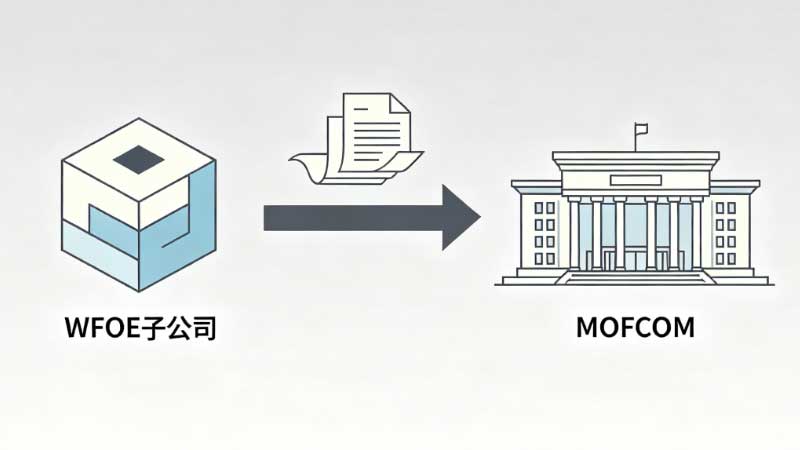
For wholly foreign-owned enterprises (WFOEs) looking to reinvest their China-earned profits into a domestic subsidiary or capital increase, the Ministry of Commerce (MOFCOM) filing process has been significantly streamlined in 2026. Under the amended Foreign Investment Law and the new “Reinvestment Filing Management Measures,” WFOEs can now complete the entire reinvestment filing online through the Foreign Investment Comprehensive Management Information System (外商投资综合管理信息系统) in as little as 5 working days. The new rules eliminate redundant document submissions, reduce waiting times, and integrate the filing with tax and foreign exchange registration. This guide provides a complete overview of the streamlined MOFCOM reinvestment filing process, required documents, eligibility criteria, and a practical compliance roadmap for foreign investors.
📑 What You'll Learn
- What reinvestment filing is and when it is required
- 2026 simplification: reduced document list and 5‑day processing
- Eligibility requirements for profit reinvestment and capital increase
- Step‑by‑step online filing procedure via MOFCOM portal
- Tax clearance and foreign exchange registration integration
- Common filing errors and how to avoid them
- Post‑filing obligations and annual reporting
- Practical compliance roadmap for foreign investors
1. What Reinvestment Filing Is and When It Is Required
Reinvestment filing (再投资备案) refers to the mandatory registration with MOFCOM when a foreign-invested enterprise (FIE) in China uses its after-tax profits, capital reserves, or other retained earnings to invest in a new domestic subsidiary (establishment of a new company) or to increase the registered capital of an existing domestic investee company. This filing is required under Article 22 of the Foreign Investment Law and its implementing regulations, regardless of whether the reinvested entity is also foreign‑invested or a domestic company.
The filing must be completed before or within 30 days after the reinvestment transaction is executed (e.g., the capital injection is made). Failure to file on time can result in fines, restrictions on profit repatriation, and adverse credit records for both the investing WFOE and the receiving subsidiary. The 2026 streamlined process applies to all reinvestment transactions, including:
- Profit reinvestment: Using after‑tax profits from the WFOE to set up a new subsidiary.
- Capital increase: Increasing the registered capital of an existing subsidiary.
- Equity acquisition: Acquiring equity in a domestic company using retained earnings.
- Capitalization of retained earnings: Converting retained earnings into registered capital.
2. 2026 Simplification: Reduced Document List and 5‑Day Processing
The most significant changes in 2026 are the reduction of required documents and the accelerated processing timeline. Previously, reinvestment filings could take 10‑15 working days and required a bulky paper submission. Under the new rules:
- Online‑only submission: All documents must be uploaded in PDF format through the MOFCOM portal; no physical copies are required.
- Reduced document list: The number of mandatory documents has been cut from 11 to 5 (see Section 4).
- 5‑working‑day processing: MOFCOM will issue the electronic filing confirmation within 5 working days of a complete application (previously 10‑15 days).
- No pre‑approval for most categories: Only reinvestment into restricted industries (Negative List) requires pre‑approval; general reinvestment is now a post‑transaction filing with immediate acceptance.
- Integration with tax and SAFE: The filing confirmation is automatically shared with the tax bureau and State Administration of Foreign Exchange (SAFE), reducing duplicate submissions.
For reinvestment amounts below RMB 30 million, the filing is now considered “simple registration” and is processed within 3 working days without substantive review. For amounts above RMB 30 million, a standard 5‑day review applies.
3. Eligibility Requirements for Profit Reinvestment and Capital Increase
To qualify for the streamlined reinvestment filing, the investing WFOE must meet the following conditions:
- After‑tax profits source: The funds used for reinvestment must be after‑tax profits that have already been subject to Corporate Income Tax (CIT) in China. Proof of tax payment (CIT return and payment receipt) is required.
- Audited financial statements: The WFOE must have audited financial statements for the fiscal year in which the profits were generated.
- Board resolution: A board resolution (or shareholder resolution) approving the reinvestment must be provided.
- No outstanding tax liabilities: The WFOE must have no unpaid taxes, late fees, or penalties.
- Sufficient distributable reserves: The reinvestment amount cannot exceed the WFOE‘s distributable retained earnings (未分配利润) as shown in the audited financial statements.
If the reinvestment is structured as a capital increase into an existing subsidiary, the subsidiary must also be in good standing (no abnormal operations, valid business license). If the reinvestment is used to establish a new subsidiary, the new company’s proposed business scope must not be in a prohibited industry under the Negative List. For restricted industries, a pre‑approval from MOFCOM (or NDRC) is still required before the filing can be accepted.
4. Step‑by‑Step Online Filing Procedure via MOFCOM Portal
The online reinvestment filing process consists of the following steps:
- Log into the Foreign Investment Comprehensive Management Information System: Access the portal at wzxxbg.mofcom.gov.cn using the investing WFOE‘s corporate digital certificate or e‑port card.
- Select “Reinvestment Filing” (再投资备案): Navigate to the “Foreign Investment Information Reporting” module and choose “Reinvestment Filing” from the dropdown menu.
- Complete the electronic form: Enter basic information: investing WFOE name and registration number, investee company name (or “new company” if establishing a new subsidiary), reinvestment amount, source of funds (e.g., retained earnings, capital reserve), and intended business scope of the investee.
- Upload required documents (PDF format):
- Board resolution (or shareholder resolution) authorizing the reinvestment.
- Audited financial statements of the investing WFOE for the latest fiscal year.
- CIT return and payment receipt for the distributed profits (or a tax clearance certificate).
- Proof of the investee‘s business license (for capital increase) or proposed articles of association (for new subsidiary).
- A notarized letter of explanation (if the reinvestment is to a related party or involves complex structures).
- Submit and track status: After submission, the system generates a filing number. The applicant can monitor progress online. If any document is missing or incorrect, the system will issue a correction request within 2 working days.
- Receive electronic filing confirmation: Upon approval, the system issues an electronic “Reinvestment Filing Confirmation” (再投资备案回执) bearing a QR code. The confirmation is automatically shared with the tax bureau and SAFE. The investing WFOE and the investee should retain a copy for their records.
The entire process, from submission to confirmation, takes 3‑5 working days for standard cases. The filing is free of charge (no government fee).
5. Tax Clearance and Foreign Exchange Registration Integration
A major 2026 simplification is the integration of the reinvestment filing with tax clearance and foreign exchange registration. Previously, after MOFCOM approval, the WFOE had to separately obtain a tax clearance certificate (免税证明 or 完税证明) and then register the reinvestment with SAFE for foreign exchange purposes. Now, the electronic filing confirmation serves as a single reference document for both tax and foreign exchange authorities.
For tax purposes, the confirmation automatically notifies the local tax bureau that the reinvestment has been approved. The WFOE does not need to apply for a separate tax certificate unless the reinvestment involves the transfer of assets or cross‑border elements. However, the investing WFOE must still file its annual tax returns and report the reinvestment as a distribution of retained earnings.
For foreign exchange, the investee company (or the new subsidiary) can use the MOFCOM filing confirmation to open a capital account bank account and receive the inward remittance of the reinvestment funds. The bank will verify the confirmation via the MOFCOM portal. The investee must then complete the standard foreign exchange registration for foreign direct investment (FDI) within 30 days of receiving the funds.
6. Common Filing Errors and How to Avoid Them
Despite the streamlined process, many applicants still face rejections or delays. The most common errors include:
- Inconsistent amounts: The reinvestment amount declared in the filing does not match the amount shown in the board resolution or the audited retained earnings. Always cross‑check the figure.
- Missing tax payment proof: For profit reinvestment, the tax bureau requires evidence that the profits have already been taxed. Submit the CIT return and bank payment slip for the relevant year.
- Outdated financial statements: The audited financial statements must be for the most recent completed fiscal year (not older than 18 months). For reinvestment made in 2026, the 2025 audit report is required.
- Unclear source of funds: If the reinvestment uses retained earnings from multiple years, provide a breakdown by year. If it uses other reserves (e.g., capital reserve), provide an explanation.
- Investee information mismatch: For capital increase, the investee‘s business license name and registration number must exactly match the filing. For new subsidiary, the proposed company name must be pre‑approved by SAMR before filing.
To avoid delays, run a self‑audit using the MOFCOM checklist (available on the portal) before submission. If the filing is rejected, the system provides specific reasons. Correct the errors and re‑submit within 10 working days.
7. Post‑Filing Obligations and Annual Reporting
After the reinvestment filing is completed, both the investing WFOE and the investee company have ongoing obligations:
- Investing WFOE: Must reflect the reinvestment in its own financial accounts (reduce retained earnings, record the investment as long‑term equity investment). The WFOE must also report the reinvestment in its annual Foreign Investment Information Report (FI report), submitted by June 30 each year.
- Investee company (new subsidiary or existing company): Must update its business license with SAMR to reflect the new registered capital (if any). Within 30 days of receiving the funds, the investee must complete FDI foreign exchange registration with its bank and submit a capital account usage report.
- Annual compliance: Both entities must maintain the MOFCOM filing confirmation and supporting documents for at least 5 years. The investee must also file its own annual FI report (if it becomes foreign‑invested).
If the reinvestment is later revoked or the funds are returned, the investing WFOE must file a “reinvestment cancellation” notice with MOFCOM within 30 days.
8. Practical Compliance Roadmap for Foreign Investors
To successfully complete a reinvestment filing under the streamlined 2026 process, follow this six‑step roadmap:
- Prepare the investee structure (Immediate): Decide whether you are establishing a new subsidiary or increasing capital in an existing one. For a new subsidiary, pre‑approve the company name with SAMR. For capital increase, obtain the investee‘s current business license and latest shareholder register.
- Verify profit availability and tax status (Month 1): Review the WFOE‘s audited financial statements to confirm distributable retained earnings. Ensure all corporate income taxes on those profits have been paid and obtain the CIT payment receipts.
- Pass a board resolution (Month 1): Hold a board meeting (or shareholder meeting) to formally approve the reinvestment, specifying the amount, source of funds, and investee details. Sign the resolution and retain the minutes.
- Complete the online MOFCOM filing (Month 2): Log into the MOFCOM portal, fill in the electronic form, upload all required documents, and submit. Track progress daily and respond to any correction requests within 2 working days.
- Download the filing confirmation (Within 5 working days): After approval, download the electronic confirmation. Share it with the investee and keep a copy for the WFOE‘s records.
- Execute the reinvestment and complete post‑filing steps (Month 2‑3): Transfer the funds from the WFOE‘s capital account to the investee’s capital account. For a new subsidiary, complete SAMR registration and obtain the business license. For capital increase, file the business license change with SAMR. Complete FDI foreign exchange registration with the investee‘s bank within 30 days.
Total time from board resolution to finalized reinvestment is typically 4‑6 weeks, with MOFCOM filing taking only 5 working days of that period.
Summary: The 2026 MOFCOM reinvestment filing process for WFOE subsidiaries has been significantly streamlined: online‑only submission, reduced document requirements, 5‑day processing for standard cases, and integration with tax and foreign exchange authorities. Qualifying reinvestments include profit‑funded capital increases, new subsidiary establishment, and equity acquisitions using retained earnings. The filing requires a board resolution, audited financials, tax payment proof, and investee details. Common errors include amount mismatches, missing tax receipts, and outdated financial statements. Post‑filing obligations include updating the investee‘s business license, completing FDI foreign exchange registration, and annual reporting. By following the step‑by‑step roadmap, foreign investors can complete the entire reinvestment in 4‑6 weeks – faster and with less paperwork than ever before.