
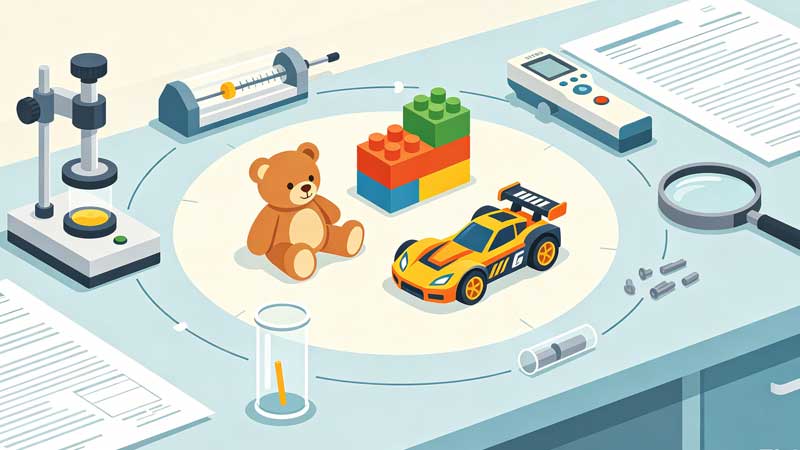
China is one of the world's largest importers of toys, but the compliance barrier is high. The mandatory national standard GB 6675 (Safety of toys) is enforced through CCC certification, and a significant percentage of imported toys fail their first round of testing. According to data from CNCA, over 40% of foreign-made toys require corrective actions after initial GB testing – leading to costly redesigns, delayed shipments, and even container holds at customs. Understanding the most common GB testing failures for imported toys can help manufacturers design for compliance from the start. This guide covers the top failure modes and provides practical prevention strategies.
1. Mechanical and Physical Hazards (GB 6675.2)
The mechanical and physical safety section is the most frequent source of failure. Key issues include:
- Small parts (Clause 4.4): Toys intended for children under 36 months must not produce small parts when broken or disassembled. Common failures: buttons that detach under 90N pull force, wheels that come off, or molded plastic parts that fracture into pieces smaller than the small‑parts cylinder (31.7mm diameter, 57.1mm depth).
- Sharp edges and points (Clause 4.7, 4.8): After abuse testing (drop, torque, tension), any exposed edge or point that can cut skin fails. Mold flash on plastic toys is a frequent culprit.
- Hazards in packaging (Clause 4.3): Plastic bags with a thickness less than 0.038mm (0.0015 inches) and no suffocation warning fail. Many imported toys use thin retail bags without proper labeling.
- Projectiles (Clause 4.20): Toy arrows, darts, or launcher projectiles must not have kinetic energy density exceeding 0.25 J/cm². Foam darts with hard plastic tips often exceed this limit.
How to avoid: Design with integrated (non‑detachable) parts wherever possible. Perform pre‑compliance small‑parts testing using a small‑parts cylinder (available from test labs). For plastic bags, increase thickness to ≥0.04mm and print the required warning: “WARNING: Plastic bags can be dangerous. To avoid suffocation, keep this bag away from babies and children.”
2. Flammability (GB 6675.3)
Flammability failures are common for soft toys, costumes, and textiles. Key requirements:
- Surface flash time: For soft‑filled toys, the fabric must self‑extinguish after flame application; any flame spread faster than 30 mm/s fails. Many plush toys use untreated polyester fleece that burns rapidly.
- Costume flammability (Clause 4.2): Toy wigs, beards, and capes must not have a burning rate exceeding 10 mm/s. Feathers, long‑pile fabrics, and tinsel are frequent failure points.
- Stuffed toys with loose fill: The filling material (e.g., polyfill) must not ignite when a flame is applied to a torn seam. Some low‑cost polyfill does not meet GB/T 1468 requirements.
How to avoid: Use inherently flame‑retardant fabrics (e.g., modacrylic blends) or apply certified flame‑retardant finishes. Pre‑test small fabric samples with a simple lighter test – if the fabric melts and drips without sustained flame, it is likely compliant. For costumes, avoid long, loose fringe or feathers near the neckline.
3. Migration of Certain Elements (Heavy Metals) – GB 6675.4
Heavy metal limits for toy materials are among the strictest in the world. Common failures include:
- Lead (Pb): Limit 90 mg/kg for coatings, 23 mg/kg for substrate plastics (depending on material category). Paints, inks, and coatings on cheap toys often exceed limits.
- Cadmium (Cd): Limit 75 mg/kg for coatings, 17 mg/kg for plastics. Low‑cost metal alloys (e.g., zinc alloy parts) can leach cadmium above the limit.
- Chromium (Cr VI): Limit 60 mg/kg for coatings. Hexavalent chromium is sometimes present in yellow or green pigments.
- Mercury (Hg): Limit 60 mg/kg for coatings, 5 mg/kg for plastics. Rare but possible in some imported paints.
Failure often occurs in small painted parts (buttons, eyes, decals) or colored plastics (red, yellow, orange, green).
How to avoid: Require an ICP‑OES or ICP‑MS test report from your material supplier before production. Use certified “toy‑safe” paints and plastics (e.g., EN 71-3 or ASTM F963 certified materials). Avoid using recycled plastics of unknown origin. For metal components, choose stainless steel or nickel‑free alloys.
4. Phthalates and Other Restricted Chemicals
China has adopted restrictions similar to EU REACH for phthalates in toys. Common failures:
- DEHP, DBP, BBP (≤0.1% each): Frequently found in soft PVC parts (teethers, squeeze toys, doll limbs, inflatable toys).
- DINP, DIDP, DNOP (≤0.1% each): Also common in flexible plastics, especially in toys intended for children over 36 months.
- Short‑chain chlorinated paraffins (SCCPs): Used as plasticizers in some rubber and PVC, now restricted under GB 24613.
How to avoid: Specify phthalate‑free PVC (e.g., using DINCH or ATBC plasticizers) or use alternative materials like TPE, silicone, or EVA. Request a phthalate test report from your raw material supplier. For small production runs, consider using silicone instead of PVC – silicone is naturally phthalate‑free and passes migration limits.
5. Electrical Safety for Electric Toys (GB 19865)
Toys with batteries, motors, lights, or sound are also subject to GB 19865, which is harmonized with IEC 62115. Common failures:
- Temperature rise: Motors, batteries, and LEDs under normal use must not exceed temperature limits (e.g., accessible surface ≤60°C). Sealed battery compartments without proper ventilation cause overheating.
- Insulation and electric shock: For battery‑operated toys (up to 24V), accessible metal parts must be insulated from live circuits. Often, a user‑replaceable battery with exposed terminals fails.
- Battery reverse polarity protection: If batteries can be inserted incorrectly, the toy must not catch fire or eject parts. Many cheap toys lack a physical or electronic blocking mechanism.
- Radio equipment (SRRC separate): If the toy has Bluetooth, Wi‑Fi, or RF remote control, it must also pass SRRC – a separate certification often overlooked.
How to avoid: Use a sealed battery compartment with a screw‑closed door. Ensure the battery holder design prevents reverse insertion (e.g., molded bumps on the negative terminal side). Pre‑test temperature rise with the toy running continuously for 4 hours. For any toy with wireless, plan for both CCC (safety) and SRRC (radio) applications in parallel.
6. Labeling and Documentation Errors
Even when the product passes physical and chemical tests, labeling mistakes cause CCC application rejections:
- Missing or incorrect age grading: The label must state the minimum and recommended age (e.g., “Ages 3+”). If the toy contains small parts, the age grade must be at least 36 months.
- No “CCC” mark: After certification, the CCC logo must be affixed to the product or its packaging. Many importers forget to include the logo on samples for initial testing – the lab may reject the samples.
- Missing warnings in Chinese: Required warnings (e.g., “Warning! Not suitable for children under 36 months.”) must be in simplified Chinese, clearly visible, and permanent.
- Inconsistent model number: The model number on the label must match the application form, test reports, and user manual. Any mismatch leads to rejection.
How to avoid: Create a label template with all required Chinese warnings and the CCC logo position (even before certification – you can add the actual certificate number later). Have your agent review the label design before mass printing.
7. Real‑World Case: Plush Toy with Detachable Button Eyes
A European toy brand imported a line of plush rabbits with plastic button eyes secured by metal washers. During GB 6675.2 small‑parts testing, the eyes detached under 95N pull force (limit for toys intended for under 36 months is 90N). The product failed. The manufacturer corrected the issue by redesigning the eyes with a larger washer and ultrasonic welding, achieving a pull force >100N. After re‑testing, the toy passed. The delay cost the company two months of sales. Lesson: always pre‑test pull forces on any detachable component – not just eyes, but noses, buttons, and accessories.
8. Pre‑Compliance Checklist for Imported Toys
To avoid the most common failures, use this checklist before submitting your toy for formal GB testing:
- [ ] Small‑parts test: Use a small‑parts cylinder on any removable or breakable component.
- [ ] Pull force test: Apply 90N (or 70N for toys under 36 months) to any protrusion using a push‑pull gauge.
- [ ] Sharp edges: Run a fingernail over all edges; if it snags, deburr or redesign.
- [ ] Plastic bag thickness: Measure with a micrometer – must be ≥0.038mm, print warning.
- [ ] Flammability: Pre‑test fabric samples (unwashed and after 5 washes).
- [ ] Heavy metals: Request ICP‑MS report from paint/plastic supplier.
- [ ] Phthalates: Request GC‑MS report for all soft plastic/PVC parts.
- [ ] Electric toys: Measure temperature rise after 4 hours of continuous operation.
- [ ] Label: Include Chinese warnings, age grade, and placeholder for CCC logo.
Summary: Common GB testing failures for imported toys – small parts, sharp edges, flammability, heavy metals, phthalates, electrical safety, and labeling errors – can all be prevented with early pre‑compliance testing and careful design. By understanding the requirements of GB 6675 (parts 1-4) and GB 19865, and by using qualified materials and proper labeling, foreign manufacturers can achieve CCC certification without costly redesigns and delays. Invest in pre‑compliance – it pays for itself many times over.