
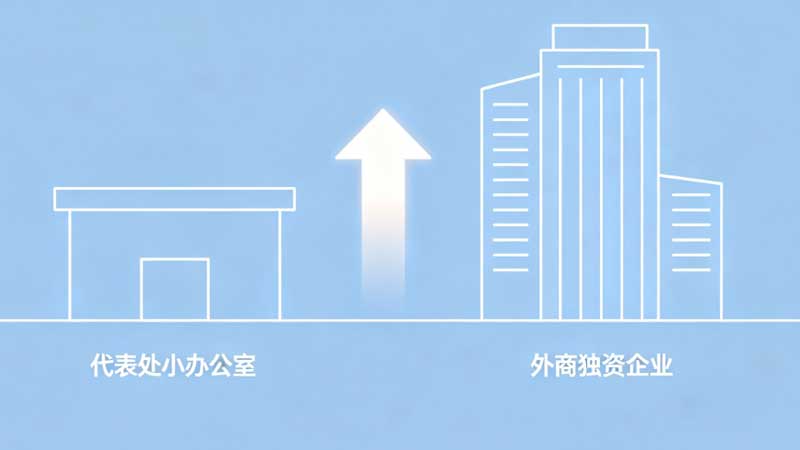
For many foreign companies, establishing a Representative Office (RO) in China is the first step toward market entry. ROs are inexpensive to set up, require no registered capital, and allow non‑profit activities such as market research and business liaison. However, as your business grows and you begin to directly sell products or services, generate local revenue, or need to issue invoices, the RO structure becomes insufficient. Upgrading to a wholly foreign‑owned enterprise (WFOE) – the preferred legal entity for foreign investors – opens the door to profit‑generating activities, full operational control, and tax‑efficient profit repatriation. But when is the right time to upgrade? And what does the conversion timeline look like? This guide provides a practical, stage‑by‑stage timeline to help you plan your transition from RO to WFOE without disrupting your China operations.
1. When to Upgrade: Identifying the Triggers
Not every RO needs to become a WFOE. Many companies operate ROs for years without crossing the line into taxable activities. However, specific business developments will force the upgrade. Key triggers include:
- Direct sales or service delivery: Once you begin signing contracts with Chinese customers in the RO‘s name or receiving payment for goods or services, you are engaging in profit‑making activities – strictly prohibited for an RO. The WFOE is the proper vehicle.
- Need to issue invoices (fapiao): ROs cannot issue VAT invoices. If your Chinese customers demand invoices (and they will), you must have a WFOE or a Chinese legal entity.
- Local hiring beyond liaison staff: While ROs can hire local employees, they cannot enter into extensive service agreements. A WFOE offers full flexibility to build a local team.
- Intellectual property licensing or protection: ROs cannot hold trademarks or patents in their own name; a WFOE can manage IP registration and licensing.
- Parent company has existed for more than 2 years: Many new companies start with an RO because the parent company is less than 2 years old (a requirement for RO registration). Once the parent company crosses the 2‑year mark, the option to upgrade opens.
- Significant operational expenses and profit potential: The RO‘s deemed‑profit tax regime (tax on expenses) may become more expensive than the WFOE’s actual profit tax if the RO‘s margins are high. A WFOE allows you to deduct expenses and pay tax only on net profit.
The optimal time to upgrade is when you have identified at least one of these triggers and have a clear business plan for revenue generation in China. Waiting too long exposes you to legal risk (operating an RO as a de facto profit center) and tax penalties.
2. Prerequisites Before Starting the Upgrade
Before initiating the WFOE registration, ensure the following conditions are met:
- Parent company good standing: The foreign parent must be in active status (no liquidation or dissolution).
- Business scope alignment: The intended WFOE business activities must be open to 100% foreign ownership under the current Foreign Investment Negative List. Most service and manufacturing sectors are fully open.
- Registered capital planning: Unlike an RO, a WFOE requires registered capital (paid in within 5 years under the 2024 Company Law). Plan a realistic amount – over‑capitalization creates unnecessary liability.
- Office address: The WFOE requires a commercial office address (same as the RO or a new location). Virtual addresses are generally not accepted.
- Tax clearance for the RO (if closing): If you plan to close the RO before or after the WFOE setup, you must obtain tax clearance from the local tax bureau – no outstanding tax liabilities.
<h2.3 Practical Timeline: Month‑by‑Month Roadmap for RO‑to‑WFOE Upgrade
The complete upgrade process from RO closure (or parallel setup) to fully operational WFOE typically takes 3‑6 months. Below is a month‑by‑month breakdown assuming you start with a compliant RO and decide to establish the WFOE as a new entity (rather than converting the RO in situ – there is no direct conversion procedure; the WFOE is a separate registration).
Month 1 – Preparation and Documentation
- Consult with a local law firm or registration agent: Review your business scope, confirm Negative List compliance, and select a WFOE name (3‑5 alternatives).
- Prepare parent company documents: Certificate of incorporation, articles of association, good standing certificate, and power of attorney for the WFOE‘s legal representative. Notarize and obtain Apostille (or consular legalization) as required.
- Decide on registered capital amount and payment schedule: For most small to medium service WFOEs, RMB 100,000–500,000 is sufficient; for trading or manufacturing, RMB 500,000–2,000,000.
- Draft the Articles of Association (AoA): Include the capital payment schedule (must be within 5 years of incorporation) and define the board of directors or executive director.
Month 2 – WFOE Registration Process
- Online name pre‑approval (1‑3 working days): Submit the proposed WFOE name(s) to SAMR via the online portal. Upon approval, the name is reserved for 6 months.
- Submit business license application (5‑10 working days): Upload the AoA, parent company documents, legal representative ID, registered address proof, and the completed application form. SAMR reviews and issues the WFOE‘s business license (electronic and physical).
- Company chop engraving (2‑3 working days): With the business license, carve the WFOE‘s official name stamp, financial stamp, contract stamp, and legal representative’s personal stamp.
Month 3 – Post‑Registration Setup
- Tax registration (within 30 days of license issuance): Register with the local tax bureau to obtain the tax identification number and activate VAT, CIT, and withholding tax categories. Apply for VAT invoice issuance capability (general taxpayer or small‑scale status).
- Open corporate bank account (1‑2 weeks): Open a RMB basic account and, if needed, a foreign currency capital account. Remit initial registered capital injection (at least the first tranche). The bank will issue a capital verification confirmation (though formal capital verification reports are no longer mandatory for all companies, but banks require proof for foreign currency remittance).
- Social insurance and housing fund registration (within 30 days): Register with local social insurance bureau and housing fund center. Prepare to enroll employees (including any staff transferring from the RO).
Month 4 – Transition and RO Closure (Optional)
- Decide whether to keep the RO or close it: Many companies keep the RO for non‑profit liaison activities while the WFOE handles revenue‑generating contracts. Others close the RO entirely. If closing:
- RO cancellation process (2‑3 months): Apply for RO deregistration with SAMR, obtain tax clearance certificate (prove no outstanding taxes), cancel bank accounts, and submit the RO‘s final annual report. This step can run in parallel with WFOE operations.
- Notify customers and partners: Transfer any active contracts from the RO to the WFOE (with the counterparty‘s consent). Update business cards, website, and marketing materials to reflect the new legal entity.
Months 5‑6 – Operational Handover and Compliance
- Transfer employees (if any): Employees previously employed by the RO must sign new labor contracts with the WFOE. The RO‘s labor contracts are terminated (with proper severance if required).
- Update contracts and invoices: Ensure all new contracts, purchase orders, and invoices use the WFOE‘s name, tax ID, and bank account details.
- First tax filings (monthly or quarterly): The WFOE must file VAT returns (generally monthly) and CIT prepayments (quarterly). Stay on top of filing deadlines.
- Annual compliance calendar: Mark deadlines for annual CIT reconciliation (May 31), annual report to SAMR (March 1‑June 30), and foreign investment information report (June 30).
<h2.4 Cost Comparison: RO vs. WFOE Establishment
The table below summarizes the main financial differences:
- Registered capital: RO – none; WFOE – mandatory (e.g., RMB 100,000‑500,000).
- Government registration fees: RO – low (approx. RMB 2,000‑5,000); WFOE – moderate (approx. RMB 5,000‑15,000 depending on capital).
- Legal and agent fees: RO – RMB 5,000‑15,000; WFOE – RMB 15,000‑40,000 (due to more complex documentation).
- Annual audit and tax fees: RO – RMB 8,000‑20,000 (deemed profit method); WFOE – RMB 20,000‑50,000 (actual profit accounting).
- Minimum operating capital required upfront: RO – no statutory minimum; WFOE – at least RMB 30,000‑50,000 for initial expenses, plus eventual capital injection.
<h2.5 Tax Implications of the Upgrade
Upgrading from an RO to a WFOE does not trigger a taxable event for the parent company. However, there are several tax considerations:
- RO‘s final CIT filing: When closing the RO, the tax bureau will require a final CIT return (using the deemed‑profit method for the partial year). Any outstanding taxes must be paid.
- WFOE’s tax regime: The WFOE will file CIT based on actual net profit (revenue minus deductible expenses). It can also apply for VAT refunds on exports (if applicable) and benefit from R&D super‑deductions.
- Transfer of assets: If the RO owned any assets (e.g., office equipment, vehicles), transferring them to the WFOE may trigger VAT or CIT. Consult a tax advisor.
- Profit repatriation: WFOEs can remit after‑tax profits to the parent company after statutory reserve allocations (10% of after‑tax profit until reserve reaches 50% of registered capital). The standard withholding tax rate on dividends is 5%‑10% depending on tax treaties (e.g., 5% for companies in Hong Kong, Singapore, EU with treaty benefits). ROs cannot repatriate profits because they cannot generate profits.
6. Common Mistakes to Avoid When Upgrading
- Waiting too long to upgrade: Operating an RO as a de facto trading entity exposes the parent company to fines (up to RMB 50,000) and potential revocation of the RO registration. If you are already generating revenue, upgrade immediately.
- Under‑capitalizing the WFOE: Some investors set registered capital too low, limiting the ability to sign large contracts (customers may check capital as a sign of credibility). However, over‑capitalizing creates a 5‑year payment burden. Strike a balance.
- Not obtaining tax clearance for the RO: If you close the RO without tax clearance, the parent company may be held liable for any future tax assessments. Always complete the cancellation procedure.
- Ignoring employee contract transition: Failing to properly terminate RO labor contracts and re‑issue WFOE contracts can lead to labor disputes and claims for severance. Follow the legal procedures.
- Using the same bank account across entities: Keep RO and WFOE accounts separate. Mixing funds is a red flag during tax audits.
7. Pre‑Upgrade Checklist for a Smooth Transition
- [ ] Confirm that the parent company has been in operation for at least 2 years (if not, RO upgrade must wait).
- [ ] Business scope is fully open to foreign investment (check current Negative List).
- [ ] Registered capital amount decided and payment schedule (within 5 years) drafted.
- [ ] Local agent or law firm engaged with experience in RO‑to‑WFOE transitions.
- [ ] Notarized + Apostilled parent company documents ready (certificate of incorporation, AoA, good standing).
- [ ] Commercial office lease in place for the WFOE (or existing RO address may be used if the landlord agrees).
- [ ] Decision made: close the RO or keep it running in parallel.
- [ ] For closing RO: initiate tax clearance and SAMR cancellation process.
- [ ] Employee transfer plan prepared (severance calculations, new contracts).
- [ ] New branding, invoices, and contracts updated to the WFOE name.
Summary: Upgrading from a Representative Office to a wholly foreign‑owned enterprise is a strategic move when your China operations shift from non‑profit liaison to direct sales, invoicing, and profit generation. Key triggers include signing local contracts, issuing invoices, or the need for intellectual property protection. The upgrade process – which is essentially a new WFOE registration – takes 3‑6 months and requires careful planning of registered capital, documentation notarization, and post‑registration tax and bank account setup. Companies can either close the RO after the WFOE is established or run both entities in parallel (RO for liaison, WFOE for revenue). To avoid legal risk, do not operate an RO as a de facto profit center. By following the practical timeline and checklist, foreign investors can transition smoothly and unlock the full potential of China‘s market.