
For foreign entrepreneurs and multinational companies, setting up a wholly foreign-owned enterprise (WFOE) in China has historically involved complex paperwork, multiple government approvals, and weeks of waiting. However, China’s pilot Free Trade Zones (FTZs) have dramatically changed the landscape. In 2026, WFOE registration simplified in pilot FTZs means reduced capital requirements, faster name approval, and fully digital submission — often completed in as few as 4 weeks. This guide walks you through the new FTZ-specific procedures, eligibility criteria, and post-registration benefits.
What Are Pilot FTZs and Why Do They Simplify WFOE Registration?
China has established 22 pilot Free Trade Zones, including Shanghai, Guangdong (Qianhai), Tianjin, Fujian, and Hainan. These zones serve as testing grounds for liberalized foreign investment policies. Within FTZs, the WFOE registration process is streamlined through a “negative list” approach (only restricted industries require extra approvals), online one-stop portals, and relaxed capital contribution deadlines. Unlike standard WFOE registration outside FTZs (which can take 6-10 weeks), FTZ-based registration averages 4-5 weeks from name reservation to business license issuance.
Key Simplifications in 2026 for FTZ WFOEs
Recent updates effective January 2026 have introduced several breakthroughs for China company setup within FTZs:
- No minimum registered capital for most service and trading WFOEs (previously at least RMB 100,000).
- Capital contribution grace period extended to 5 years (versus 2 years in non-FTZ areas).
- Remote identity verification for foreign directors and shareholders via video call + digital notarization.
- Same-day business license for low-risk industries after document submission (physical delivery within 3 days).
- Integrated tax, customs, and foreign exchange registration through a single online form.
These simplifications mean foreign founders can now establish a wholly foreign-owned enterprise without ever traveling to China — a game changer for startups and SMEs targeting the Chinese market.
Step-by-Step: WFOE Registration in Pilot FTZs (Remote-Friendly)
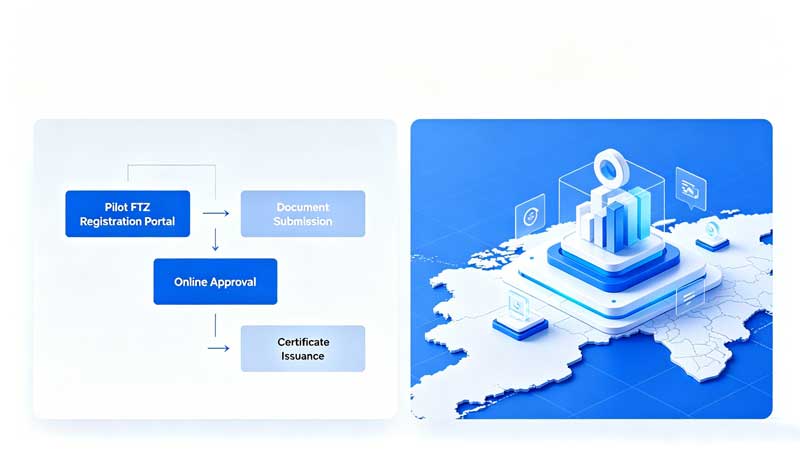
Here is the streamlined workflow for registering a WFOE in an FTZ, based on actual 2026 procedures:
- Step 1 – Choose the right FTZ: Each zone has specializations (e.g., Shanghai FTZ for finance/trade, Hainan FTP for tourism/tech). Select based on your industry and local incentives.
- Step 2 – Name pre-approval: Submit 2-3 proposed English/Chinese names via the FTZ online portal. Approval within 1-2 days.
- Step 3 – Prepare digital documents: Lease agreement (virtual office addresses are accepted in many FTZs), articles of association, passport copies of shareholders, and power of attorney for a local agent.
- Step 4 – Online application submission: Fill out the unified “One-Form” application (covering business license, tax registration, and statistical reporting).
- Step 5 – Remote verification: Foreign signatories complete facial recognition via the official “Suishenban” or “Shanghai E-Office” app (with English interface).
- Step 6 – Receive business license and seals: Digital license available immediately; physical license and company chops couriered within 5 days.
- Step 7 – Bank account & tax activation: Many FTZ banks offer remote account opening with video KYC. Tax registration is auto-activated upon license issuance.
Eligibility and Restrictions – What You Should Know
Not every business can take advantage of WFOE registration simplified in pilot FTZs. The negative list prohibits foreign investment in certain sectors (e.g., news publishing, traditional Chinese medicine processing). Additionally, industries like education, legal services, and some manufacturing still require ministry-level approvals. However, most technology, consulting, trading, e-commerce, and R&D activities are fully permitted. Always check the latest FTZ-specific “special management measures” before starting.
Cost Comparison: FTZ vs Non-FTZ WFOE Registration
Lower government fees and no minimum capital requirement make FTZ registration significantly cheaper. Typical all-in costs (including government fees, agent service, registered address rental, and bank account setup) range from $2,800 to $4,500 for an FTZ WFOE. Outside FTZs, expect $4,500 to $7,000 due to higher notary fees and longer processing. Annual maintenance costs (accounting, tax filing, audit) are similar, but some FTZs offer tax holidays (e.g., Hainan FTP provides 15% corporate income tax for encouraged industries).
Post-Registration Benefits of FTZ WFOEs
Beyond simplified setup, FTZ-incorporated WFOEs enjoy unique operational advantages:
- Faster customs clearance for import/export businesses (single-window system).
- Cross-border RMB settlement without prior approval.
- Easier foreign worker visa sponsorship (FTZ companies get expedited work permit processing).
- Access to FTZ innovation programs (e.g., data cross-border pilot zones, fintech sandboxes).
These benefits make FTZs the preferred choice for foreign companies planning to use China as a regional hub or supply chain base.
Common Mistakes to Avoid
Even with simplified procedures, many applicants face delays due to:
- Choosing a business scope that includes restricted items (even unintentionally).
- Submitting unauthenticated translations of foreign documents.
- Using a residential address that is not recognized as a commercial premise by the FTZ authority.
- Failing to complete the mandatory post-license filings (e.g., foreign exchange registration, monthly tax zero declarations).
Working with a local compliance partner familiar with each FTZ’s specific online portal eliminates these pitfalls.
Is an FTZ WFOE Right for Your Business?
If your primary goals are speed, cost efficiency, and operational flexibility, then pursuing WFOE registration simplified in pilot FTZs is a smart move. For companies needing a physical factory or those in heavily regulated sectors (e.g., healthcare devices), a standard WFOE outside FTZs may still be necessary. However, for the vast majority of software, consulting, trading, and light manufacturing foreign investors, an FTZ-based WFOE offers the fastest, most affordable path to a legal presence in China.
Summary: China's pilot Free Trade Zones have transformed foreign company registration. Lower capital requirements, digital submissions, and remote verification mean you can establish a fully operational wholly foreign-owned enterprise in weeks, not months. As of 2026, the trend is clear: FTZs are the new standard for hassle-free China market entry.