
For foreign investors, the wholly foreign-owned enterprise (WFOE) remains the preferred corporate structure for establishing a fully operational presence in China. However, the regulatory framework governing WFOE formation has undergone the most significant transformation in a decade. The amended PRC Company Law, effective July 1, 2024, introduced the cornerstone change: a mandatory five‑year deadline for fully paying in subscribed registered capital for all new limited liability companies. This shift fundamentally alters capital planning for foreign investors. Simultaneously, the State Administration for Market Regulation (SAMR) rolled out 2026‑edition registration forms and material specifications, effective May 1, 2026, streamlining documentation and digitizing identity verification. Understanding these new capital requirements and simplified registration procedures is essential for a smooth WFOE setup in 2026 and beyond. This guide provides a comprehensive breakdown of the amended rules, the updated registration process, and a practical compliance roadmap.
1. The New 5‑Year Paid‑In Capital Rule for New WFOEs
The most consequential change in China‘s amended Company Law — effective July 1, 2024 — is Article 47. It mandates that shareholders of any limited liability company (including a WFOE, which is registered as an LLC) must pay their full subscribed registered capital within five years of the company’s incorporation date as stipulated in the company‘s Articles of Association.
Under the old legal regime, shareholders could nominate any reasonable paid‑in schedule, and in practice many foreign investors promised to pay in contributions over 20 or 30 years or left capital entirely “called but unpaid” for extended periods. That flexibility is now over. For any new WFOE established after July 1, 2024, the maximum time allowed to fully contribute subscribed capital is five years. The Articles of Association can impose a shorter timeline, but it cannot exceed the statutory five‑year cap. While the five‑year paid‑in rule is a binding legal requirement, the government has not reinstated a general statutory minimum registered capital. For most general WFOEs, the theoretical minimum is RMB 1. However, regulators and local market supervision authorities still expect registered capital to be aligned with the scale and nature of operations. In practice, small consulting and service‑oriented WFOEs often declare registered capital in the range of RMB 100,000 to RMB 200,000, while trading companies, e‑commerce platforms, and manufacturing ventures typically start from RMB 500,000 to RMB 1,000,000 or more. Over‑declaring capital without a realistic timeline for full payment under the five‑year rule is now risky; capital declared must be fully attainable within the five‑year window.
2. Simplified Registration Process Under the 2026 SAMR Forms
On May 1, 2026, new nationwide registration document and material specifications came into force, replacing older templates and simplifying documentation requirements. The key changes include:
2.1 Transparent Capital Contribution Schedule: From “出资日期” to “出资期限”
New templates now require disclosure of each shareholder‘s contribution timeline: the form tracks the amount, type, and precise start and end dates of the contribution period. The shift from “payment date” to “payment period” gives companies flexibility to spread contributions over the 5‑year window but also creates a clear legal record of each shareholder’s expected payment schedule.
2.2 Shareholder Register Now a Standard Submission Element
Under the 2026 rules, new submissions for capital increases, capital reductions, and shareholding changes must include a formal shareholder register. This register records each shareholder‘s name, address, subscribed and paid‑in amounts, contribution methods, share certificate numbers, and the date of share acquisition or loss. This change closes a loophole where some companies previously neglected to maintain shareholder registers or issued share certificates inconsistently, strengthening internal governance and the alignment of internal records with publicly disclosed information.
2.3 Digital Identity Verification Replaces Simple Name Checking
The new forms introduce a compulsory “实名登记确认表”, moving from basic identity verification to an integrated digital confirmation process that authenticates both identity and the intent to file. The system cross‑matches applicant details across multiple sources and records the agent‘s representation. Key improvements include:
- Integration of online and offline identity confirmation – the applicant no longer needs to appear in person at the SAMR office for basic checks.
- Formal ID confirmation for key legal roles: legal representative, directors, supervisors, senior managers, and the designated contact person.
- Enhanced protection for sensitive personal information – ID numbers, residential addresses, and mobile phone numbers are now displayed on separately paginated sheets, separated from the general application.
2.4 Fewer Paper Submissions and Simplified Decision Procedures
The 2026 forms meaningfully reduce the documentation burden: for share transfers, the share transfer agreement is no longer required; for changes of directors or supervisors, if the identity and appointment can be confirmed through the online ID verification system, no separate appointment document is needed. Applications for changes and dissolution no longer require the company’s physical chop. For wholly foreign‑owned investors, name pre‑approval and the AMR business license application are now handled in a single step under the unified online window introduced by the Regulations on the Registration and Administration of Market Entities.
3. Transition Rules for Existing WFOEs: The “3+5” Window
For WFOEs incorporated before July 1, 2024, the rules differ substantially from new entities. There is a mandatory transitional period running from July 1, 2024 to June 30, 2027 (three years) to adjust capital schedules. The classification is straightforward: if an existing WFOE‘s original paid‑in timeline would extend beyond June 30, 2032 (i.e., more than five years after the close of the transition period), the company must adjust its schedule and shorten the final back‑stop deadline to June 30, 2032. If the original timeline already requires full payment on or before June 30, 2032, no adjustment is needed. Any company that fails to adjust its capital schedule by June 30, 2027, risks having its registration suspended and its non‑compliance publicly flagged on the National Enterprise Credit Information Publicity System. Additionally, the company may be subject to fines.
For many foreign‑owned enterprises that previously declared large subscribed capital amounts but did not intend to pay in those amounts in full, reducing capital through formal capital reduction procedures (ordinary or simplified) will be the most efficient solution.
4. Amendments to the Foreign Investment Framework
The 2026 registration reforms are closely tied to the broader liberalization of foreign investment in China. The Foreign Investment Law has eliminated the separate treatment of wholly foreign‑owned enterprises under the legacy WFOE law. FIEs are now treated the same as privately owned Chinese entities under the Company Law, with the term “WFOE” becoming a commercial convenience rather than a formal legal category. The Foreign Investment Access Negative List continues to be refined. As of the latest version, all manufacturing sectors have been opened to full foreign ownership. The current Negative List restricts foreign participation in only 29 business activities across 11 sectors, down from over 60 categories a decade ago. At the same time, the Market Access Negative List (applying to all domestic and foreign investors) prohibits private investment in six activities and restricts investment in 100 others across 21 categories.
For foreign investors, this means that for most non‑restricted service and industrial sectors, the pathway to establishing a 100 percent foreign‑owned entity is now clearly defined and simpler than ever—provided capital compliance under the 5‑year rule is properly addressed.
5. Practical Compliance Roadmap for Foreign Investors in 2026
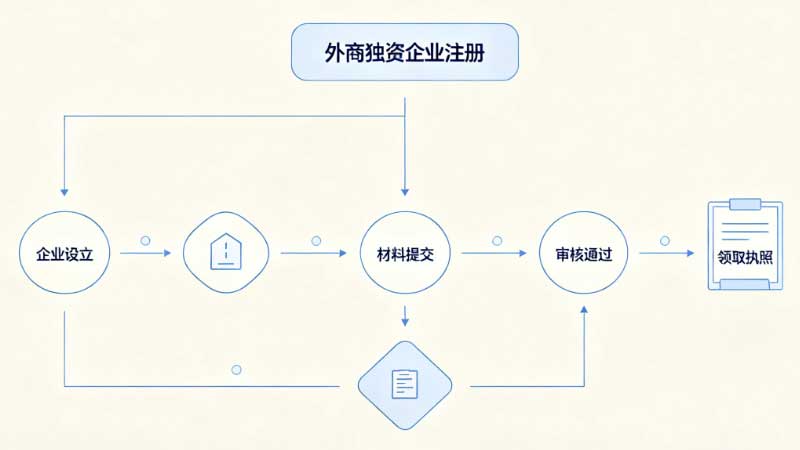
To successfully establish a WFOE in 2026 while satisfying the new capital and documentary rules, foreign investors should follow this 6‑step roadmap:
- Determine Feasibility and Business Scope: Verify whether your intended business activity is open to 100% foreign ownership under the current Foreign Investment Negative List. For activities requiring a license, obtain the license documents before submitting the business registration application.
- Calibrate Registered Capital Honestly: Declare only the capital that can realistically be paid in within 5 years. For small consulting or service ventures, RMB 100,000 to RMB 200,000 is typical; for manufacturing or trading, RMB 500,000 to RMB 1,000,000 or more may be appropriate. Excess capital extended over a 5‑year timeline is now a liability, not a marketing asset.
- Engage a Professional Translator and Local Agent: All documents submitted to SAMR must be in simplified Chinese or be accompanied by a certified translation. Work with an agent experienced in the new 2026 forms and with a valid business license for company registration services.
- Use the Unified Online Filing Portal: The application for name pre‑approval, the business license, and the Articles of Association filing can now be submitted simultaneously through the national online portal. Under the 2025 process updates, the review period is typically 5–10 working days, with the license delivered electronically. Legal representatives and designated contact persons must complete digital identity verification and, where required, upload a short facial recognition video.
- Complete Post‑Licensing Formalities: After receiving the business license, proceed to company chop registration (legal, financial, and contract seals). Register for value‑added tax (VAT) with the tax bureau within 30 days. Open the corporate bank account and, if applicable, the foreign exchange account with a Chinese bank. Social insurance and housing fund registration must also be completed within 30 days of license issuance.
- Maintain Ongoing Compliance: Under the 5‑year paid‑in rule, create a capital‑call calendar that ensures the full subscribed capital is fully contributed before the 5‑year anniversary of incorporation. Foreign shareholders may remit capital in one or multiple tranches. If the company changes its shareholding structure, capital, or Articles of Association, the updated shareholder register must be filed with SAMR. File the annual Foreign Investment Information Report with the Ministry of Commerce (MOFCOM) online before June 30 each calendar year.
Total time to incorporate a basic WFOE is now 4 to 8 weeks, depending on local authority efficiency. The simplified forms and 10‑day online processing windows have meaningfully reduced entry barriers for foreign investors.
Summary: China‘s 2026 WFOE registration framework is defined by the dual pillars of stricter capital discipline—the mandatory 5‑year paid‑in capital rule under Article 47 of the amended Company Law—and significant administrative simplification through the 2026 SAMR registration forms. New WFOEs must pay their full subscribed capital within 5 years of incorporation, with no statutory minimum but practical benchmarks ranging from RMB 100,000 for consulting ventures to RMB 1,000,000+ for manufacturing. Existing WFOEs have a “3+5” transition window, with a final back‑stop payment deadline of June 30, 2032, requiring capital schedule adjustments before June 30, 2027. The 2026 SAMR forms introduce transparent “出资期限” disclosures, mandatory shareholder registers, digital identity verification replacing simple name checks, and reduced documentation – including no share transfer agreement for equity changes and no physical chop on applications. The Foreign Investment Negative List has removed all manufacturing restrictions, opening most non‑restricted sectors to 100% foreign ownership. Foreign investors who properly calibrate their capital, use the simplified online portal, and maintain ongoing compliance will complete WFOE formation in 4‑8 weeks – faster than ever before.