
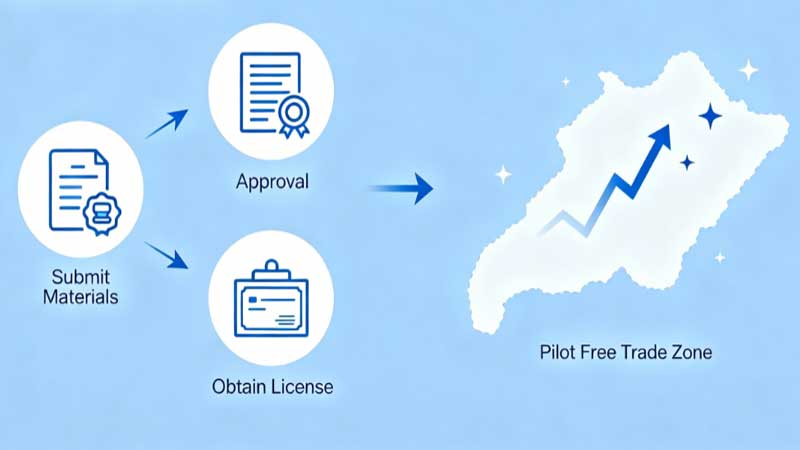
For decades, establishing a Wholly Foreign-Owned Enterprise in China was a test of patience and bureaucratic navigation. Endless document authentication, capital injection deadlines, and multi-department approval ping-pong meant the WFOE registration timeline often stretched beyond six months. Today, that landscape is shifting dramatically. Within China's designated pilot free trade zones, aggressive policy updates are turning the foreign company setup process from a marathon into a sprint. By replacing rigid approval mechanisms with streamlined record-filing systems and digital one-stop shops, these zones now offer a faster, more transparent pathway for global businesses to establish a legal presence in China without diluting their equity. This guide explains how the FTZ simplified process works, highlights the key differences from non-FTZ registration, and details how foreign investors can leverage these reforms to operationalize their China business in record time.
📑 What You'll Learn
- The barriers of traditional WFOE registration outside pilot zones
- Specific policy simplifications introduced in pilot FTZs
- Step-by-step timeline of the accelerated WFOE setup
- How the Negative List approach eliminates unnecessary approval hurdles
- Post-registration compliance and operational considerations
1. Breaking Down the Traditional WFOE Registration Bottleneck
To appreciate the revolutionary nature of the pilot free trade zone reforms, one must first understand the structural friction that defined the traditional process. Outside these zones, setting up a WFOE required a lengthy approval chain involving the Ministry of Commerce (MOFCOM) and the State Administration for Market Regulation (SAMR). Every aspect of the business scope was scrutinized, requiring investors to submit voluminous notarized and consularized parent company documents, feasibility study reports, and lease agreements before a single business license could be issued.
The complexity was compounded by capital requirements. Investors were bound by strict total investment and registered capital ratios, often forcing them to lock up significant working capital in a rigid schedule governed by the old paid-in capital system. If the Articles of Association required even a minor amendment, the cycle of approval started again. For many foreign SMEs, this administrative burden created significant opportunity costs, delaying market entry and complicating operational planning.
2. The FTZ Advantage: Record-Filing Replaces Approval
The core innovation driving WFOE registration in pilot free trade zones is the shift from an "approval-centric" to a "filing-centric" model. Under the updated policies, unless the proposed business activity falls into a restricted category on the updated Negative List, foreign investors no longer need to seek prior MOFCOM approval. Instead, they proceed directly with a simplified record-filing procedure at the local SAMR branch.
This FTZ simplified process drastically reduces the pre-establishment documentation burden. Investors can now submit signed application forms, lease agreements, and identification documents without the immediate need for full notarization and consular legalization, thanks to digital identity verification pilots running in zones like the Shanghai and Guangdong FTZs. The integration of the "单一窗口" (Single Window) digital platform allows investors to apply for the business license, tax registration, and foreign exchange registration simultaneously, compressing the administrative timeline from months to just a handful of working days.
Furthermore, the capital subscription system has been fully liberalized in these zones. Foreign investors can now determine their own registered capital amount and contribution schedule, eliminating the statutory minimums and rigid deadlines that previously plagued foreign company setup. This allows businesses to deploy capital into operational growth—hiring local talent, signing distribution agreements, and marketing—rather than idly sitting in a bank account.
3. Navigating the Negative List and Accelerated Timeline
Central to leveraging the FTZ simplified process is understanding the Free Trade Zone Negative List. This list identifies sectors where foreign investment is prohibited or restricted. For industries not on this list—covering the vast majority of consulting, trading, technology, and advanced manufacturing sectors—the principle of "national treatment" applies. This means the registration process is identical to that of a domestic Chinese company.
The practical timeline for a WFOE in Shanghai FTZ or similar hubs now follows a predictable pattern. After digitally pre-screening the company name, the investor uploads the registration data. Provided the articles of association and legal representative details are in order, SAMR typically issues the unified business license within 3 to 5 working days. This is a radical departure from the months-long back-and-forth previously required. Once the license is granted, post-establishment procedures like the Public Security Bureau (PSB) chop carving and tax bureau registration can be completed seamlessly through the integrated online platform, making the entire process fully operational within two weeks.
4. Practical Compliance and Post-Registration Steps
While the entry barriers have been lowered, post-registration compliance remains critical. Foreign investors must ensure their actual business scope precisely matches the registered items, as conducting unregistered activities can still trigger regulatory action. Although the initial registration is faster, banks in pilot FTZs are applying stringent "Know Your Customer" checks to prevent money laundering. The opening of a corporate bank account—essential for capital injection—still requires the legal representative or authorized signatory to appear in person, and banks will scrutinize the company's office lease and the backgrounds of the ultimate beneficial owners.
Additionally, ongoing compliance with annual reporting and immediate updates to the filing system for any corporate changes (such as equity transfers or domicile amendments) are mandatory. The FTZ authorities have proven they are quick to reward compliance and equally quick to penalize lapses through the social credit system. Therefore, while the foreign company setup journey begins faster, sustained corporate maintenance is what ensures the business continues to thrive.
Summary: The policy updates governing WFOE registration in China's pilot free trade zones have transformed the foreign investment landscape. By adopting a Negative List approach and shifting from laborious MOFCOM approval to a fast-track record-filing system, the FTZ simplified process enables foreign investors in non-restricted sectors to obtain a business license within days rather than months. Combined with the liberalization of registered capital requirements and the implementation of integrated digital single-window platforms, these zones offer an unprecedented opportunity for agile market entry. While the pre-establishment phase has been significantly accelerated, foreign companies must maintain rigorous post-registration compliance with bank KYC procedures and the social credit system to ensure sustained operational success. For foreign investors seeking to bypass the traditional bureaucratic bottlenecks, the pilot FTZ pathway is no longer just a pilot—it is the new standard for efficient China market entry.