Certificate of Origin China | CO Application & FTA Preferential Tariff Services 2026
Professional certificate of origin China services for exporters and importers. We help you obtain the correct CO (Certificate of Origin) to claim preferential tariff rates under Free Trade Agreements (FTAs). Whether you need FORM E (China-ASEAN), RCEP CO, China-Korea CO, China-Australia CO, FORM F (China-Chile), FORM A (GSP), or standard non-preferential certificate of origin – we manage the entire application process. Reduce import duties, avoid customs delays, and ensure compliance. Apply for electronic CO issuance directly with China Chamber of International Commerce (CCIC) or China Council for the Promotion of International Trade (CCPIT). Fast processing, worldwide acceptance, full customs clearance support.
📄 Apply for Certificate of Origin
What is a Certificate of Origin? Why Do You Need One?
A Certificate of Origin (CO) is an official document certifying the country where goods were manufactured or produced. It is required by customs authorities in the importing country to determine applicable import duties, enforce trade agreements, or apply trade restrictions. A valid certificate of origin China is essential for:
- Claim preferential tariff rates – Under Free Trade Agreements (FTAs), products originating from China may enjoy reduced or zero import duties in partner countries. Without correct CO, you pay MFN (Most Favored Nation) rates – often 5-20% higher.
- Avoid customs delays – Missing or incorrect CO triggers inspection, verification, and clearance delays (days to weeks).
- Comply with import regulations – Many countries require CO for statistical purposes or for goods subject to quotas, anti-dumping duties, or trade remedies.
- Prove origin for customs valuation – Origin affects duty rates. CO provides legal proof of origin.
📌 Key fact: China has signed 19+ Free Trade Agreements covering over 50 countries and regions. Using the correct FTA certificate of origin can save importers 5-20% in duties – potentially millions for high-volume traders.
Types of Certificate of Origin – Which One Do You Need?
China issues several types of certificates of origin depending on the destination country and applicable trade agreement:
FORM E – China-ASEAN FTA
For exports to ASEAN countries: Thailand, Vietnam, Malaysia, Singapore, Indonesia, Philippines, Brunei, Cambodia, Laos, Myanmar. Preferential tariff reductions up to 0% duty.
FORM ERCEP Certificate of Origin
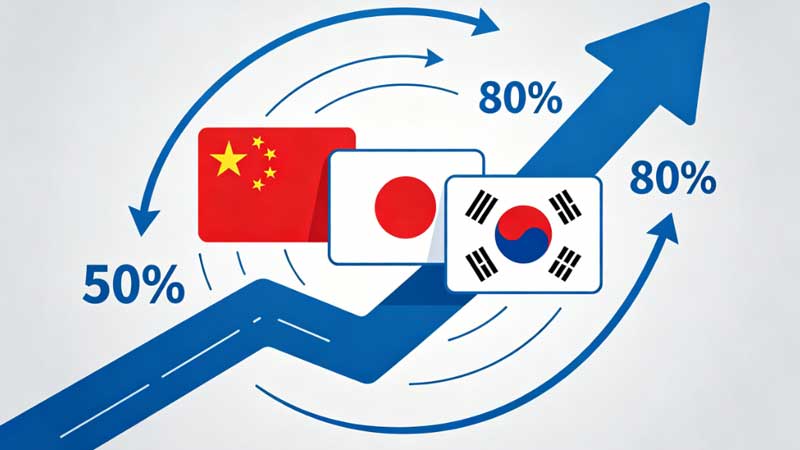
Regional Comprehensive Economic Partnership – 15 countries: China, Japan, Korea, Australia, New Zealand, plus 10 ASEAN nations. Single CO covering world's largest FTA.
RCEPChina-Korea FTA Certificate
For exports to South Korea. Tariff reductions on over 90% of products, phased to zero over 20 years.
China-KoreaChina-Australia FTA Certificate
For exports to Australia. Zero tariffs on most goods immediately or phased within 5-10 years.
China-AustraliaFORM F – China-Chile FTA
For exports to Chile. Zero tariff on over 97% of products.
FORM FFORM A – GSP Certificate (Generalized System of Preferences)
For exports to GSP beneficiary countries (EU, Japan, Norway, Switzerland, etc.). Note: Some countries have graduated China from GSP.
FORM AChina-New Zealand FTA Certificate
For exports to New Zealand. Zero tariff on most goods.
China-New ZealandChina-Switzerland FTA Certificate
For exports to Switzerland, Liechtenstein. Progressive tariff reductions.
China-SwitzerlandChina-Pakistan FTA Certificate
For exports to Pakistan. Preferential tariff rates on thousands of products.
China-PakistanChina-Peru FTA Certificate
For exports to Peru.
China-PeruChina-Iceland FTA Certificate
For exports to Iceland.
China-IcelandStandard Non-Preferential CO
For countries without FTA or where FTA does not apply. Required for customs clearance but no duty preference.
Standard CO
FTA Preferential Tariff Savings – Real Examples
| FTA | Product Example | MFN Duty Rate | FTA Preferential Rate | Savings per Container |
|---|
| RCEP (China → Japan) | Auto parts | 8-12% | 0-4% (phased) | $4,000-$10,000 |
| China-Korea FTA | Electronics | 8% | 0% | $6,400 per $80,000 shipment |
| China-Australia FTA | Furniture | 5% | 0% | $4,000 per $80,000 shipment |
| FORM E (China-ASEAN) | Machinery | 5-15% | 0-5% | $3,000-$12,000 |
| China-New Zealand FTA | Textiles | 10% | 0% | $8,000 per $80,000 shipment |
💰 Example savings: An electronics exporter shipping $2 million annually to Korea can save $160,000 per year in import duties using China-Korea FTA certificate. Our CO service fee is a fraction of the savings.
FTA Rules of Origin – Key Requirements
To qualify for preferential tariffs under an FTA, products must meet specific rules of origin. Common criteria include:
- Wholly obtained – Products entirely grown, extracted, or manufactured in China (agricultural products, minerals, live animals).
- Substantial transformation – Product undergoes significant processing in China, changing tariff classification (HS code change at 4 or 6-digit level).
- Regional Value Content (RVC) – A percentage of the product's value must originate from China or FTA partner countries. Typically 40-60%.
- Specific manufacturing process – Certain products must undergo specified processes (e.g., weaving, assembly, chemical reaction).
- Cumulation – Under RCEP and some FTAs, materials from other FTA partners count toward origin percentage.
📌 Note: Incorrect origin declaration can result in denied tariff preference, retroactive duty assessment, fines, and loss of future FTA benefits. We verify origin criteria before applying for certificate of origin.